Your message has been sent.
We’ll process your request and contact you back as soon as possible.
The form has been successfully submitted.
Please find further information in your mailbox.
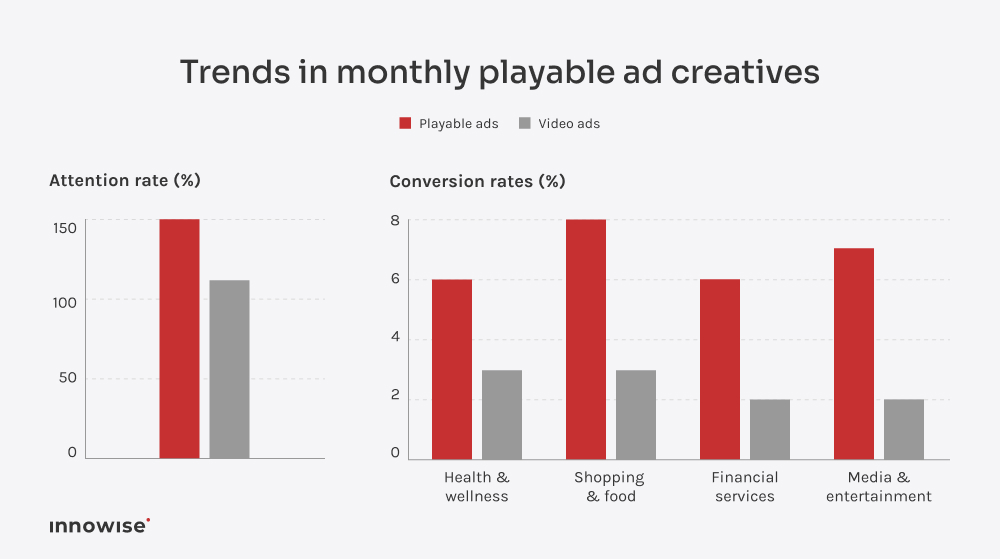
And budgets are following the results:

In short, playable ads are winning installs and retention because they align with the habits and behaviors of mobile device users.
So, we understand the impact that playable ads are having on the industry, but for those of us who are unfamiliar, just what are they exactly? Playable ads are interactive mini-games used in advertising. Instead of watching a 15–30 second video, users try a short slice of the app itself, usually a simplified level, mechanic, or core loop. Think of it as a “test drive” that happens right inside the ad.
Three guesses where they started? Yes, playables began their journey in mobile games, but the idea is bigger than gaming. Millions of companies can reap the benefits of providing a quick, hands-on demo of their product.
Why? Because playables tap into the undeniable consumer psychology of emotion – they let people feel what your app is about before they install. If they enjoy those few seconds, the decision to install becomes almost automatic. And if they don’t enjoy it, they’ll pass, saving you money and effort on low-intent users.
It’s a win-win because of these two reasons:
It’s easy to see how the format lends itself to gaming, and that’s still very much the most popular use case, but we’re now seeing them appear in non-game apps too, such as fitness or education apps. This snappy “hands-on preview” helps users understand value faster than a static ad ever could.
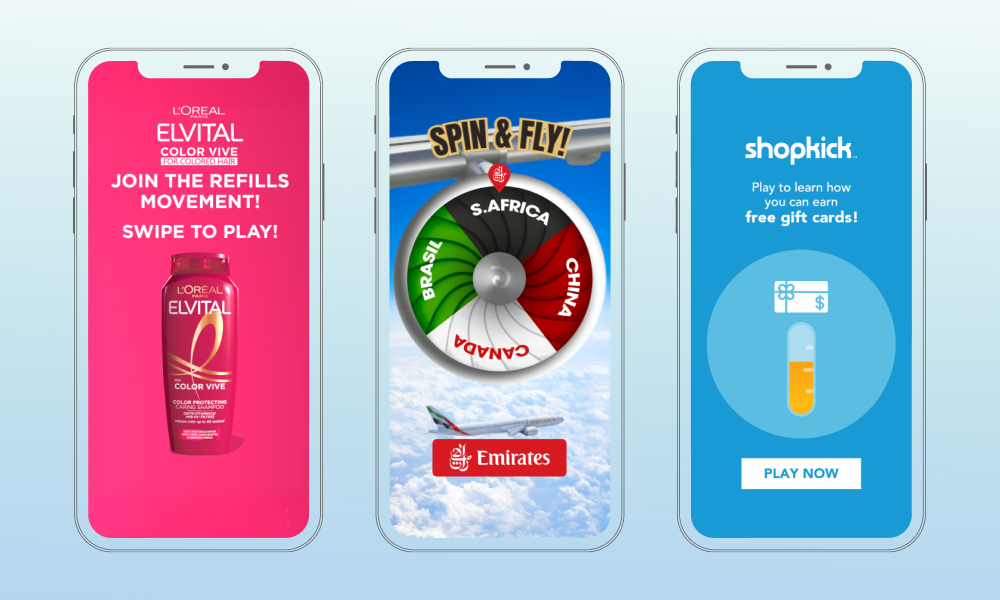
Look at these examples:

Source: Playable Factory
Every playable ad is built from three core elements that guide the user from curiosity to conversion. Let’s break them down:
This is the opening hook — a quick instruction or visual cue that tells users how to interact. Think of it as the “warm-up” phase. It might be as simple as “Swipe to play” or “Tap to solve the puzzle.” The goal here is to lower the entry barrier and immediately engage users by showing how easy and fun the experience will be. A clear and inviting tutorial means that even first-time players know exactly what to do.
The hands-on demo that lets users actually try the product is the heart of the playable ad. In gaming, it’s often a short, simplified version of gameplay that highlights the most exciting mechanics. In non-gaming industries, it could simulate using an app feature, testing a product, or personalizing a virtual item. This interactive section delivers instant gratification and creates a sense of accomplishment, which keeps users emotionally connected.
Once the mini-experience wraps up, the user is guided to the final screen. This is where the call-to-action (CTA) appears, inviting users to “Install Now,” “Shop the Look,” or “Learn More.” It ties the interaction to a clear next step and often reinforces the brand message with visuals, rewards, or social proof. A well-crafted end card converts excitement from the interaction directly into action.
I’ve been in this game long enough to remember when a simple banner ad with a “Click Here” button was considered high-tech. Those days are gone.
We are currently living through the era of “zombie scrolling.” I see it on the subway, in coffee shops, and let’s be honest, I do it myself on the couch at 11 PM. Our brains have evolved a built-in ad blocker. We just ignore static ads.
Playable ads, however, take a fundamentally different approach. Instead of trying to grab a split second of attention, they encourage users to interact and quickly understand what the product actually does. This shift from simply watching to actively participating makes the experience more memorable and increases the chances of them progressing to the next step
When done properly, this is what you get from it.
Playable ads give users something to do, not just something to look at. That interaction grabs attention and keeps people engaged far longer than static or video ads.
Because users try a mini version of the product first, only genuinely interested people continue. This filters out low-intent users early, leading to higher conversion rates and better retention.
With fewer wasted clicks and more qualified users, campaigns typically see stronger return on ad spend compared to banners or videos. Playables attract users who actually stick around.
Interactions inside the playable (taps, choices, time spent, outcomes) provide deep insights into user behavior and preferences. This data fuels smarter optimization.
Built for mobile-first behavior (tapping, swiping, short attention spans), playables align perfectly with how people actually use their devices.
Innowise delivers high-quality playables that boost user engagement and conversion rate.
If you’re choosing playable ads over banners or standard video, you’re already aiming higher than just wanting to be noticed. Playables are about experience-first acquisition, which means the design does a lot of the heavy lifting. Not just look good, but hit KPIs, qualify users, and drive installs.
Here’s how to make sure your playable doesn’t turn into an expensive gimmick.
Playable ads live in a brutal attention economy. You’ve got maybe two seconds before a user scrolls past, so the opening screen has to drop them straight into action. Skip logos, menus, and slow build-ups. Start mid-moment, show something moving, and give a clear first cue (“Tap to start,” a pulsing button, an animated arrow).
Assume nobody reads instructions. Your playable should teach through motion and obvious UX signals. Users need to understand what to do by instinct: drag here, tap there, swipe this. One gesture, one purpose. If they have to think “wait, what am I supposed to do?”, the ad already failed.
High-performing playables follow a tight rhythm: fast start → quick challenge → satisfying reward → CTA. You’re aiming for 10–25 seconds of play, not a full level. The key is the ending — give users a tiny victory (a level cleared, a combo landed, a problem solved). That little dopamine pop makes the install button feel like “continue playing,” not “please download.”
If it lags, users bounce. Playables have to load fast, run smoothly, and respond instantly, even on mid-range devices. That means small file size, lightweight animations, compressed assets, and no unnecessary effects. Think of performance as part of the creative: a playable that starts instantly will beat a prettier one that loads slowly.
The demo earns attention — the end card converts it. Don’t slap a generic “Install Now” screen at the end. Tie it to what the user just did: “Install to keep playing,” “Unlock the next level,” “Finish the challenge in the full app.” Visually echo the playable moment so the momentum carries through. The end card is where curiosity turns into installs, so make it count.
Playable results can swing wildly based on small tweaks: first 3 seconds, difficulty curve, reward timing, CTA wording. Run A/B tests on concepts early — different hooks, different challenge levels, different endings. Once you find a winner, then you scale and refine.
Looking ahead, playable ads will continue to blur the lines between entertainment and advertising. What began as a smart tactic for mobile games is rapidly becoming a powerful format for brands of all kinds.
For mobile games, playables will evolve into hyper-personalized experiences that adapt to each user’s behavior. By leveraging AI to dynamically personalize the playable experience, brands can make every interaction feel more relevant and engaging.
For brands beyond the gaming industry, playable ads are opening new doors. From trying on virtual outfits to testing product features in real time, they let users experience before they buy. In a world flooded with static content, the future belongs to brands that let people participate in their story.


Your message has been sent.
We’ll process your request and contact you back as soon as possible.
By signing up you agree to our Privacy Policy, including the use of cookies and transfer of your personal information.