Why DevOps is becoming the new standard for digital banking

Feb 26, 2026 13 min read

Forty people on Zoom. Someone shares a screen with a checklist. Everyone quietly hopes nothing will break.

That’s what releases looked like not so long ago. DevOps in banking still felt optional. But once you’re running 10+ digital products and customers expect everything to work 24/7, that kind of setup starts to feel fragile.

Now think about the banking industry today. Mobile apps, web portals, internal systems, APIs — all connected. Customers transfer money at midnight. They open accounts on Sundays. They don’t care how your teams are structured. They expect it to work. 

That’s why devops in the banking sector has become the default way of operating. Without it, digital banking simply can’t keep up.

Why digital banking demands a new operating model

Digital banking runs on constant change: new features, regulatory updates, partner integrations, performance fixes. The flow never stops. When the operating model can’t keep pace, friction builds up. And you feel it. In delayed releases and overloaded teams.

The market sets the tempo, not internal planning

Banks used to plan a few major releases per year. Back when digital channels weren’t the centerpiece of customer experience, that worked.

Today, mobile banking competes with fintech apps that update every few weeks. Customers expect constant refinement: smoother payment flows, stronger security layers, faster authentication, cleaner interfaces.

If your internal processes still rely on manual coordination and long approval chains, the gap widens. Your structure simply resists speed.

DevOps in banking addresses that structural mismatch. It introduces repeatable, smaller delivery cycles that absorb change instead of fighting it. The tempo becomes sustainable rather than reactive.

Reputation risk compounds instantly

In digital banking, availability equals trust. A failed payment or a frozen balance screen doesn’t trigger curiosity about root causes. It triggers doubt. And doubt spreads fast.

Even minor disruptions create visible ripple effects: support queues grow, app ratings drop, and social commentary spreads. Meanwhile, alternatives sit one tap away.

Without a model that prioritizes resilience, recovery becomes slow and expensive. DevOps in the banking sector reduces that exposure through automated deployments, consistent environments, and controlled rollback capabilities.

Growth exposes operational fragility

Digital banking ecosystems often expand in fragments: one team owns the mobile app, another manages internal systems, and a third handles integrations. Over time, the architecture reflects that separation.

It works until complexity increases. Then releases depend on key people and sometimes (or often) testing stretches longer than expected.

DevOps in banking restructures that environment. Shared repositories, unified workflows, and automated pipelines reduce dependency on individual gatekeepers.

Add DevOps engineers who automate releases and remove bottlenecks

What DevOps changes in the banking sector

So what changes when a bank adopts DevOps? It isn’t something dramatic on the surface. There’s no single big moment. Instead, everyday work is getting more structured.

End-to-end lifecycle transparency

One of the first improvements teams notice is visibility. Everyone can see what is planned, what is in progress, and what is ready for release. Product managers, developers, QA engineers, operations — all working from the same source of truth.

This transparency cuts ramp-up time for new team members. It reduces endless status meetings. It protects timelines because blockers become visible early. For leadership, it means fewer unpleasant surprises at the end of a sprint.

And here’s the subtle part: transparency builds trust inside the team. When people see the full pipeline, they make better decisions.

Faster and more predictable releases

Speed alone means nothing in banking. A fast release that breaks payments creates more damage than a slow one. DevOps in banking focuses on repeatability. Automated builds. Automated testing. Automated deployments.

Instead of “big bang” releases every few months, teams ship smaller updates more often. If something goes wrong, rollback takes less time. That stability lowers operational risk and protects revenue.

Predictability also reduces management overhead. Leaders stop chasing status updates. They can look at pipeline metrics and know exactly where things stand. That clarity moves projects forward without constant supervision.

Embedded quality throughout development

Quality stops being a final checkpoint and becomes part of daily work. Code runs through automated tests before it reaches production. Performance checks happen continuously. Problems surface early, when they cost less to fix.

With DevOps in place, things change. Instead of constantly putting out fires, teams start focusing on what really matters — making the product better. Developers aren’t stuck fixing the same issues over and over. They can actually build new features. And as a result, things keep moving forward, without risking stability.

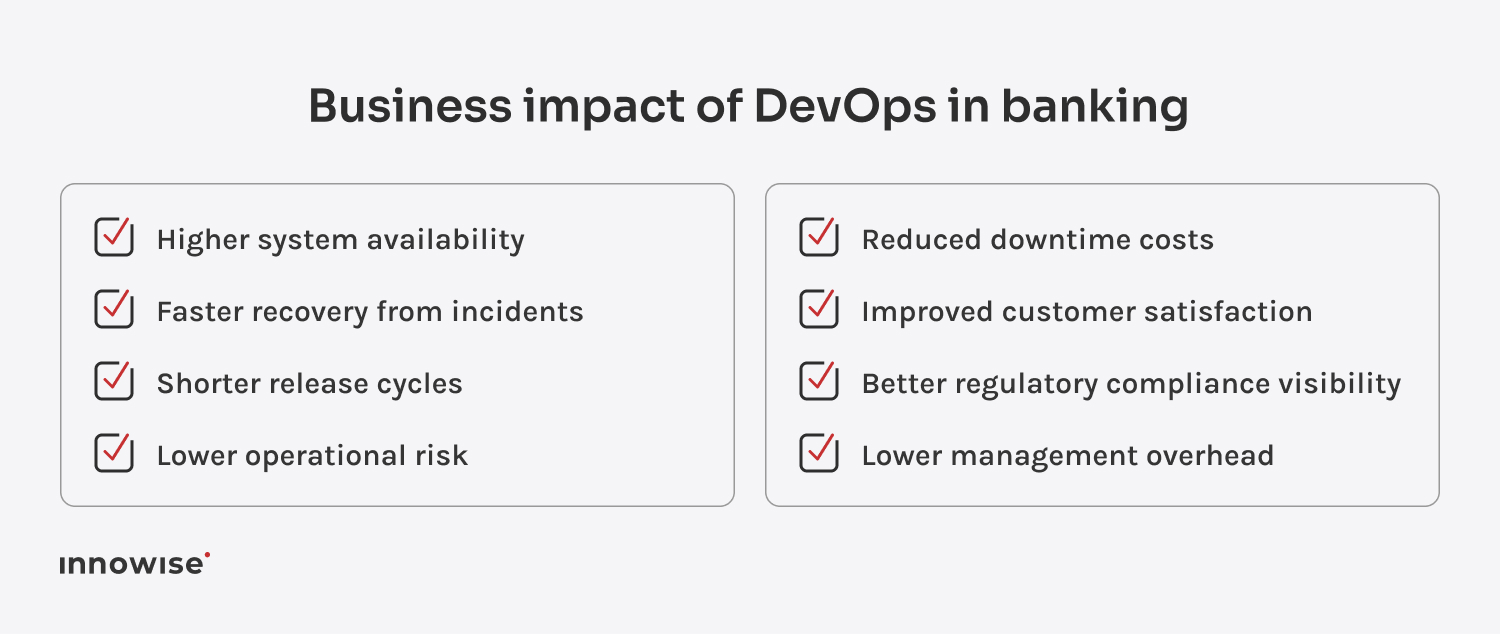
Measurable business impact of DevOps in banking

At some point, every leadership team asks the same question: is this actually improving the business, or does it just make engineers happier? Fair question. DevOps in banking earns its place when operational metrics move in the right direction.

Infographic outlining measurable business impact of DevOps in banking, including higher system availability, faster incident recovery, shorter release cycles, reduced operational risk, and improved customer satisfaction.

Improved system availability

Availability sounds technical. It isn’t. It’s the difference between a customer completing a transfer and staring at a loading screen.

Implementing a large digital banking environment can increase availability from 96% to 99.7% by standardizing delivery and monitoring practices. That gap might look small on paper. In real operations, it means far fewer interrupted sessions and far fewer frustrated users.

When uptime stabilizes, things change in more ways than one. The constant pressure on support teams fades, and the frantic emergency calls start to die down. With fewer crises to handle, product teams can finally shift focus — they can plan ahead and make real improvements, instead of just patching things up. Stability allows everyone to breathe easier and get to work.

Shorter recovery times

Incidents still happen. Complex systems always produce surprises. The real question is how fast you recover.

In the same transformation, mean time to recovery went from around five hours to roughly thirty minutes. That shift changes the financial exposure of every outage. It also changes team behavior. Engineers stop fearing deployments because rollback is structured and fast.

Here’s the insight many banks miss: recovery speed protects reputation. Customers rarely remember a brief issue that gets resolved quickly. They remember prolonged instability.

More predictable product delivery

Unpredictable delivery slowly eats away at the budget. Delays pile up, and deadlines keep shifting. As this happens, stakeholders start to lose trust in the process.

DevOps brings structure to the chaos. With continuous integration, teams always know exactly where each feature stands, which means they can move forward with confidence. Automated testing catches issues early, so by the time a release is ready, there are no surprises. Instead of scrambling, releases happen naturally, with everything falling into place as planned.

And when IT delivers on schedule repeatedly, trust grows. That trust has business value.

Release updates faster with controlled rollbacks

Common challenges when adopting DevOps in the banking industry

DevOps might sound straightforward: automate more, release faster, improve collaboration. But when it comes to banking, things get tricky fast. There’s real friction along the way.

Legacy systems and accumulated technical debt

Most banks don’t build from scratch. They carry years of integrations, custom modules, and historical decisions. Core systems often sit at the center, and touching them feels risky.

When DevOps comes into play, teams need to modernize, but without disrupting what’s already working. It’s a careful process — you can’t automate everything all at once. Start with the areas that’ll have the most impact, but are lower risk. Once you’ve built confidence, you can start expanding gradually.

Cultural resistance to new workflows

Technology moves fast, but people don’t always keep up. Developers who are used to manual deployments might feel uneasy about letting go and handing control over to automated pipelines. Similarly, managers who are used to long sign-off meetings may struggle with the idea of automated approvals.

Here’s where things get tricky: DevOps reduces visible control. There are fewer dramatic release nights, fewer long coordination calls. For some leaders, that calm can feel like a loss of oversight. But once leadership buys in and starts tracking clear metrics, things change. As teams see that automation actually reduces stress and risk, the resistance fades.

Toolchain complexity

Banks love tools, and over time, they tend to pile them up. Different CI systems, testing frameworks, repositories, and monitoring tools scattered across platforms. It feels like progress, but more tools don’t always mean better results. In fact, it often leads to fragmentation that slows everything down. Teams waste time switching between systems, errors creep in, and integration gaps pop up.

When adopting DevOps, banks need to simplify before they scale. This means standardizing repositories, unifying pipelines, and cleaning up what’s already in place. It’s not the flashy solution, but it’s the one that leads to better, more reliable results.

Balancing innovation with operational control

In banking, oversight is strict. Every change needs to be traceable, and every release must be documented. This kind of pressure can really slow down innovation.

But of course it doesn’t mean you need to stop innovating. You just need to create structured pipelines where compliance steps happen automatically. By integrating governance into the workflow, teams can move faster while still staying within the rules.

Stabilize payments, onboarding, and core banking releases

Best practices for implementing

Rolling out DevOps in the banking sector works best when it starts from real delivery friction. Missed deadlines. Stress before releases. Too many approvals. Slow onboarding of new engineers. These are signals. Address those first.

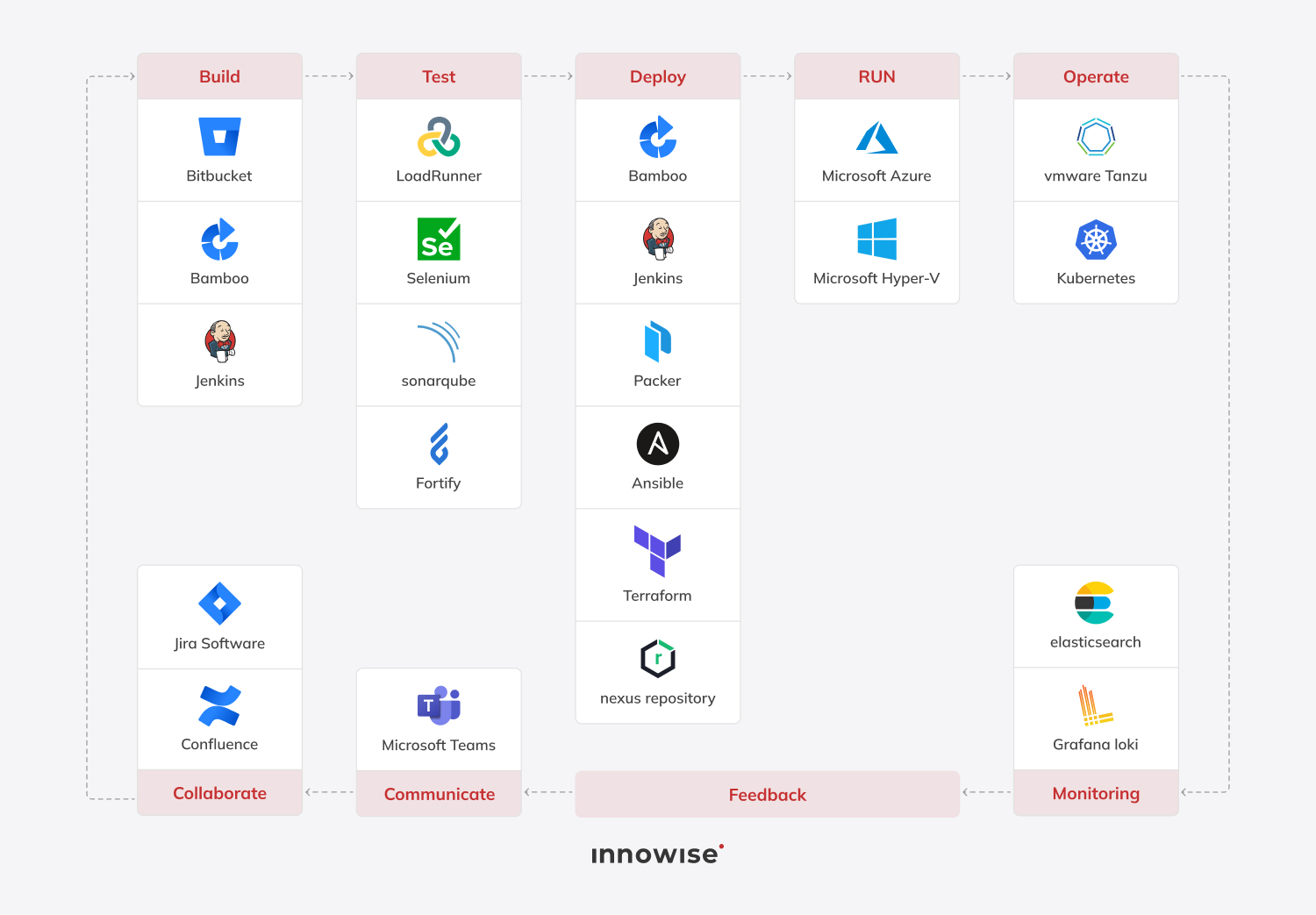
Before we go deeper into practical steps, it helps to see what a structured DevOps setup in banking actually looks like. A mature pipeline connects collaboration, build, testing, deployment, infrastructure, and monitoring into one continuous system. Nothing isolated. Nothing ad hoc.

DevOps in banking CI/CD toolchain showing build, test, deploy, run, and monitoring stages Caption if needed (under the img): Example of a structured DevOps pipeline for digital banking, covering build, testing, deployment, infrastructure, and monitoring in one continuous flow.

Start with process visibility

Before automation, you need clarity. Map how a change moves from idea to production. Where does it wait? Who approves it? What gets tested, and when?

When teams see the full path, bottlenecks become obvious. That’s where you begin.

Pro tip: Run a “release shadow” exercise. Pick one real feature and trace every single step it takes to reach production. Write down each handoff. You’ll usually find hidden delays nobody talks about. Fixing just two of those often speeds delivery more than adding a new tool.

Standardize version control and CI pipelines

When every team builds and deploys in their own way, scaling becomes a challenge. Standardized pipelines create consistency across the board. This consistency makes onboarding easier and reduces risk because everyone follows the same process.

In the banking sector, shared standards help protect timelines. New developers can plug into an existing system instead of reinventing the wheel.

Pro tip: Create one “golden pipeline” template and treat it as a product. Assign ownership. Review it quarterly. Small continuous refinements keep it aligned with business goals instead of turning it into outdated infrastructure nobody maintains.

Automate testing before scaling releases

More frequent releases without automated testing simply multiply risk. Automation acts as a safety net. It catches defects before customers do.

For DevOps in the banking industry, this step protects reputation. Quality becomes part of the process rather than a last-minute inspection.

Pro tip: Measure test execution time alongside coverage. If automated tests take too long, teams avoid running them. Fast feedback encourages discipline. Aim for pipelines where developers see results quickly, not hours later.

Measure recovery and availability metrics

Deployment frequency looks impressive in dashboards. Recovery speed tells you how mature your system really is.

Track availability. Track mean time to recovery. These numbers reflect operational health. They also influence financial exposure during incidents.

Pro tip: Share recovery metrics beyond IT. When business leaders see how faster recovery protects revenue, support for DevOps investments grows. It stops being a technical upgrade and becomes a risk management decision.

Align DevOps goals with business KPIs

DevOps should move projects forward without constant supervision. It should reduce management load, not increase it.

Tie delivery metrics to outcomes that matter: onboarding time, transaction success rate, feature adoption speed. When pipelines connect directly to revenue or customer retention, prioritization becomes clearer.

Pro tip: Include DevOps metrics in quarterly business reviews, not just engineering meetings. That visibility positions you as a strategic partner, not just a delivery team.

Build a resilient DevOps foundation for your bank

Wrapping up: Why DevOps is becoming the default for digital banks

Digital banking never sleeps. Payments move at night, identity checks happen on weekends, and systems sync constantly. That pace exposes weak delivery models fast.

DevOps changes the rhythm. Releases become routine instead of stressful. Recovery takes minutes, not hours. That kind of shift changes how teams work and how customers experience the bank.

And maybe the most underrated outcome — people stop firefighting. Engineers focus on building. Managers focus on growth. Progress becomes steady instead of dramatic.

For digital banks competing on reliability and speed, DevOps is no longer an upgrade. It’s infrastructure.

Head of DevOps Department

Igor Aristov leads Innowise’s DevOps department, overseeing 120+ engineers across six specialized teams. With more than a decade in DevOps, Igor has built and scaled high-performance infrastructure for complex, high-load systems across finance, banking, and e-commerce. Whether it’s local hardware, hybrid environments, or full cloud-native setups, his focus is always on creating stable, scalable, and cost-efficient systems that hold strong under pressure.

Table of contents

    Contact us

    Book a call or fill out the form below and we’ll get back to you once we’ve processed your request.

    Send us a voice message
    Attach documents
    Upload file

    You can attach 1 file up to 2MB. Valid file formats: pdf, jpg, jpeg, png.

    By clicking Send, you consent to Innowise processing your personal data per our Privacy Policy to provide you with relevant information. By submitting your phone number, you agree that we may contact you via voice calls, SMS, and messaging apps. Calling, message, and data rates may apply.

    You can also send us your request
    to contact@innowise.com
    What happens next?
    1

    Once we’ve received and processed your request, we’ll get back to you to detail your project needs and sign an NDA to ensure confidentiality.

    2

    After examining your wants, needs, and expectations, our team will devise a project proposal with the scope of work, team size, time, and cost estimates.

    3

    We’ll arrange a meeting with you to discuss the offer and nail down the details.

    4

    Finally, we’ll sign a contract and start working on your project right away.

    More services we cover

    arrow