Bank API integration: a complete guide to open banking and bank data APIs

Apr 7, 2026 10 min read

Key takeaways

  • Bank API integration is less about “connecting once” and more about how your product operates at scale.
  • Open banking APIs sit inside an ecosystem model, where customer consent and third-party access shape how data moves.
  • Bank data APIs are only as useful as their freshness, consistency, and update behavior across banks.
  • Choosing a bank API provider works best in two steps: baseline fit checks first, then trade-off comparison across viable options.
  • Exit and migration efforts should be evaluated early, not after a provider becomes deeply embedded.

Global open banking services are now used by more than 470 million people worldwide, and API-based access to bank data underpins everyday functions like onboarding, payments, reconciliation, and credit decisions. At that level, bank APIs stop being “integrations” and start behaving like core infrastructure. Early structural choices often fade into the background until growth or regulation makes them hard to change.

In this guide, I focus on those execution choices. Not what bank APIs are, and not why they exist, but how teams structure them in practice, where problems usually appear, and what to think through before those problems are locked in. The goal is to help you assess bank API integration as an operating model, rather than just a technical task.

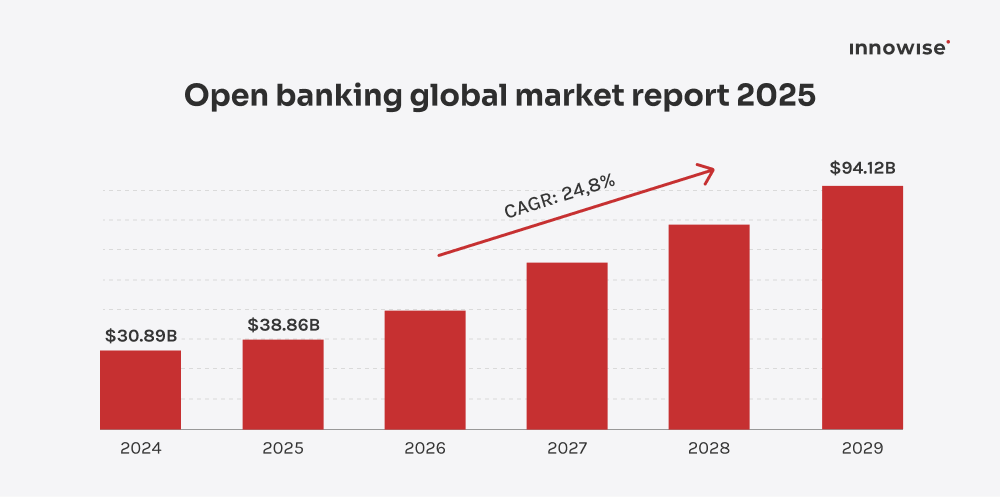
Bar chart showing rapid global open banking market growth through 2029, with a strong upward trend.

What is bank API integration and why it matters

Bank API integration is often described as a technical link between a product and a bank. That’s accurate, but incomplete. In practice, it sets the boundaries for how a financial product operates. It affects how data moves, how decisions are made, and how much manual work sits behind the scenes once the product is live.

Where bank API integration shows up in the business

Well-structured integrations shape how the business functions across several areas:

Business model

  • Whether the product can support partners or ecosystems
  • How easily new services can be added without reworking core systems
  • How dependent the business becomes on specific providers or intermediaries

Speed to market

  • How quickly teams can test and ship new features
  • How much effort is needed to enter new regions or respond to regulatory change
  • Whether changes require small adjustments or full rework

Customer experience

  • Access to up-to-date balances and transactions
  • Faster onboarding and decision flows
  • Fewer delays caused by batch processing or manual checks

Why this matters in the current banking setup

Bank API integration exists within a very different banking environment than it did a decade ago. Open banking initiatives have encouraged banks to make customer-approved data available through APIs. In Europe, this took shape through PSD2. In the UK, through a dedicated open banking framework. In the US, data sharing has evolved through market-led agreements rather than a single regulatory mandate.

What these approaches have in common is a shift away from closed banking systems. Financial products no longer operate in isolation. Data moves between banks, fintechs, and third parties based on customer consent, supporting use cases like account aggregation, payment initiation, and real-time financial insights.

This ecosystem-based setup is what makes bank API integration strategically important. It allows products to participate in broader financial workflows rather than replicating functionality internally. For businesses, that means faster access to bank data, clearer paths to partnerships, and more flexibility in how financial services are delivered across platforms.

What you gain from structuring bank API integration well

Structuring bank API integration well doesn’t change what a product offers. It changes how reliably the organization can operate as usage grows and more teams and partners depend on the same connections.

Internally, this usually shows up as:

  • Fewer repeated decisions around data formats, consent handling, and error cases
  • More predictable integration effort as volume and coverage increase
  • Clearer ownership between product, engineering, legal, and operations
  • Less rework when regulations, partners, or use cases change

Externally, this tends to result in:

  • More consistent product behavior across banks
  • Lower friction when working with partners
  • Clearer explanations during regulatory or audit reviews
  • More dependable inputs for downstream processes like pricing or eligibility

Get a bank API integration plan that fits your product

Who should integrate bank APIs and when

For executives, the real question is rarely what bank API integration is. It’s whether now is the right moment. Timing matters because integrating too early creates drag, while waiting too long can lock teams into manual workarounds that are hard to unwind.

The answer depends less on company size and more on operating reality.

Early-stage fintechs

For early teams, bank API integration can be useful, but it’s rarely urgent.

Integration often makes sense when:

  • The core product depends on live bank data
  • Manual data collection is already slowing down delivery
  • There’s a clear path from integration to a working feature

Integration is often premature when:

  • The use case isn’t clearly defined yet
  • Transaction volume is low or inconsistent
  • The team is still validating whether users need bank connectivity at all

At this stage, committing to full integration too early can pull focus away from product fit.

Scale-ups

This is where bank API integration usually becomes unavoidable.

Integration is often necessary when:

  • Manual processes are taking up increasing time
  • Data inconsistencies are causing support or reconciliation issues
  • New markets or partners require direct bank access

Delaying integration at this stage often creates risk:

  • Temporary workarounds turn into long-term dependencies
  • Delivery slows as every change touches bank connectivity
  • Compliance questions start surfacing without clear answers

For many scale-ups, this is the point where integration stops being optional and starts affecting growth and cost control.

Incumbents and established financial institutions

For incumbents, the question isn’t whether bank APIs are needed, but how broadly they should be used.

Integration is often driven by:

  • Partner or platform strategies
  • Pressure to expose data under regulatory or commercial terms
  • Internal efforts to reduce manual processes and system fragmentation

Delaying structured integration here can lead to:

  • Uneven data access across business units
  • Slower partner onboarding
  • Higher coordination cost between legacy systems

At this stage, the challenge is less about building APIs and more about deciding where they sit in the organization.

The decision to integrate bank APIs rarely comes down to a single trigger. It’s usually a choice between staying with the current setup or taking on the cost and commitment of integration. A useful way to frame the decision is this: if the current approach is influencing product scope, delivery speed, or compliance posture more than the integration itself would, it’s time to move forward.

Types of bank APIs

Not all bank APIs serve the same purpose. Teams often group them together, but in practice, they solve different problems, come with different obligations, and introduce different trade-offs. Understanding these differences early helps avoid mismatched expectations later.

Open banking APIs

Open banking APIs provide secure, customer-approved access to bank data for third parties. Their scope and behavior are usually shaped by regulation.

They typically involve three parties:

  • Banks, which expose the data
  • Third-party providers (TPPs), which consume it
  • Aggregators, which sit in between and normalize access across banks

Open banking APIs are commonly used for account aggregation, financial insights, and payment initiation, where regulatory frameworks apply.

Bank data APIs

Bank data APIs focus on retrieving financial information, whether through open banking frameworks or proprietary agreements.

Common data includes:

  • Account balances
  • Transaction history
  • Categorized transaction data

These APIs are often the foundation for reporting, analytics, lending decisions, and cash-flow visibility. Their usefulness depends heavily on data freshness, consistency across banks, and update frequency.

Payment APIs allow systems to initiate and manage money movement directly.

Typical use cases include:

  • Payment initiation from customer accounts
  • Credit transfers between accounts
  • Real-time or near-real-time payments

Compared to read-only data APIs, payment APIs carry a higher operational and regulatory weight because they involve direct movement of funds.

Other key banking-related APIs

Beyond data access and payments, many financial products rely on additional API categories that sit alongside core bank integrations:

  • KYC/AML APIs
    Used to verify identity, screen users, and support compliance checks.
  • Fraud detection APIs
    Help assess transaction risk and flag suspicious activity based on patterns and rules.
  • Loan and credit APIs
    Support credit checks, loan servicing, and exposure management.

These APIs are often combined with bank data APIs rather than used on their own.

Comparison of common bank API types

API typePrimary business use casesData sensitivityRegulatory requirementsImplementation complexity
Open banking APIsAccount aggregation, payment initiation, and financial insightsHighDefined by region (e.g. PSD2, UK Open Banking)Medium to high
Bank data APIsReporting, analytics, and lending decisionsMedium to highVaries by access modelMedium
Payment APIsTransfers, payouts, and real-time paymentsVery highStrong oversight and controlsHigh
KYC/AML APIsIdentity checks, compliance screeningHighStrict, jurisdiction-specificMedium
Fraud detection APIsRisk assessment, transaction monitoringMediumIndirect, often policy-drivenMedium
Loan and credit APIsCredit servicing, exposure trackingHighLending and data regulationsMedium to high

Each API type brings different responsibilities and constraints. Many products use several of them at once, but not all need the same level of depth or control in every category.

From here, the next practical question is how to access these APIs. Whether to build direct connections, rely on intermediaries, or combine both approaches. That’s what the next section covers.

Add engineering firepower to your open banking API delivery

Build vs buy vs aggregate

Once the decision to integrate bank APIs is made, attention shifts to the integration model. Most teams choose between direct bank connections, API aggregators, or a mix of the two. The right option depends on priorities, internal capacity, and the level of control the business needs to keep over data and operations.

Direct bank integrations

This approach means connecting directly to individual banks and managing those connections in-house.

What this looks like in practice

  • Separate integrations for each bank
  • Direct handling of authentication, data formats, and changes
  • Full responsibility for uptime, updates, and compliance touchpoints

When teams choose this

  • They need deep control over data and behavior
  • They operate in a limited number of markets
  • They have strong internal engineering and compliance capacity

Trade-offs to consider

  • Slower initial rollout
  • Higher upfront engineering effort
  • Greater long-term maintenance responsibility

API aggregators

Aggregators sit between your product and multiple banks, offering a single access layer.

What this looks like in practice

  • One integration instead of many
  • Standardized data structures across banks
  • Aggregator manages bank-specific changes

When teams choose this

  • Speed matters more than control early on
  • Coverage across many banks or regions is required
  • Internal teams want to limit the integration scope

Trade-offs to consider

  • Faster initial rollout, but less control over bank connectivity
  • Ongoing usage-based costs
  • Dependence on the aggregator’s roadmap and coverage

Hybrid approaches

Many mature products combine both models.

What this looks like in practice

  • Aggregators used for broad coverage
  • Direct integrations for high-volume or strategic banks
  • Different paths for different use cases

When teams choose this

  • They want flexibility over time
  • Some connections justify deeper control
  • Cost or data needs differ by bank

Trade-offs to consider

  • More moving parts to manage
  • Clear rules needed to avoid duplication
  • Strong internal coordination becomes important

Bank API integration models compared

FactorDirect integrationsAggregatorsHybrid
Time to marketSlower at the startFaster at the startFast for broad coverage, slower for selected banks
Cost over timeHigher upfront, lower per unitLower upfront, ongoing feesAggregator fees for most banks, direct costs for key ones
Regulatory exposureMostly internalShared with the providerSplit by integration type
Vendor dependenceLowHigherDepends on which banks use aggregators
Ability to grow coverageSlower, bank by bankFaster across regionsBroad coverage via aggregators, deeper control where needed

A practical way to decide between models is to separate short-term needs from long-term constraints.

If speed and coverage matter most right now, aggregators often make sense. If control, data behavior, or cost predictability matter more over time, direct integrations become attractive. Hybrid setups usually appear once products have enough volume to justify different approaches for different banks.

This choice doesn’t need to be permanent. But it does need to be intentional, because switching models later is rarely trivial.

In the next section, we’ll look at how to choose the right bank API provider, regardless of which model you start with.

How to choose the right bank API for your business

In practice, choosing a bank API provider happens in two steps. First, teams rule out options that don’t fit their operating reality at all. Only then does it make sense to compare the remaining providers side by side.

Step 1. Baseline checks. Is this provider a fit at all?

These checks answer a simple question: could this provider reasonably work for us? If the answer is no, there’s little value in going further.

Key areas to check include:

  • Ability to support higher volume and wider use
    How the API behaves as usage grows, including limits, thresholds, and what changes when new banks or regions are added.
  • Security and compliance scope
    Which responsibilities sit with the provider and which remain yours, including consent handling, audit records, and regulatory updates.
  • Ongoing integration effort
    How often changes are introduced, how breaking changes are communicated, and how much custom handling is required to keep connections working.
  • Documentation and support
    Whether documentation answers real questions, and whether support is available when issues affect live systems.

If a provider raises concerns in any of these areas, those concerns tend to resurface later as operating work rather than one-time setup issues.

Step 2. Comparison. Choosing between viable options

Once a provider passes the baseline checks, the decision becomes comparative. At this stage, the goal is to understand trade-offs and decide which gaps are acceptable.

Common comparison areas include:

  • Bank coverage by region
    Support for the banks and markets you rely on today, as well as those you expect to add next.
  • Data freshness and update timing
    How current the data is when it reaches your systems, and how consistent the update behavior is across banks.
  • Consent and re-authentication handling
    How often users are asked to re-authorize access, and how clearly consent status is exposed to your product.
  • SLA and uptime commitments
    What is stated contractually, how incidents are communicated, and what happens when targets are missed.
  • Pricing behavior over time
    How costs change as usage grows, and whether pricing is tied to units that can increase faster than expected.
  • Exit and migration effort
    How difficult it would be to move away if requirements change, including data portability and contract terms.

Different businesses will weigh these areas differently. What matters is being explicit about those priorities before a provider is selected.

The biggest mistake is treating bank APIs like a vendor purchase. The real test comes months later, when volumes rise, audits start, and a bank changes something without warning. The best provider on paper isn’t always the easiest to run in production. Be picky here. Ask uncomfortable questions, push for clear answers, and don’t hesitate to walk away if something feels vague.

Dzianis Kryvitski

Delivery Manager in fintech

Steps to integrate bank APIs

Once a provider and integration approach are chosen, the work becomes operational. At this stage, success depends less on architecture diagrams and more on how clearly decisions are made before the first connection goes live.

01
Identify use cases and objectives

Define exactly how bank data or payments will be used. Common cases include account aggregation, payment initiation, fraud checks, and financial analytics. Clear use cases help avoid building unnecessary integrations.

02
Choose API providers

Decide whether to use aggregators, direct bank integrations, or both. Aggregators suit broad coverage and faster starts. Direct integrations suit specific banks, higher volume, or tighter control over data and behavior.

03
Plan the architecture

Set the basic structure before coding. Decide on API styles (REST or SOAP), where integrations run, how credentials are managed, and which internal systems depend on bank data.

04
Integrate and test

Build against sandboxes, but test for real conditions. Validate data, test authentication and permissions, and check failure cases. Expect production behavior to differ from test environments.

05
Monitor and maintain

Once live, focus on operation. Track performance, errors, and consent status. Assign clear ownership for monitoring and response so issues don’t linger or get passed between teams.

arrow-iconarrow-icon
01 Identify use cases and objectives

Define exactly how bank data or payments will be used. Common cases include account aggregation, payment initiation, fraud checks, and financial analytics. Clear use cases help avoid building unnecessary integrations.

arrow-iconarrow-icon
02 Choose API providers

Decide whether to use aggregators, direct bank integrations, or both. Aggregators suit broad coverage and faster starts. Direct integrations suit specific banks, higher volume, or tighter control over data and behavior.

arrow-iconarrow-icon
03 Plan the architecture

Set the basic structure before coding. Decide on API styles (REST or SOAP), where integrations run, how credentials are managed, and which internal systems depend on bank data.

arrow-iconarrow-icon
04 Integrate and test

Build against sandboxes, but test for real conditions. Validate data, test authentication and permissions, and check failure cases. Expect production behavior to differ from test environments.

arrow-iconarrow-icon
05 Monitor and maintain

Once live, focus on operation. Track performance, errors, and consent status. Assign clear ownership for monitoring and response so issues don’t linger or get passed between teams.

Security, compliance, and data governance

Security and compliance around bank API integration don’t appear all at once. They surface at different points in the lifecycle of an integration, from early design decisions to day-to-day operation and formal reviews. Thinking about them in that order helps you focus on the right concerns at the right time.

Before go-live. Set the baseline early

Most security and compliance foundations are set before the first request is sent to a live bank API. Decisions made here tend to stay in place longer than expected.

At this stage, it is important to focus on:

  • Access control and authentication, usually through OAuth, to ensure access is granted only with valid user consent.
  • Data protection in transit, using encrypted connections between your application, providers, and banks.
  • Consent scope and duration, defining what data can be accessed, for what purpose, and for how long.

This is also the point where you should agree internally on how bank data will be stored, who can access it, and which systems are allowed to consume it. Getting these basics clear early reduces friction later.

Once live. Operate with real data

After go-live, security and compliance move from design to operation. Bank data starts flowing through real user journeys, and expectations around reliability and traceability increase.

At this stage, you should pay attention to:

  • Consent lifecycle management, including expiry, renewal, and withdrawal.
  • Ongoing access control, making sure tokens, credentials, and permissions remain current as systems evolve.
  • Third-party dependencies, especially if an API provider or aggregator sits between you and the bank.

This is where the shared responsibility model becomes visible in practice:

  • Banks control API availability and enforce access rules.
  • API providers handle connectivity and normalization within their scope.
  • You remain responsible for how bank data is stored, processed, and used across your systems.

Being explicit about this split makes daily operation calmer and response to issues more direct.

During audits, incidents, or reviews. Show control and resilience

The third phase is often triggered by an external event, such as a regulatory review, a customer complaint, or a service disruption.

When this happens, you are usually expected to demonstrate:

  • Traceability, showing when and why data was accessed.
  • Clear responsibility, identifying who investigates issues and communicates outcomes.
  • Operational resilience, especially for integrations that support core product flows.

This is where regional frameworks come into play:

  • PSD2 and UK Open Banking shape expectations around access, authentication, and reporting.
  • GDPR governs consent records, data retention, and deletion.
  • DORA (EU) adds requirements around ICT risk management, incident handling, and oversight of third-party dependencies. Using an intermediary does not remove accountability for failures or outages.

Planning for this phase upfront usually makes audits and incidents less disruptive.

Build bank API connections that hold up in production

How different businesses use bank API integrations

By this point, it’s clear what bank APIs are and how they’re integrated. What tends to be less obvious is how the same building blocks are used very differently depending on the business model. Here’s how that usually looks in practice.

Fintech companies

For fintechs, bank APIs are part of the decision engine. They’re rarely used once and discarded.

A typical setup pulls account and transaction data on a schedule, normalizes it, and feeds it into services that handle onboarding checks, credit limits, pricing, or monitoring. As new transactions arrive, decisions update automatically.

Where fintechs get value is in reuse. The same bank data supports onboarding, ongoing reviews, and alerts. Where they get burned is inconsistency. Different banks report balances, pending items, and timestamps differently. Teams that don’t centralize handling early usually end up with overrides and manual reviews later.

Banks and financial institutions

Banks use APIs mainly to control access. Externally, APIs define what partners can see and do without exposing core systems. Internally, the same APIs reduce point-to-point links between teams.

In practice, this means partner onboarding becomes more predictable, access rules live in one place, and audit trails are easier to follow. Banks that skip this layer often find that each new partner adds permanent operational overhead.

Marketplaces and payment-heavy platforms

Here, bank APIs are tied to money flow rather than insight. They sit between orders, delivery events, and payouts.

Platforms use them to initiate payments, wait for confirmation, release funds, and reconcile transactions back to internal records. The hard part isn’t sending money. It’s handling late updates, retries, and partial failures without human involvement. When this is done well, finance teams stop chasing edge cases and start trusting the system.

Bank API integration trends to plan around in 2026

Today, bank API integration is under pressure from higher expectations around security, payment timing, and data quality. In 2026, the focus shifts from adding endpoints to making existing connections predictable and easier to operate. Here are the trends I’d advise you to plan around.

Security is getting more standardized

Banks and providers are moving away from “our special OAuth setup” and toward common security profiles. The OpenID Foundation finalized key parts of FAPI 2.0 in 2025, including the Security Profile and Attacker Model, and later Message Signing. In 2026, that matters because more partners will expect these kinds of controls as the baseline for sensitive financial APIs.

Instant payments are changing what customers expect

In the euro area, instant payment rules hit major milestones in 2025, including sending instant payments and verification of payee tied to October 9, 2025. That’s now in the rear-view mirror. In 2026, “it settles in seconds” is becoming the normal expectation for many euro payment flows, which puts pressure on how you track payment status and handle exceptions.

Payments data is getting richer

SWIFT confirmed that the ISO 20022 coexistence period for cross-border payment instructions ended on November 22, 2025. So more structured fields are now flowing through payment messages. If your internal systems flatten that into free text, you lose the benefit and reconciliation stays painful.

ML use is mostly about controls, not dashboards

The useful ML work around bank APIs is narrow. Think anomaly detection in payment flows and transaction monitoring. The BIS has published research on machine-learning methods for spotting anomalies in payment systems and on analytics for real-time retail payment monitoring. In 2026, the takeaway is simple: these tools only work if your bank data is consistent and refreshed often enough.

Blockchain shows up in institutional settlement projects, not everyday bank APIs

The realistic use is mostly on the “wholesale” side. Tokenised settlement experiments, cross-border rails, shared state between institutions. BIS Innovation Hub works like Project Agorá and ECB material on tokenisation point in that direction. If you’re not in institutional payments or markets, keep this as a watch item, not a roadmap item.

One last thing

By the time teams start thinking seriously about bank API integration, the question is rarely whether to connect to banks. That decision is already made. The harder part is deciding how those connections should be structured, who owns what, and how much flexibility the setup needs to support growth, regulation, and partnerships over time.

That’s where bank API setup becomes a strategic concern. Teams planning a new integration, entering additional markets, or revisiting an existing setup often reach a point where internal assumptions need a second look. Questions around structure, ownership, and long-term impact are easier to address before they are embedded in production systems. Innowise works with organizations at that stage to help assess options and clarify trade-offs early.

A short, focused consultation can be enough to confirm whether the current approach holds up or where adjustments may be needed for what comes next.

Siarhei Sukhadolski

FinTech Expert

Siarhei leads our FinTech direction with deep industry knowledge and a clear view of where digital finance is heading. He helps clients navigate complex regulations and technical choices, shaping solutions that are not just secure — but built for growth.

Table of contents

    Contact us

    Book a call or fill out the form below and we’ll get back to you once we’ve processed your request.

    Send us a voice message
    Attach documents
    Upload file

    You can attach 1 file up to 2MB. Valid file formats: pdf, jpg, jpeg, png.

    By clicking Send, you consent to Innowise processing your personal data per our Privacy Policy to provide you with relevant information. By submitting your phone number, you agree that we may contact you via voice calls, SMS, and messaging apps. Calling, message, and data rates may apply.

    You can also send us your request
    to contact@innowise.com
    What happens next?
    1

    Once we’ve received and processed your request, we’ll get back to you to detail your project needs and sign an NDA to ensure confidentiality.

    2

    After examining your wants, needs, and expectations, our team will devise a project proposal with the scope of work, team size, time, and cost estimates.

    3

    We’ll arrange a meeting with you to discuss the offer and nail down the details.

    4

    Finally, we’ll sign a contract and start working on your project right away.

    More services we cover

    arrow