The power of data mapping in healthcare: benefits, use cases & future trends. As the healthcare industry and its supporting technologies rapidly expand, an immense amount of data and information is generated. Statistics show that about 30% of the world's data volume is attributed to the healthcare industry, with a projected growth rate of nearly 36% by 2025. This indicates that the growth rate is far beyond that of other industries such as manufacturing, financial services, and media and entertainment.

Crypto exchange development cost in 2026: CEX vs. DEX breakdown

Jan 13, 202610 min read

Key takeaways

  • Building a crypto exchange involves a mix of factors like technology, security, and compliance, all of which contribute to the overall cost and complexity.
  • As your exchange grows, so will the demands for performance and security. Planning for scalability from the start is crucial to avoid future costly upgrades.
  • The cost of launching a crypto exchange depends on the type. A CEX starts at around $420,000, while a DEX is the more budget-friendly option, starting at roughly $40,000.
  • Security updates, bug fixes, and platform optimizations are necessary for smooth operations and add to monthly expenses.
  • Knowing which factors affect the cost of your exchange is essential because understanding them can help you manage your budget wisely.

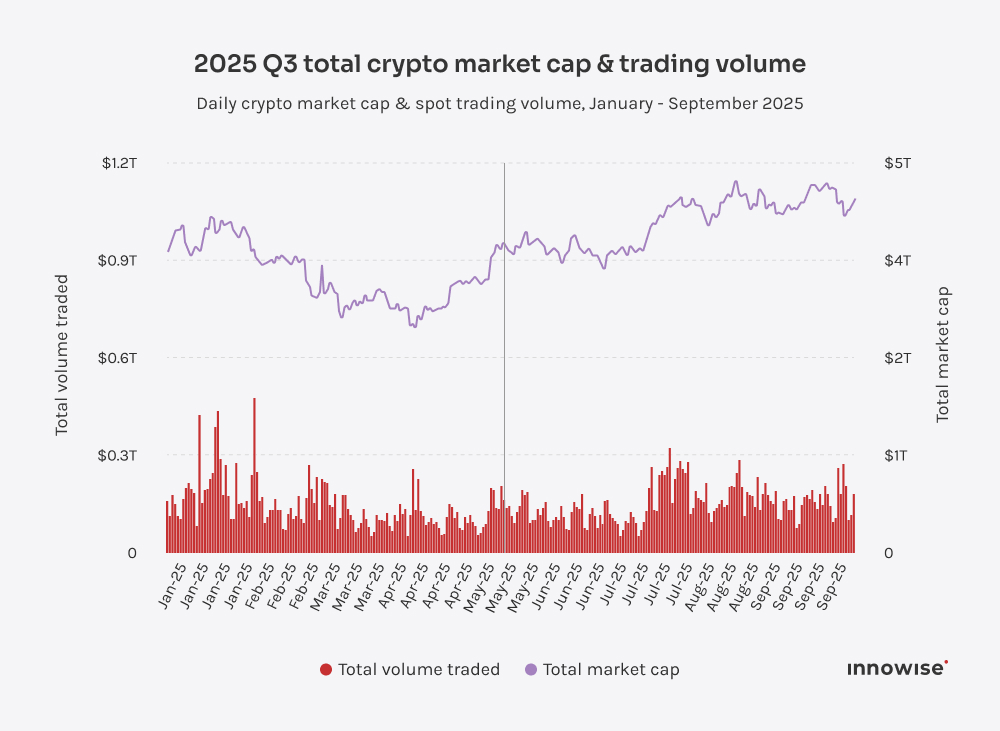
Before we discuss crypto exchange development costs, let me hit you with some numbers. In Q3 2025, the crypto market cap jumped by over $563 billion, hitting $4 trillion. Daily trading volume also made a strong comeback, climbing 43.8% from the previous quarter to $155 billion. After two slower quarters, that kind of rebound signals a real shift in momentum and renewed market participation.

With crypto adoption growing fast, the demand for crypto exchanges in 2026 is bigger than ever. But for many of our clients, launching an exchange isn’t the main goal anymore. It’s often just one piece of a larger puzzle, like supporting the trade of tokenized assets. When that’s the case, building from scratch rarely makes sense. It’s usually faster and cheaper to fork an existing solution and fit it into the wider system they’re already building. In this article, I’ll break down what it actually costs to build a crypto exchange today, from development through launch, based on Innowise’s hands-on work in blockchain and exchange development.

Line and bar chart showing daily crypto market cap and spot trading volume for Q3 2025. Image name: crypto-market-cap-chart

Don’t just plan it — start your own crypto exchange with experts!

Cryptocurrency exchange development costs explained

I’m sure it won’t come as a surprise that there’s no set price for launching a crypto exchange. The features, security, integrations, and compliance needs (and, of course, the cost) will vary a lot depending on whether you go for a centralized exchange (CEX) or a decentralized exchange (DEX). 

To give you a better idea of what to expect, I’ve broken down the key components and costs for both.

UX/UI design

  • CEX: Due to its centralized nature, a CEX must offer custom branding, TradingView charts, multi-order types, and a high-performance UI to ensure smooth trading. This drives costs from $20,000 – $50,000+.
  • DEX: A DEX focuses on DeFi-friendly dashboards, token swap interfaces, and seamless Web3 wallet integration. If you’re using open-source UI kits with adjustable colors and fonts, expect to spend around $5,000 – $10,000. But if you’re building a custom interface from scratch, the range jumps to $10,000 – $30,000+.

User authentication & compliance (KYC/AML)

  • CEX: Since CEXs must comply with financial regulations, they require KYC/AML verification, biometrics, and fraud detection tools like Chainalysis or Sumsub, increasing costs to $30,000 – $100,000+.
  • DEX: Most DEXs avoid compliance costs, but those implementing optional KYC spend around $5,000 – $20,000+.

Blockchain integration

  • CEX: To support multiple assets, a CEX needs multi-chain integration (Ethereum, BNB Chain, Solana) and Layer 2 scaling, which costs $30,000 – $80,000+.
  • DEX: A DEX must integrate on-chain transaction processing, cross-chain compatibility, and smart contract deployment, driving costs from $20,000 – $50,000+.

Trading engine

  • CEX: A CEX requires a high-frequency trading (HFT) engine with order matching and trade execution capabilities, which makes it one of the most expensive components, costing $50,000 – $200,000+.
  • DEX: DEXs use on-chain smart contracts instead of a centralized trading engine, so you will not incur any costs for this.
  • CEX: Since CEXs hold user funds, they require hot/cold wallets, MultiSig, and HSM security, pushing costs to $30,000 – $80,000+.
  • DEX: A DEX connects directly to Web3 wallets like MetaMask and Trust Wallet, making integration range from $5,000 – $10,000+.

Liquidity integration

  • CEX: To ensure deep liquidity, CEXs must integrate with market makers and liquidity providers, which increases costs to $50,000 – $150,000+. If a CEX chooses not to rely on third-party market makers, it must provide its own liquidity. This can require tens of millions of dollars in capital, especially for highly liquid pairs like BTC/USDT or ETH/USDT.
  • DEX: DEXs use automated market-making (AMM) models and liquidity pools, where users provide liquidity in exchange for fees. This removes the exchange’s liquidity costs, while AMM development is a one-time expense already included in blockchain integration.

Payment gateway integration

  • CEX: To support fiat deposits and withdrawals via bank transfers and credit cards, CEXs must integrate third-party processors, raising costs to $20,000 – $50,000+.
  • DEX: Most DEXs avoid fiat, but those that integrate fiat-to-crypto swaps spend $10,000 – $30,000+.

Admin panel & analytics

  • CEX: A CEX requires an admin panel with security logs, API/webhook support, and analytics dashboards, driving costs to $20,000 – $50,000+.
  • DEX: DEXs do not have centralized admin panels.

Security & encryption

  • CEX: Due to its custodial nature, a CEX must include DDoS protection, 2FA, cold storage, and institutional-grade security measures to protect funds. This drives costs from $50,000 – $150,000+.
  • DEX: A DEX requires smart contract audits, governance protections, and decentralized security measures, pushing costs to $20,000 – $70,000+. Notably, forking existing audited contracts can significantly reduce or even eliminate these costs.

Testing & QA

  • For both CEXs and DEXs, testing and QA are crucial to ensure functionality, compliance, and security. It’s tough to pin down exact costs, but they typically make up around 25–35% of the total expenses from the previous development stages, depending on the complexity of the crypto exchange.

Deployment & hosting

  • CEX: Since a CEX relies on dedicated servers, cloud hosting, and load balancing, deployment costs range from $10,000 – $50,000+.
  • DEX: Most DEX operations run on-chain, reducing infrastructure costs to $5,000 – $20,000.

Mobile app development

  • CEX: A mobile trading app requires real-time updates, portfolio tracking, and wallet security, which drives costs from $100,000 – $250,000.
  • DEX: A DEX focuses on Web3 compatibility and DeFi app integration, keeping costs between $10,000 – $15,000.

Maintenance & support

  • CEX: To ensure security, compliance updates, and customer support, ongoing costs range from $10,000 – $30,000/month.
  • DEX: DEXs require smart contract monitoring and UI refinements, costing $5,000 – $15,000/month.

Marketing & promotion

  • Marketing and promotion should be considered when starting a crypto exchange, which is why I included them as well. A CEX must invest in SEO, paid ads, influencer marketing, and liquidity incentives, while a DEX relies more on community-driven marketing and token airdrops. These costs can vary widely, from minimal to virtually unlimited, depending on the scale of your efforts.

CEX vs. DEX development costs: a breakdown

Component/feature CEX DEX
UX/UI design $20,000 — $50,000+ $5,000 — $30,000+
User authentication & compliance $30,000 — $100,000+ $5,000 — $20,000
Blockchain integration $30,000 — $80,000+ $20,000 — $50,000
Trading engine $50,000 — $200,000+ N/A
Wallet integration $30,000 — $80,000+ $5,000 — $10,000
Liquidity integration $50,000 — $150,000+ N/A
Payment gateway integration $20,000 — $50,000+ $10,000 — $30,000
Admin panel & analytics $20,000 — $50,000+ N/A
Security & encryption $50,000 — $150,000+ $20,000 — $70,000
Testing & QA 25 — 35% of the previous stages' total 25 — 35% of the previous stages' total
Deployment & hosting $10,000 — $50,000+ $5,000 — $20,000
Mobile app development $100,000 — $250,000+ $10,000 — $15,000
Maintenance & support $10,000 — $30,000/month $5,000 — $15,000/month
Marketing & promotion Variable Variable
Total $420,000 — $1,240,000+ $85,000 — $260,000+

As you can see, the cost of building a CEX vs. a DEX is worlds apart. I’ve laid out the expected cost ranges, but they’re not set in stone, and the totals in the table don’t even factor in marketing and QA costs. With that in mind, the smart move is to partner with experts who can guide you through every stage, helping you make strategic investments and build a crypto exchange positioned for long-term success.

The rise of cryptocurrencies has fueled demand for exchange platforms, but the market moves too fast to build one from scratch. At Innowise, we always recommend using an NDB — it’s faster, cheaper, and comes with access to external liquidity. Plus, we have strong partnerships with solution providers, making the launch process even smoother.

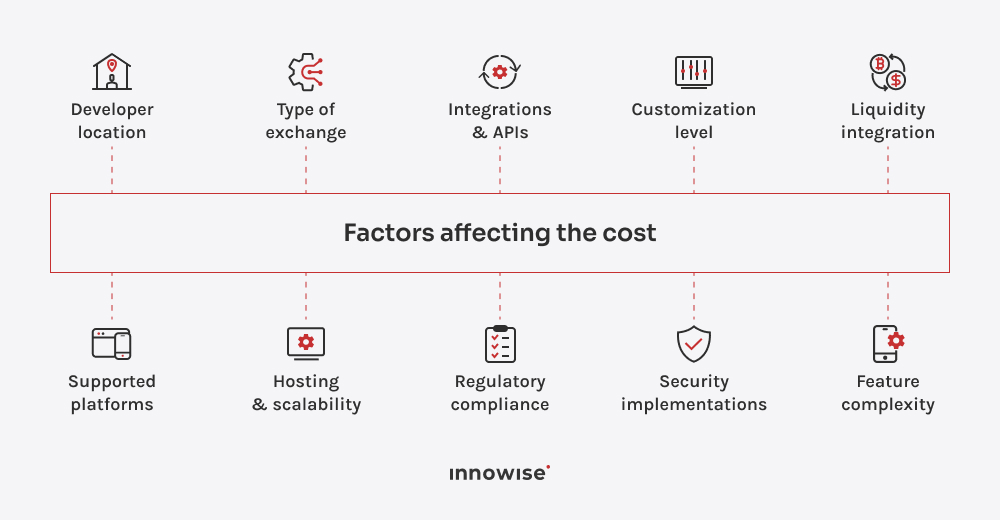
Factors affecting the cost of starting a crypto exchange platform

I think the key to building a successful crypto exchange is finding the right balance. If you understand what drives costs and carefully craft the project based on your business needs, you can keep your budget in check and get real value from your crypto exchange. 

So, let’s explore the factors that can drive up your costs, as well as those that can help you cut them down.

Type of exchange

The type of exchange you pick affects how complicated the development is, how secure it is, what kind of regulations you need to follow, and how much it’ll cost overall.

  • CEX: CEXs, like Binance and Coinbase, need solid backend systems, security, and liquidity management. Building one means creating a trading engine, security features, and compliance tools like KYC/AML. They’re usually more expensive because of the complex compliance requirements and centralized management.
  • DEX: DEXs like Uniswap and PancakeSwap use smart contracts on blockchain networks. They don’t rely on centralized systems, and liquidity pools are created directly by the platform. Though they require more advanced blockchain development, they’re more affordable to maintain in the long run.
  • Hybrid exchanges: A hybrid exchange, like Kinesis, combines centralized systems for order matching with decentralized elements like token management, so building that would require expertise in both areas. This mix makes hybrid exchanges more costly to build due to the need for cross-platform integration.
  • Peer-to-Peer (P2P) exchanges: P2P platforms like LocalBitcoins let users trade directly with each other. While they’re cheaper to run, the platform still needs escrow systems, user verification, and solid security to keep transactions safe.
Custom development vs. white-label solutions

Choosing between custom development and white-label solutions impacts how much you’ll spend upfront, how quickly you can launch, and how well your platform can grow in the future.

  • Custom development: Custom solutions give you full control over features, which makes them perfect for businesses that want to stand out. However, they often require specific programming languages or frameworks, which can influence both the speed of development and the cost to hire skilled engineers.
  • White-label solutions: White-label platforms, like AlphaPoint or Coinsoft, come ready-made and can be customized to your brand. They’re faster and cheaper to launch, but can limit scalability and custom features. These are great for businesses looking for a quick market entry without high upfront costs.
Liquidity integration

Liquidity is key for smooth, fast trading. By integrating liquidity sources, you make sure users can trade quickly without any holdups.

  • For CEXs, liquidity usually comes from big providers like Binance or Cumberland or through market makers. However, with non-disclosure broker (NDB) solutions, exchanges can tap into pre-integrated liquidity pools, automate market-making, and connect with multiple providers instantly. This means faster launches, lower costs, and smoother trading without the hassle of building everything from scratch.
  • DEX platforms opt to build their own liquidity pools rather than rely on external providers. While this demands expertise in tokenomics, smart contracts, and incentives, it maximizes profits and fosters a more self-sustaining ecosystem.
Feature complexity

The more features you add, the more time and money it’ll take to develop your exchange.

  • A basic exchange with features like spot trading and limit orders is easier and cheaper to build. You don’t need as much backend work or complex integrations.
  • Adding advanced features like staking, yield farming, NFTs, or other DeFi functionalities increases tech complexity, expands project scope, and inevitably drives up costs.
Integrations and APIs

Connecting your exchange to liquidity pools, payment gateways, and KYC/AML services is a must, but it definitely adds to the complexity and cost.

  • Integrating payment services like PayPal, Stripe, or local providers like AliPay requires API development, which can add to your costs.
  • Adding extra APIs for services like KYC, AML, or liquidity providers increases both development time and expenses.
  • APIs that offer real-time data or regulatory compliance features are essential for a reliable exchange but come with their own set of costs.
Supported platforms

For users, accessibility is essential, whether it’s catching the right moment to trade or accessing their accounts anytime, anywhere. Therefore, investing in web and mobile platforms is a must — an added cost, but crucial to stay competitive.

  • To provide mobile access for CEX traders, native iOS and Android apps can be developed alongside a web platform. This increases costs, but skipping them means trading off some user experience, as web platforms, no matter how responsive, lack certain mobile-native advantages like push notifications for trade alerts or offline access to portfolio data.
  • For a DEX, mobile access works differently. Instead of standalone apps, users connect via WalletConnect by linking their mobile wallet to a web app or using the built-in browser in a non-custodial wallet. Either way, the DEX interface needs to be optimized for mobile wallets, which adds to the cost but is still far more affordable than developing a native iOS or Android app.
Security implementations

Security is a top priority for crypto exchanges. It’s what keeps user assets safe and prevents potential breaches.

  • For CEXs, security features like cold storage, DDoS protection, and MultiSig wallets are crucial but come at a high cost due to the need for robust infrastructure and constant monitoring.
  • DEXs are naturally safer in terms of custody but still require strong security for smart contracts, liquidity pools, and Oracle integrations. Regular security audits, penetration testing, and vulnerability checks are essential and add to the cost, though typically not as much as CEX security requirements.
Regulatory compliance

Regulatory compliance is a big part of your exchange’s costs. And here’s the tricky part: every region has its own rules and tech standards, so the legal landscape, as well as the price of staying compliant, can look completely different depending on where your exchange operates.

  • In the EU, crypto exchanges must follow strict GDPR and AML rules, while in Asia, local payment methods like AliPay or WeChat Pay may be required, which adds complexity and cost to development.
  • In the US, compliance with FinCEN rules often requires additional systems to track transactions, report suspicious activity, and integrate with monitoring tools, all of which add to operational costs.
Hosting & scalability

Choosing between cloud and on-premise hosting affects your exchange's performance and scalability over time. The choice impacts both initial investment and ongoing maintenance, so it’s key to pick the right option based on your growth plans.

  • Cloud hosting (AWS, Google Cloud, Microsoft Azure) offers flexibility and easy scaling, but costs can rise as your user base grows.
  • On-premise hosting gives you more control, but it’s harder to scale and requires higher upfront costs for infrastructure.
Developer location

If you don’t have an in-house team or your team lacks the required expertise, hiring developers becomes essential. The cost can vary based on their location and collaboration model, which can significantly impact your budget.

  • US developers typically charge $150 — $250 per hour, while Eastern European and Asian developers charge $50 — $100 and $30 — $75 per hour, respectively, depending on the skill set and project complexity.
  • Offshoring can lower costs, but it’s important to make sure that the development team has the right experience and expertise to deliver quality results.
Show all Show less
Diagram of key factors affecting crypto exchange development cost, including exchange type, security, and compliance.

Start your crypto exchange strong at a price that makes sense!

Start your own crypto exchange with Innowise

Our team has real, hands-on experience in crypto and blockchain, so we know what works and why. This lets us deliver solid solutions and fine-tune everything so that your crypto exchange doesn’t just work but changes the game completely.

  • Diverse blockchain platforms

Within the Substrate modular ecosystem, we develop DEXs that provide better scalability, custom tokenomics, and cross-chain interoperability. On EVM-compatible blockchains, we create forks of popular DEXs like Uniswap v2 and Uniswap v3, adding extra features to improve UX and performance.

  • User incentive enhancements

We add loyalty programs to boost user engagement on crypto exchanges, with rewards for providing liquidity to pools, cashback for token swaps, and sharing fees with liquidity providers. Plus, we roll out custom features like exclusive tokenized rewards just for your platform. These moves help keep users active and loyal.

  • DEX integration into larger solutions

We integrate DEXs into larger products by connecting them with things like non-custodial wallets, portfolio trackers, DAO tools, or NFT marketplaces. What’s even more exciting is bringing DEXs into on-chain agents like HAIA. This lets users automate trades, run cross-chain swaps, or trigger custom strategies just by setting rules or giving a simple command.

  • Minimizing costs for clients

For CEX, we use NDB solutions to cut down development costs, saving you from hefty upfront investments in building complex systems. By integrating these solutions, we help you launch faster, stay competitive, and use your resources more wisely to drive your business forward.

Wrapping up

We know what it takes to launch a crypto exchange, whether it’s a lightweight swap platform or a full-featured DEX. Even when it comes to deploying on unique blockchains, like EVM-compatible L1s that lack the EIPs needed for standard forks, there are still ways forward. 

No matter your case, stack, or budget, we focus on making the exchange work where others might stop. We adapt to constraints, avoid unnecessary rebuilds, and deliver a solution that’s solid, maintainable, and ready to launch.

Blockchain expert & DeFi analyst

Andrew lives and breathes blockchain. He helps clients navigate a space that’s constantly evolving — translating big ideas into technical strategies that are secure, scalable, and built for real-world use.

Table of contents

    Contact us

    Book a call or fill out the form below and we’ll get back to you once we’ve processed your request.

    Send us a voice message
    Attach documents
    Upload file

    You can attach 1 file up to 2MB. Valid file formats: pdf, jpg, jpeg, png.

    By clicking Send, you consent to Innowise processing your personal data per our Privacy Policy to provide you with relevant information. By submitting your phone number, you agree that we may contact you via voice calls, SMS, and messaging apps. Calling, message, and data rates may apply.

    You can also send us your request
    to contact@innowise.com
    What happens next?
    1

    Once we’ve received and processed your request, we’ll get back to you to detail your project needs and sign an NDA to ensure confidentiality.

    2

    After examining your wants, needs, and expectations, our team will devise a project proposal with the scope of work, team size, time, and cost estimates.

    3

    We’ll arrange a meeting with you to discuss the offer and nail down the details.

    4

    Finally, we’ll sign a contract and start working on your project right away.

    More services we cover

    arrow