The power of data mapping in healthcare: benefits, use cases & future trends. As the healthcare industry and its supporting technologies rapidly expand, an immense amount of data and information is generated. Statistics show that about 30% of the world's data volume is attributed to the healthcare industry, with a projected growth rate of nearly 36% by 2025. This indicates that the growth rate is far beyond that of other industries such as manufacturing, financial services, and media and entertainment.

IT team extension explained: how it expands your development capabilities

Dec 4, 2025 10 min read

Key takeaways

  • “Team extension” gives you embedded engineers who follow your process, priorities, and product roadmap.
  • Meet delivery capacity in weeks rather than months-long hiring cycles.
  • Best-suited for stable, in-house teams that need to scale without disruption.
  • While engineering quality plays a role, failures often reflect broader issues like unclear ownership or siloed processes.
  • The biggest ROI boost is evident when preventing roadmap delays and ensuring consistency on high-priority deliverables – not solely when used for scaling.

This is where we stand – The global IT outsourcing market is projected to reach $732.38 billion by 2030. But here’s what the headline doesn’t tell you: it’s not traditional outsourcing that’s driving this growth. It’s the evolution of how companies scale their engineering teams without sacrificing speed, control, or product quality.

Meet the IT team extension model — also called a software development team extension or extended team model — a modern, flexible outsourcing approach that helps companies expand their in-house development teams with vetted external experts. Unlike handing off an entire project, you’re simply extending your existing team with additional skills, speed, and scale, without the long-term hiring overhead.

So why is this such a game-changer for CTOs, CIOs, and tech-driven companies? Because in today’s climate, there’s new and capable competition popping up by the time you have your morning coffee. The pressure to deliver faster, innovate continuously, and optimize spend has never been higher.

By the end of this article, you’ll be able to:

  • Clearly define what an IT team extension is and how it differs from outsourcing or staff augmentation
  • Understand why CTOs and tech execs are turning to extended software development teams
  • Spot the risks before they become problems and know how to mitigate them

If you’re exploring how to scale strategically, stay lean, and ship faster, this guide will help you get there, with fewer compromises and a whole lot more clarity.

So let’s unpack it.

What is IT team extension (or “development team extension”)?

IT team extension is best described as a resourcing strategy. When organizations need extra hands, be it additional experts or new ones entirely, they can scale appropriately by integrating external engineers directly into their workflows.

It’s that level of integration that sets it apart from freelancing or other subcontracting; the folks you bring in become a part of your core team, not as a detached vendor or outsourced unit. And you still maintain full control over the product roadmap, architecture, and delivery priorities, while gaining instant access to specialized talent and additional capacity.

In essence, it’s a way to expand without overextending, boosting your team’s velocity and expertise without the long hiring cycles or overhead of full-time recruitment. Which for many, has become an attractive prospect.

How IT team extension differs from staff augmentation and other outsourcing models

Now, let’s clear up the confusion because terms like outsourcing, staff augmentation, and team extension are often used interchangeably when they shouldn’t be.

Here’s the key distinction:
Staff augmentation adds people. Team extension adds capability.

Staff augmentation is a short-term, transactional fix. You hire a contractor to fill a gap, usually for a specific task or project. They’re often lightly onboarded, with limited context or alignment with your product goals.

IT team extension, on the other hand, is strategic and deeply integrated. Your extended developers join your sprints, communicate daily with your in-house team, and stay in tune with your company’s engineering culture and KPIs. They’re not a pair of rented hands. They’re a genuine extension of your product team.

Here’s a quick breakdown of how these models stack up:

Traditional outsourcingStaff augmentationIT team extension
OwnershipVendor — owns deliveryClient (you) — owns tasksClient (you) — owns outcomes
Team integrationLow — isolated vendor teamsLow to medium — limited syncHigh — embedded in your team
Engagement typeFixed-scope project contractHourly / time & materialsTeam-based collaboration
Primary focusDeliverables & contract scopeTask execution or skill gapProduct delivery & velocity
DurationFixed (short- to mid-term)Typically short- to mid-termMid- to long-term (flexible)
Speed to onboardMedium — requires planning & setupFast — quick resource placementFast — team ramp-up possible
Level of controlLow — vendor manages team/processMedium — you manage individualsHigh — you manage the team
Talent continuityLow — project ends, team disbandsLow — high turnover riskMedium to high — stable teams
ScalabilityLow — rigid scope & team sizesHigh — flexible team scalingHigh — flexible team scaling
Best forDefined projects with clear scopeShort-term gaps or urgent needsScaling roadmap delivery

So, while outsourcing delivers results for you, and staff augmentation provides hands to you, team extension works with you

This distinction matters. Because the further removed your developers are from your product context, the harder it becomes to sustain quality, speed, and innovation.

Build faster with developers who work like your own team.

5 strategic benefits of using the extended team model

You’re probably thinking, “Okay, but what’s in it for us?” Fair question. So below, I’ll outline the most important benefits of team extension. Some of them may sound similar to what you’d get with staff augmentation or outsourcing, and that’s normal. However, there are nuances in how team extension works that make its impact on delivery and team dynamics unique.

Access to niche skills and domain expertise

Yes, this one’s not unique. Staff aug and outsourcing also promise access to hard-to-find talent. But here’s why it still matters: with team extension, that expertise doesn’t orbit your team. It becomes part of it. They unblock architecture decisions. They speed up delivery. They raise the quality of what gets shipped. Not as side contributors, but as engineers working shoulder to shoulder with your core team.

Strategic cost control

It’s definitely more cost-effective than hiring a dozen engineers in a high-cost market. But the real gain is in time-to-impact, infrastructure savings, and operational flexibility. You don’t pay for ramp-up. You don’t burn cycles onboarding contractors who’ll leave in 3 months. You invest in delivery continuity that pays off across multiple releases.

Full oversight, no black box

With team extension, you don’t hand off work to a vendor’s internal backlog or rely on a third-party manager to interpret your goals. The extended team follows your release cycles, reports through your engineering leads, and works inside your planning and review process. That means no duplicated oversight, no shadow process, and no surprises at release time. Just one team, running on your terms.

Accelerated learning and knowledge retention

Contractors rotate. Staff aug burns out. Extended team engineers stay on longer timelines. They build context. They document. They leave the codebase in better shape than they found it. Over time, they become part of the delivery memory of the team, rather than a short-term patch.

Scale without disrupting your core team

Your core team isn’t unlimited. When they’re stretched, velocity drops. Quality slips. People leave. An extended team lets them breathe. You protect your internal team’s focus and let them do the high-impact work only they can do, while the extended team handles the rest.

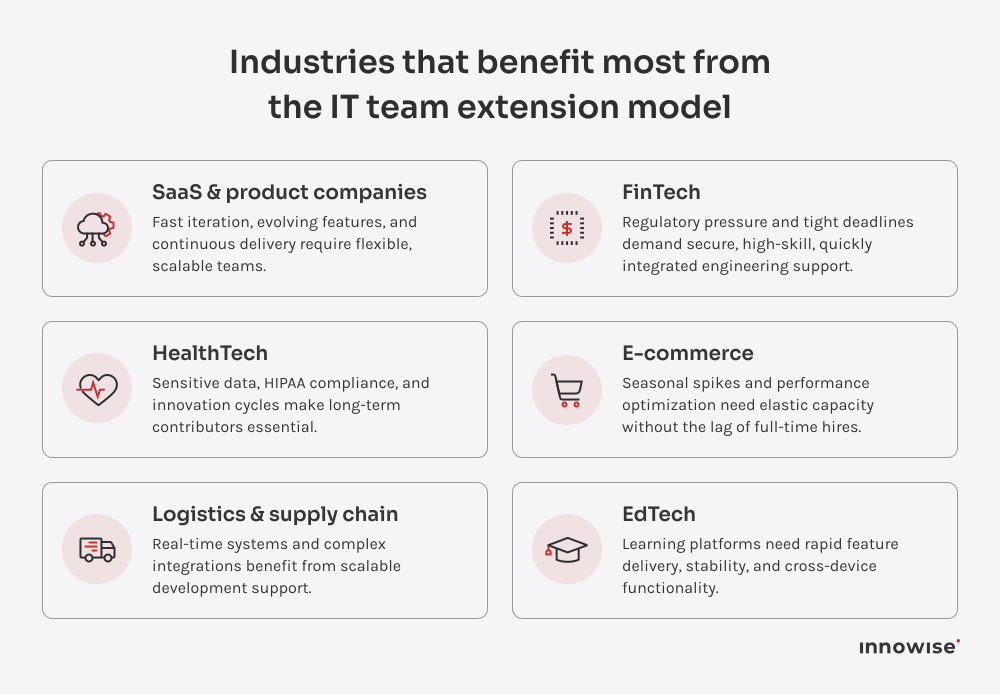
Table showing industries that benefit from IT team extension

Decision framework: is IT team extension right for you?

So you’ve seen the benefits. You understand how team extension compares to staff augmentation and traditional outsourcing. But does that mean you should rush out and sign with the first IT team extension provider you find?

Absolutely not.

The truth is, you might not need this model at all. And a trustworthy partner would tell you that upfront.

So how do you know if it’s right for you?

A good vendor will always start with a consultation before suggesting any engagement model. But you also need to come into those conversations with the right questions and a clear sense of what you actually need.

Here’s a short list of absolute Yes and No signals. It’s not exhaustive, and it won’t replace a deep dive with your internal leads or an experienced partner, but it’ll give you a strong starting point.

When team extension could be the right model

SituationWhy team extension works
Your roadmap is growing faster than your internal team can keep upTeam extension quickly adds delivery capacity, without full-time hiring delays
You want to stay in control of product direction and team workflowsEngineers integrate into your workflows, reporting to your leads
Hiring locally is too slow, too expensive, or not feasible for certain rolesTeam extension gives you access to global, pre-vetted specialists in days
You have mid- to long-term work that requires ongoing iterationThe model supports product evolution, not just one-off delivery
You’re stretched thin but don’t want to burn out your core teamExternal support takes pressure off without fragmenting your delivery process
You need specific skills (e.g., DevOps, React Native, AI/ML) that aren’t available in-houseExtended teams fill those gaps without long onboarding or recruiting cycles

When team extension might not be the best fit

SituationWhy team extension doesn’t work
You have a very small, fixed-scope projectTeam extension adds unnecessary overhead — the required onboarding and integration outweigh the benefits. A freelancer or project-based vendor might be more cost-efficient
You can fully define specs and hand off workTeam extension isn’t built for pure handoff models. Traditional outsourcing could be simpler and lower-touch
You need immediate delivery with zero ramp-up timeTeam extension requires some ramp-up to work effectively. If you need immediate delivery with no onboarding time, a contractor or vendor with a plug-and-play model may be a better fit
Your internal team isn’t equipped to manage external contributorsTeam extension relies on strong internal ownership. If your team can't manage external contributors, the benefits are unlikely to materialize. In this case, a fully managed outsourcing model or project-based vendor may be a better choice
You only need one-time maintenance or bug fixesTeam extension isn’t suited for one-off tasks. A support contract or short-term contractor is a more efficient and cost-effective option
Your goal is purely cost-cutting with minimal collaborationTeam extension offers the most value in collaborative, high-ownership environments. For low-touch, cost-driven work, classic offshore outsourcing or BPO may work better

Not sure? Try a short-term engagement.

Many companies test the model with a pilot sprint or 1–2 month engagement before scaling up. This lets you assess integration, communication, and velocity without locking into a long-term commitment.

Sometimes teams go through multiple replacements and ramp-ups, yet nothing moves forward. The issue is usually a lack of strategic planning. Extending your team requires a deep understanding of your internal processes, infrastructure, and team readiness. My advice is simple: before you commit, bring in professionals who can audit your setup. That way, you’re making an informed decision, not just burning budget.

What can go wrong (and how to avoid it)

Even if you’ve extended your team with great developers, it doesn’t mean you won’t run into issues. Miscommunication, scope creep, and engineers working in silos — the root cause is often mismatched expectations, rushed onboarding, or unclear ownership.

That’s why we need to talk about what can go wrong, and more importantly, how to prevent it. Think of this as your pre-launch checklist to make sure you walk in with your eyes open and your team set up for success.

Poor communication and alignment

The risk: External engineers feel like outsiders. Updates get delayed. Priorities get lost in translation.

How to avoid it: Set clear communication rules from day one. Use shared tools (Slack, JIRA, Notion), run joint standups, and assign a strong internal point of contact. Keep communication structured, not just reactive.

No real onboarding

The risk: Extended devs get thrown into the codebase with zero context. Productivity suffers, and so does code quality.

How to avoid it: Treat onboarding seriously, even if the engagement is short. Give them access to relevant docs, architecture overviews, and the right internal people. A 3-hour onboarding saves 3 weeks of rework.

Mismatch in engineering standards

The risk: Different styles, inconsistent code, missed edge cases, poor test coverage.

How to avoid it: Share your coding conventions, review process, and CI/CD setup early. Include external engineers in code reviews — not just to audit them, but to align them with your team’s habits.

Time zone misalignment

The risk: Missed standups, laggy handoffs, slow feedback loops.

How to avoid it: Don’t just look at the time zone. Look at the overlap. Even 3–4 hours of shared working time is enough if the process is clear. For critical roles, prioritize overlap over price.

Team dependency without long-term continuity

The risk: One great engineer leaves mid-cycle. Context disappears. The roadmap stalls.

How to avoid it: Choose vendors with high developer retention and succession planning. Ask about backup resources and continuity planning before you sign, not after someone resigns.

Internal team resistance

The risk: Your in-house devs feel threatened or frustrated by “outsiders” joining the team.

How to avoid it: Be transparent. Frame the extension as support, not replacement. Let internal leads help shape the onboarding process. And avoid siloing — everyone should be in the same meetings, same repos, same chats.

Scope creep disguised as flexibility

The risk: You think you’re scaling up… but really you’re stretching your original setup too thin.

How to avoid it: Track capacity like you would with your internal team. Monitor sprint velocity. If the roadmap expands, scale the team and don’t overload the same people.

Stop delaying your roadmap. Get engineers who plug in.

Cost & ROI considerations

If you’re expecting a price list, I’ll stop you right here — there isn’t one.

Why? Because in the team extension model, pricing depends on too many variables: the role, the region, the level of seniority, how integrated the developers are, and even your internal setup.

So no, I’m not going to throw hourly rates at you like they’re one-size-fits-all.

What I will do is walk you through the key factors that shape the cost, so you can look at any vendor quote and understand why it is what it is, and whether it makes sense for your use case.

What affects the cost of team extension?

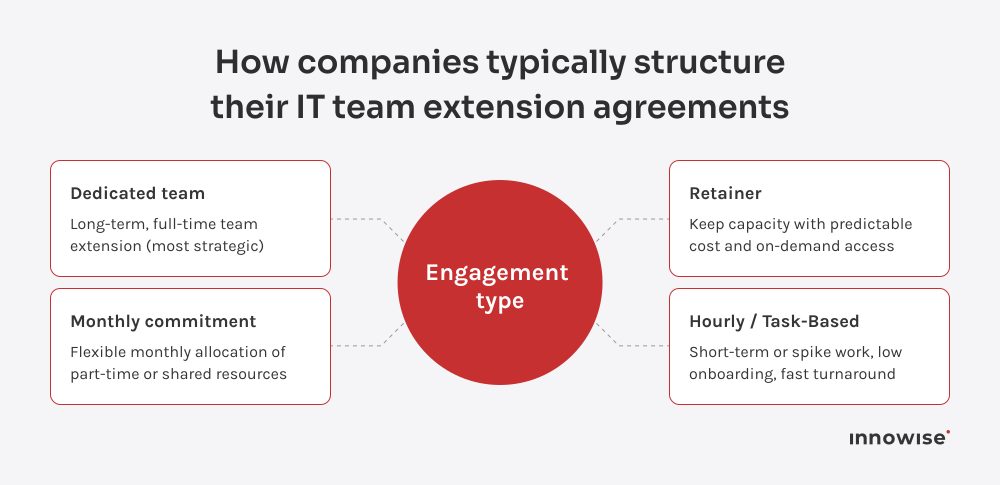
When you get a pricing proposal from a vendor, it’s usually built around a few core elements:1. Engagement modelYou can hire full-time dedicated developers for ongoing work, a part-time contributor for steady support, or use a flexible retainer for occasional tasks. The more integrated and stable the setup, the more value you get, but it usually comes at a higher monthly rate.
Diagram showing typical IT team extension engagement types

2. Role and seniority

A senior backend engineer with 10 years of experience and security expertise will obviously cost more than a mid-level QA. Specialized roles (like DevOps, AI/ML, or mobile) often come with a premium.

3. Location and time zone alignment

Developers in Eastern Europe or Latin America typically cost more than those in Southeast Asia, but they may also offer stronger time zone overlap, better English fluency, or more relevant market experience.

4. Team structure

Are you hiring individuals? A cross-functional squad? Will they work independently or closely with your in-house team? Dedicated teams that fully integrate into your workflows require more onboarding but give you higher velocity and less management overhead long-term.

5. Engagement length

Short-term, ad hoc work often comes at a higher hourly rate. Longer-term commitments (3+ months) usually give you more favorable monthly pricing and better retention.

6. Delivery risk and compliance

In regulated industries like FinTech or HealthTech, you might need developers with security clearance, specific certifications, or strong documentation habits. That adds on to the price tag.

How to balance cost vs. ROI

The ROI of team extension isn’t just about hourly rates. It’s about delivery efficiency, internal capacity relief, and time-to-impact.

Here’s what to factor in:

  • Speed: How much faster can you ship with added capacity?
  • Cost avoidance: What do you save by not hiring full-time (salaries, benefits, equipment, office space)?
  • Recruiting time saved: Internal hiring can take 2–3 months. Can your roadmap wait that long?
  • Flexibility: Can you scale up/down without severance, HR risk, or sunk onboarding costs?

When it pays off

You’ll typically see ROI in these situations:

  • You’re losing time-to-market and competitors are shipping faster
  • You need specialized skills that would take 3–6 months to hire internally
  • Your team is burning out and you’re close to velocity drop-offs
  • You want to accelerate delivery without committing to permanent headcount
  • You’re expanding globally and need follow-the-sun support or new regional teams

In most cases, the break-even point is hit in under 3 months, especially when team extension replaces opportunity cost, not just payroll.

Final thoughts

So you see, team extension can be a game-changer. It can help you move faster, scale smarter, and build with flexibility that in-house hiring just can’t match. But in the wrong context, it can create more noise than momentum.

If you’ve gone through the checklists, thought through the risks, and evaluated whether you truly need this model — great. That’s how smart decisions get made.

The extension model works best when it’s intentional:

  • You know where the gaps are.
  • You’re ready to integrate people. not just offload tasks.
  • And you’re clear on what success looks like once they’re in.

If that’s you, then you’re not just buying developer hours. You’re investing in delivery with more control, more speed, and more resilience than traditional outsourcing can offer.

And that’s what makes this model so valuable when used right.

FAQ

Team extension integrates external engineers into your in-house team. You stay in control of the roadmap, backlog, and delivery. Traditional outsourcing hands off an entire project to a vendor who manages scope, people, and process. One extends your team; the other delivers outcomes independently.


An extended team works under your direction and inside your workflows. They're part of your team. A dedicated team is managed by the vendor and may operate separately, even if aligned with your goals. Think of team extension as embedded talent, not just resourced capacity.

Costs vary based on role, region, seniority, and engagement type. On average, companies spend less than hiring full-time locally — often 30–50% less. You’ll typically pay a monthly rate per engineer. Variables like time zone overlap, specialization, and team structure also affect the final cost.

Common risks include miscommunication, inconsistent code quality, time zone issues, or poor onboarding. To mitigate them, set clear expectations, document processes, choose a reliable partner, and keep workflows transparent. A well-integrated extended team should feel like a natural part of your engineering org.

Use team extension when speed, flexibility, or access to niche skills matter more than building long-term headcount. It’s ideal if you need a fast ramp-up, temporary scaling, or can’t afford the cost or delay of full-time hiring. It's also useful during hiring freezes or market uncertainty.

Yes. Flexibility is one of the main advantages of the team extension model. Most contracts allow you to scale down with 2–4 weeks’ notice. This lets you adjust to changing roadmaps or budget shifts without long-term commitments or the risks of traditional headcount reduction.

In many cases, yes. Team extension partners often offer developers across regions to match your time zone or provide at least 3–4 hours of daily overlap. Time zone fit should be part of your selection criteria, especially for roles that require real-time collaboration.

Most extended team members can be onboarded in 2–10 days, depending on your internal process. Give them access to tools, repos, documentation, and point people early. The smoother the onboarding, the faster they start contributing, often within the first week of engagement.

Not at all. You can extend with QA engineers, DevOps, business analysts, UI/UX designers, or even product managers. It depends on your needs and what the partner offers. Many teams scale cross-functional capacity through extension, not just development firepower.

Dmitry leads the tech strategy behind custom solutions that actually work for clients — now and as they grow. He bridges big-picture vision with hands-on execution, making sure every build is smart, scalable, and aligned with the business.

Table of contents

    Contact us

    Book a call or fill out the form below and we’ll get back to you once we’ve processed your request.

    Send us a voice message
    Attach documents
    Upload file

    You can attach 1 file up to 2MB. Valid file formats: pdf, jpg, jpeg, png.

    By clicking Send, you consent to Innowise processing your personal data per our Privacy Policy to provide you with relevant information. By submitting your phone number, you agree that we may contact you via voice calls, SMS, and messaging apps. Calling, message, and data rates may apply.

    You can also send us your request
    to contact@innowise.com
    What happens next?
    1

    Once we’ve received and processed your request, we’ll get back to you to detail your project needs and sign an NDA to ensure confidentiality.

    2

    After examining your wants, needs, and expectations, our team will devise a project proposal with the scope of work, team size, time, and cost estimates.

    3

    We’ll arrange a meeting with you to discuss the offer and nail down the details.

    4

    Finally, we’ll sign a contract and start working on your project right away.

    arrow