Digital Product Passport explained

Mar 19, 2026 8 mins read

The pressure on businesses to provide clear and reliable product information has never been higher. Besides growing consumer awareness and distributors building a strong ‘green’ reputation, businesses face increasing regulatory scrutiny, especially across the European Union. 

Organizations will soon be required to adhere to more stringent standards for how product data is managed, shared, and accessed. At the heart of this transformation is the Digital Product Passport (DPP), a key initiative within the EU’s broader push for standardized product data management. The DPP aims to make product information more accessible, accurate, and trustworthy throughout its lifecycle, supporting sustainability efforts, improving consumer confidence, and streamlining supply chain processes. Naturally, the Digital Product Passport market is expected to have an extraordinary 45.7% CAGR by 2030.

This article explores how the rise of the Digital Product Passport is altering the approach to product data transparency and compliance in the EU market, and how to get prepared early on.

What is a Digital Product Passport?

Digital Product Passport is a digital record that encompasses product-related data across the entire lifecycle. It’s accessible via QR code, NFC, apps, or other gateways. DPP discloses how a product was manufactured, what materials and components were used, whether it was repaired, and the amount of recycling involved.

Also, a DPP is not a fixed document like a certificate. It’s more of a live record, since each supply chain member should supplement it based on their activity. DPP data is available for both supply chain stakeholders to verify compliance and customers to assess trustworthiness when purchasing.

Essential nuance: DPP data must be machine-readable. Information there should be structured so that computer systems can automatically process and exchange it, without humans hunting for specific details in a PDF. This drastically streamlines and simplifies verification.

Digital Product Passport and EU regulation

ESPR and DPP

As the EU Ecodesign for Sustainable Products Regulation (ESPR) was introduced in 2024, DPP is gradually being mandated across industries. ESPR establishes sustainability requirements for physical products placed on the EU market, and plays a key role in the circular economy transition. Under the ESPR framework, Digital Product Passport requirements come through product-specific delegated acts, detailing what data to provide, how to format it, and who gets access. This way, ESPR has made product transparency a fundamental market aspect, not an option, and it’s a welcome thing indeed.

Scope of application

DPP is placing accountability firmly in the laps of manufacturers and distributors who enter the EU marketplace. All parties involved in the supply chain will adhere to DPP standards and update the digital passport with relevant data as products move through the lifecycle.

Phased rollout

Ultimately, Digital Product Passports will cover all product categories, but it won’t happen overnight. Phased rollout stems from inherent differences in product complexity and data requirements across industries. For instance, DPP passports for batteries are already defined under Regulation (EU) 2023/1542, with enforcement milestones starting in 2026. Textiles and electronics come next in 2027–2028, with complete coverage projected for 2030 once all sector acts are finalized. Exact dates are not set, so EU-facing businesses should closely monitor changes, sector-specific guidance as it emerges.

The role of life cycle assessment (LCA) in Digital Product Passports

Life cycle assessment (LCA) quantifies the environmental footprint of a product from cradle to grave: extraction, production, distribution, usage, disposal. Indeed, this method becomes the analytical backbone of meaningful Digital Product Passports. When LCA data flows into DPPs, stakeholders can see what was invisible: energy hotspots in manufacturing, opportunities for material substitution, design tweaks that dramatically improve recyclability, and more.

Scaling LCA across complex supply chains, however, presents challenges, such as fragmented data, inconsistent methodologies, and resource constraints, especially for smaller enterprises. Organizations need standardized approaches aligned with ISO 14040/14044, automated data collection tools, and systems that translate technical outputs into accessible DPP formats. Consequently, companies preparing for DPP implementation are increasingly prioritizing robust LCA capabilities as both a compliance necessity and a competitive advantage.

What data does a Digital Product Passport include?

The passport pulls together several critical data categories, everything needed to form a complete view of a product’s eco status.

Data CategoryDescriptionResponsible partyProjected regulatory status
Product identificationUniquely identifies the productManufacturerExpected baseline
Materials & compositionDetails of materials and componentsManufacturer (with suppliers input)Sector-specific
Manufacturing informationWhere and how product is madeManufacturerPartially mandatory
Environmental impact indicators (LCA-based)Carbon footprint, energy use, resource efficiency metricsManufacturer (often with LCA providers)Sector-specific / Emerging mandatory
Compliance & certificationsRegulatory complianceManufacturerMandatory when applicable
Lifecycle statusTracks product through lifecycle stagesManufacturer / brand owner (with service and recycler inputs)Voluntary / emerging
Recycling & end-of-LifeGuidance for reuse, recycling, disposalManufacturer (implemented by recycler)Depends on product

Build an extensible data aggregation platform to future-proof your products.

Who uses a Digital Product Passport

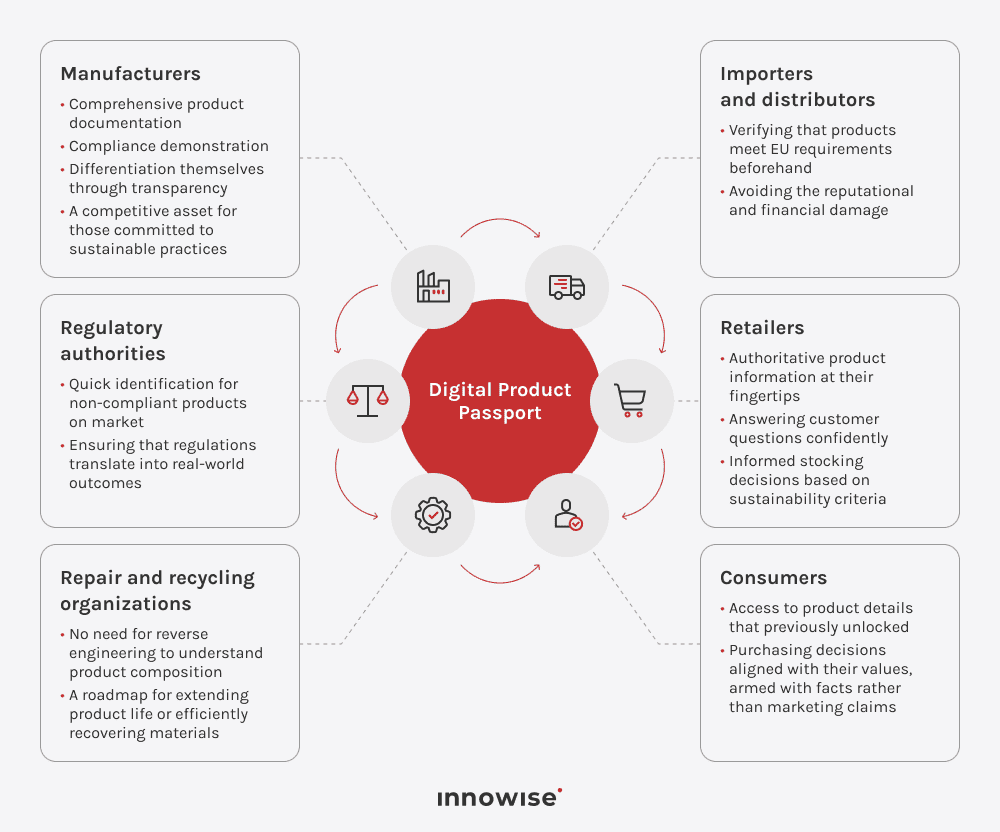
In addition to their regulatory function, DPPs serve as a central source of information for everyone involved in a product’s lifecycle. This is what various stakeholders can use DPPs for and how they rely on their data.

How manufacturers, distributors, retailers, consumers, and authorities can use Digital Product Passports.

Digital Product Passport is not ERP, PLM, or a QR code

DPP holds all lifecycle data, so the common misconception is that it somehow replaces enterprise resource planning (ERP) or product lifecycle management (PLM) systems. But it doesn’t. ERP and PLM systems manage internal operations, such as inventory, production workflows, and design iterations. The Digital Product Passport, by contrast, only provides standardized product data meant for external stakeholders. It draws information from ERP and PLM systems, but doesn’t offer operations management.

QR codes are merely one door through which users can reach the passport data. NFCs, links, and APIs are others. The QR code isn’t the passport itself any more than a website URL is the website. Behind that QR code lies the structured data repository that constitutes the actual DPP.

Real-world examples: how companies prepare for DPP

In up to five years, nearly every EU-selling product will be complemented by DPPs. Naturally, many companies decide to get prepared early on. The initiatives below are early pilots, but they show valuable insights into how DPP might function at scale.

Samsonite, the luggage manufacturer, has initiated DPP pilots for its products. As it tracks materials through the supply chain, the company can already verify sustainability claims and provide customers with authenticated product information. This groundwork positions Samsonite to hit the ground running when DPP mandates arrive.

Tesla and Audi have launched battery passport pilots, responding to the EU’s particular focus on batteries. These pilots document battery composition, the sourcing of critical minerals, and end-of-life handling instructions, which are essential for advancing recycling and circular economy goals.

Ford has started its battery passport pilot as well, utilizing blockchain technology to create an immutable record of battery data throughout the supply chain. An illustrative example of one possible technical approach to enhancing traceability in complex, multi-tier supply networks.

What’s not perfect about Digital Product Passports

For all their promise, Digital Product Passports aren’t a silver bullet against environmental impact, since they don’t automatically ensure sustainability. DPP makes information about sustainability visible, but a product with a comprehensive passport might still carry a substantial environmental footprint. Transparency doesn’t equal virtue.

The initiative itself doesn’t guarantee data accuracy without appropriate governance. Enterprise implementations require robust mechanisms for auditability, version control, third-party verification, and legal accountability to ensure that DPP data is reliable, traceable, and compliant with regulatory requirements. Until verification mechanisms are fully established, companies could theoretically populate passports with inaccurate or misleading information.

Moreover, DPP is just a tool, and improved transparency shouldn’t be mistaken for decision-making. The DPP provides information, but humans and institutions must still interpret that information, set standards, and take action.

Conclusion

Sustainability requirements change, and the Digital Product Passport is a clear sign of it. The regulatory groundwork for product transparency and traceability is being laid even as you read this. While certain sectors will face requirements sooner than others, nearly all product categories will eventually be affected.

By adopting DPP infrastructure and integrating LCA now, businesses can stay ahead of upcoming mandates and gain a competitive advantage in an increasingly transparent market. That’s why more and more businesses have chosen a proactive approach, implementing pilot passports and transparency measures incrementally, ahead of the official rollout. 

At Innowise, we support organizations in navigating this transformation, helping them build the DPP-compliant infrastructure that will drive long-term value.

FAQ

The DPP is being gradually introduced under the EU’s Circular Economy Action Plan. Full legal requirements are still being phased in: certain sectors may face early obligations in 2026, while comprehensive coverage is expected by around 2030. Ultimately, nearly all sectors will face it, so businesses should monitor Digital Product Passport updates to ensure timely compliance.

The EU plans to start rolling out DPP requirements with electronics, batteries, textiles, and complex consumer goods. They often contain critical raw materials and have a high environmental impact.

DPP centralizes product data and makes it available for all stakeholders: manufacturers, recyclers, regulators, and consumers. They can track material composition and origin, understand recycling and repair options, reduce greenwashing, and enable more responsible purchasing.

No, a DPP is not the same as a QR code. A DPP is a digital record containing structured product data. A QR code or digital label can be a gateway for how DPP can be accessed, but not the passport itself.

A typical DPP contains the data about:

  • Material composition and hazardous substances
  • Repair, maintenance, and recycling instructions
  • Origin of raw materials and production processes
  • Product environmental impact and certifications

Primarily, manufacturers and importers are responsible for submitting accurate data. They can collaborate with suppliers, distributors, and recyclers to ensure the information is complete and up to date.

First, start mapping product components, materials, and supply chains. Then, implement data collection and management systems to capture all relevant data. You can explore digital solutions and platforms to store and share product passports, or consider developing a custom one if needed.

Head of GRC, Cybersecurity & Sustainability

Stanislav brings real-world thinking to sustainability in tech. He helps clients move past checkboxes and into actual results — whether that means optimizing infrastructure, reducing waste, or building digital products with impact in mind.

Table of contents

    Contact us

    Book a call or fill out the form below and we’ll get back to you once we’ve processed your request.

    Send us a voice message
    Attach documents
    Upload file

    You can attach 1 file up to 2MB. Valid file formats: pdf, jpg, jpeg, png.

    By clicking Send, you consent to Innowise processing your personal data per our Privacy Policy to provide you with relevant information. By submitting your phone number, you agree that we may contact you via voice calls, SMS, and messaging apps. Calling, message, and data rates may apply.

    You can also send us your request
    to contact@innowise.com
    What happens next?
    1

    Once we’ve received and processed your request, we’ll get back to you to detail your project needs and sign an NDA to ensure confidentiality.

    2

    After examining your wants, needs, and expectations, our team will devise a project proposal with the scope of work, team size, time, and cost estimates.

    3

    We’ll arrange a meeting with you to discuss the offer and nail down the details.

    4

    Finally, we’ll sign a contract and start working on your project right away.

    More services we cover

    arrow