It is an outsourcing model where a partner builds and operates a team or center for a set period, then transfers full ownership to the client.
Your message has been sent.
We’ll process your request and contact you back as soon as possible.
The form has been successfully submitted.
Please find further information in your mailbox.


The build–operate–transfer concept isn’t exactly new. Back in the 1990s and early 2000s, US companies used it to expand into new markets and set up captive centers overseas.
But today’s BOT wave looks very different. Remote work has become more popular. The race for data, AI, cyber, and cloud talent keeps heating up. And at the same time, companies want tighter control over their strategic capabilities without losing speed. That’s where BOT comes in. It gives you fast access to skilled teams with the option to bring everything fully in-house later.
Cue some stats. Recent Deloitte’s research shows 71% of organizations have adopted or are adopting a BOT or BOTT model for their global in-house centers. Half of the rest are actively exploring it. The reason is clear: faster time to value, lower long-term costs, flexibility to scale, and access to talent you simply can’t find locally.
In this guide, I’ll break down what BOT actually means today, how each phase works, what to watch out for in the contract, and the real trade-offs you’ll face. You’ll get a practical playbook for running a build–operate–transfer engagement that creates lasting value instead of short-term lift.
The build–operate–transfer model is a type of business setup where a company partners with an external expert to build, run, and eventually hand over a new operation, like a tech service center, R&D hub, or product team.
In short, the partner builds your operation (handling recruitment, legal setup, and infrastructure), operates it for a defined period (overseeing performance and stability), and then transfers full ownership, including staff, IP, and assets, back to you once it’s ready to stand on its own.
Fun fact, BOT didn’t start in tech at all. It was first used in public–private partnerships for big projects like highways and power plants. But the model proved too good to stay in one lane. Today, it’s a favorite for IT and business services, helping companies rapidly spin up delivery centers while mitigating setup costs and early-stage risks with a seasoned local partner.
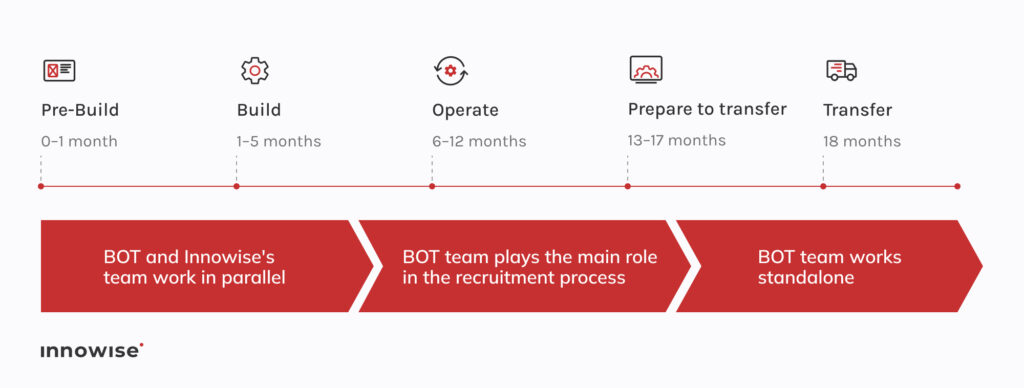
At a high level, the build–operate–transfer model follows a logical step-based path:
Up next, we’ll dig deeper into each stage and how to make every phase deliver maximum value.
From your side, a build–operate–transfer project moves through five main phases. Each one hands over a bit more control from the BOT partner to you, keeping things steady, transparent, and ready for a clean handoff when the time comes.

The operate phase is where the new team evolves from setup mode to full performance. This stage typically lasts one to three years, long enough for the team to complete training, fully integrate with your internal processes, and start delivering measurable results.
During this time, the BOT partner runs day-to-day operations in line with the KPIs and SLAs defined earlier. They manage performance, handle reviews, fine-tune processes, ensure compliance, and keep knowledge transfer moving.
Let’s say a global fintech company sets up a software engineering center in Poland under a BOT model. During the operate phase, the partner oversees around 100 engineers working on backend services and mobile apps. Over the next 18 months, they roll out agile delivery frameworks, align CI/CD pipelines with the client’s global standards, and establish a local leadership team to manage delivery and quality assurance.
By the end of the phase, the center consistently meets sprint velocity and defect rate targets, proving it’s ready to stand on its own as part of the global organization.
The transfer phase is the formal handover: full ownership of the operation, its people, and all intellectual property moves from the BOT partner to you. By now, the team is self-sufficient, processes are stable, and performance meets the KPIs defined in your BOT agreement.
This phase starts only after the operation proves it can run without day-to-day partner involvement. The goal is a hassle-free transition with no stalls: projects continue, customers see no disruption, and employees understand the new ownership structure.
Here’s what typically happens during this stage:
Let’s make it tangible. A US-based logistics company takes over a 150-person development center in Poland after a two-year BOT engagement. Before go-live, both sides complete a joint readiness checklist covering HR, IT, and finance. The transfer activates over a weekend: employment contracts switch, access rights are updated, and new in-house managers assume control. On Monday, operations continue as usual, with the partner available for two months of hypercare to address any transitional issues.
So, now that you’ve seen how the BOT model works, let’s talk about what you actually get out of it. Beyond the process and phases, here’s why companies keep turning to BOT when they want to scale fast and stay in control.
The BOT model can deliver real, lasting value, but it’s not a plug-and-play setup. It takes planning, patience, and a reliable partner to get it right. Before you jump in, here are a few challenges worth thinking through.
Running a BOT project well comes down to intention. Each stage matters, and how you handle the details makes the difference between a short-term setup and a long-term success. These practices help you get it right from the start.
The build-operate-transfer model is one of a few options worth a serious look. That’s why I’ve pulled together the most common alternatives side by side. Understanding where BOT fits among them makes it easier to choose the model that aligns with your goals and growth plans.
This is the comparison that comes up most often. Traditional outsourcing is like renting a service: you pay for the work, but the outsourcing services vendor keeps control of the dedicated team and the process. The pros and cons are clear. It’s fast to start, but it keeps you tied to ongoing fees and limited visibility. BOT, on the other hand, is more like a rent-to-own model. You work with a partner who builds and runs the operation for you while aligning it with your standards. Once the team is stable and performing well, you take full ownership. You keep the expertise, the people, and the control without the long-term vendor costs.
A captive center is the full do-it-yourself route to global expansion. It’s like flying to a new country and building an office entirely from scratch, handling every detail yourself (local laws, hiring, real estate, payroll, and compliance). You get full control from day one, but it takes time, costs more, and carries plenty of risk. The build-operate-transfer model takes a smarter route. Think of it as bringing in a local expert to get everything running. Your BOT partner sets up the entity, builds the infrastructure, hires the team, and manages operations until things are stable. Then they hand it over. You still end up with complete ownership, just like with a captive center. The difference is that BOT gets you there faster, with less risk and far fewer headaches along the way.
A Joint Venture works like co-owning a business with a partner. You split decisions, profits, and risks right down the middle. It can be effective, but it also means you never have full control, and ending the partnership later can be complicated. Build-operate-transfer services take a different shape. It’s a temporary collaboration built with an exit plan from the start. Your partner’s role is to help you set up, run, and stabilize the operation before stepping aside. Once everything’s ready, you take full ownership. The result is a smooth transition to complete independence, without the long-term ties of shared ownership.
Staff augmentation is built for short-term needs. You bring in external specialists to fill skill gaps or support your team on a specific project. It’s quick and flexible, but once the contract ends, the knowledge and expertise leave with the temporary software development partner. BOT takes a longer view. Instead of adding a few temporary hands, you’re building a complete, self-sustaining operation. It’s a structured way to create a permanent team that grows with your business and becomes a real part of your organization.
| Criteria | BOT | Traditional outsourcing | Captive center | Joint venture | Staff augmentation |
| Ownership | Transfers to the client after maturity | Vendor retains ownership indefinitely | Full client ownership from day one | Shared ownership | Client retains ownership of individual hires |
| Control | High and increasing over time | Moderate. Vendor-managed | Full. Client-managed | Shared decision-making | Medium. Client manages a project |
| Setup speed | Fast. Partner handles initial setup | Fast. The vendor provides ready resources | Slow. Requires full setup | Moderate. Depends on negotiations | Fast. Minimal setup required |
| Long-term cost | Moderate to low after transfer | Ongoing vendor fees | High initial cost, lower over time | Variable | Medium, depends on duration |
| Risk level | Shared early, low after transfer | Low operational, high dependency | High operational and legal | Shared but complex exit | Low but short-term impact |
| Flexibility | High, can adjust or delay transfer | Low, fixed vendor terms | Low, high sunk cost | Medium, contractual flexibility varies | Very high, easy to scale up/down |
| Best for | Companies seeking lasting capability | Cost-driven projects | Large enterprises | Co-investments or local market entry | Short-term or skill-specific projects |
The build-operate-transfer model gives companies a clear, low-risk way to scale while staying in control. It combines fast setup, steady growth, and full ownership once the operation is ready. When built on a solid agreement and managed with discipline, it becomes a lasting business asset that keeps delivering value.
If you’re thinking about this model, our team can help you shape a BOT strategy that fits your goals and resources. We guide you through every stage, so you can expand with confidence and build an operation that’s ready for the long run.
It is an outsourcing model where a partner builds and operates a team or center for a set period, then transfers full ownership to the client.
A BOT project typically takes 2 to 3 years. The Build phase lasts a few months to a year to hire staff and set up operations, followed by 1–2+ years of operation for stability and performance. The Transfer happens once the setup runs smoothly, with timing adjusted based on readiness and project goals.
A strong build operate transfer contract outlines duration, ownership and IP rights, termination terms, and financial conditions. It specifies who owns assets, how the transfer occurs, and what fees apply. Clear terms on quality, dispute resolution, and post-transfer support keep expectations aligned and protect both sides.
BOT suits mid-size and large firms best, but works for smaller companies with stable funding and clear growth plans. Startups can use BOT to establish overseas R&D or support centers. The key is ensuring resources are sufficient to take over once the operation transfers.
Dmitry leads the tech strategy behind custom solutions that actually work for clients — now and as they grow. He bridges big-picture vision with hands-on execution, making sure every build is smart, scalable, and aligned with the business.


Your message has been sent.
We’ll process your request and contact you back as soon as possible.

By signing up you agree to our Privacy Policy, including the use of cookies and transfer of your personal information.