Access top-tier tech talent: Nearshore software development in Brazil

Image for article

Key takeaways

  • Nearshore software development in Brazil can give you a real advantage. You get solid English skills, working hours that overlap well with the US, and a big talent pool across areas like FinTech, SaaS, and AI.
  • When you hire in Brazil, the vetting step matters a lot. Look past coding skills and check how people think about product goals, ownership, and teamwork. That’s what keeps performance steady and helps you avoid churn.
  • You’ve got options on the hiring model: full-time, contractor, or a mix. Pick what matches your scope and how long you plan to run the team. While you’re doing that, budget for the costs people forget, like management time and the tools you’ll rely on every day.
  • Day-to-day management gets easier when you spell out expectations early and treat the nearshore team like part of the core team. Encourage ownership, keep communication tight, and rely on tools like Slack and Jira so work stays visible and decisions don’t get stuck.
  • Eastern Europe still makes sense for a lot of companies, especially if you already operate there. But for many teams in 2026, Brazil nearshore development hits a sweet spot: good rates, room to scale, and real-time collaboration that feels close to working in-house.

If you run a tech business in Brazil and work with clients abroad, you already know the pressure. US and European customers want speed, senior engineers, and clear ownership. And of course, they want it yesterday. Nearshore software development puts you in a strong position to satisfy these demands, but only if you hire and scale teams the right way.

This guide is about making Brazil nearshore development work for your bottom line. I’ll look at how to find and hire software developers who can handle the high delivery expectations of the global market, and how to set teams up so they drive product growth rather than just closing Jira tickets (if you know you know).

Why Brazil is the strategic nearshore choice for 2026

In 2026, Brazil is a competitive nearshore choice for US companies wanting high-quality teams that deliver without constant oversight. Brazil’s IT sector growth is driven by digital transformation, with large enterprises investing in scalable software, giving developers real product experience.

What sets Brazil apart is predictability. A stable economy and government-backed tech initiatives ensure a steady talent supply, unlike smaller markets with high turnover rates. This makes Brazil the smart choice for long-term engagements.

“Brazilian developers earn their reputation. They combine strong product thinking with real-time collaboration that US teams value. And to be fair, other regions like Eastern Europe bring serious engineering depth too. The smart move is matching the region to the work.”

Ivan Shatukha

Global Delivery Director

Next, I’ll dive into what makes Brazilian teams unique and how to find top talent.

Brazil vs. other top nearshore destinations: a quick comparison

If you’re picking a nearshore region in 2026, don’t start with hourly rates. Start with fit. Time zones, communication style, and the local hiring market will shape your delivery speed more than a $10–$20 difference on paper. Here’s how Brazil stacks up against the most common alternatives US and EU teams consider.

Deep dive: the Brazilian advantage

From my years working across global delivery models, I’ve seen software development in Brazil win for several reasons. And they’re not the usual “cost” arguments.

1) Brazil has the deepest tech market in the region, proven in hiring outcomes

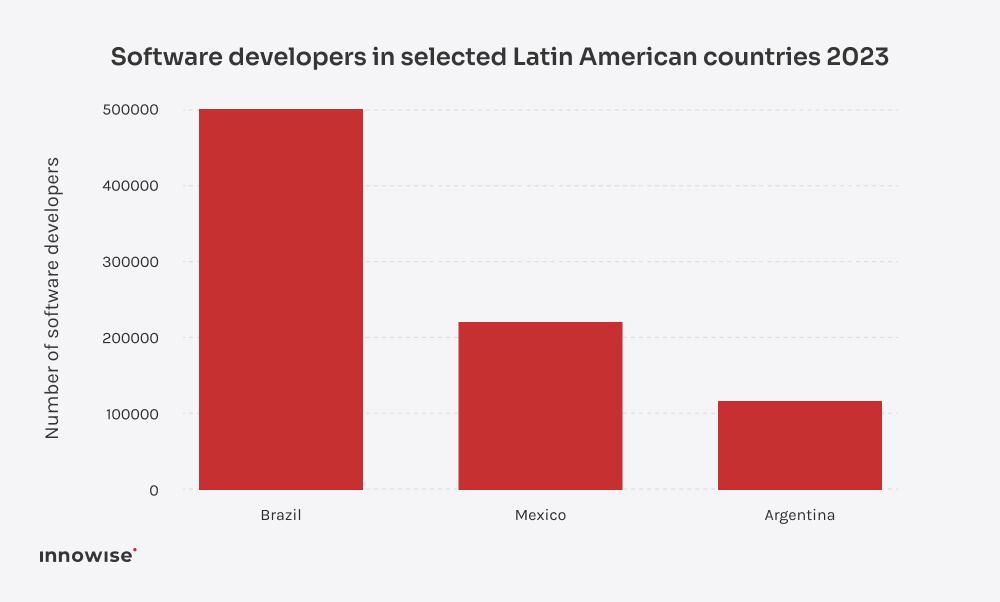
There were approximately 500,000 software developers in Brazil. Mexico had around 220,000 software developers, while Argentina totaled approximately 115,000.

Brazil is the largest tech market in Latin America, which matters for one simple reason: you can build a really reliable team (not just fill a couple of roles and hope nobody quits).

In smaller markets, senior engineers become scarce the moment a few large companies hire aggressively. Rates spike, teams churn, and you end up spending months rehiring the same positions. Brazil has sufficient volume and number of mature companies that you can scale from a few engineers to a full delivery unit (developers, QA, DevOps, tech leads) without your hiring pipeline collapsing.

What this means for you: you can plan growth like a real product company. Add people when the roadmap expands. Keep stability when the roadmap tightens.

Find vetted developers fast without hiring mistakes

2) Cultural proximity is what keeps delivery moving

A lot of nearshore conversations focus on time zones and rates. Those matter, but cultural proximity is what decides if your team becomes truly integrated or stays “external.”

In Brazil, many developers are used to working in cross-functional product setups. They ask questions. They want context. They’re comfortable speaking up when something looks risky. That behavior sounds minor, but it saves you from the worst type of delay: building the wrong thing fast.

Here’s the quick test I use: If a developer only responds with “yes” during discovery, you’re buying execution. If they respond with “yes, but here’s what I’d change,” you’re buying thinking.

Brazil has more of the second type than most people expect.

3) Overlap with US working hours makes teamwork feel normal (and lowers management overhead)

Brazil is one of the few places where the overlap with US working hours is small enough that you don’t have to restructure how you work. That’s a massively consequential benefit. You can keep your usual rhythm (daily standups, sprint planning, product demos, stakeholder calls) without turning everything into long async threads.

This is where the overlap with US working hours helps:

  • Make decisions the same day.
  • Unblock work in minutes, not tomorrow.
  • Stop losing half the sprint to clarification delays.

If you’ve ever tried to run product development with a 7–10 hour gap, then you’ll know what I mean. Nobody’s wrong per se. You just spend your life waiting.

4) Strong STEM universities feed the market with engineers who can handle complexity

Brazil’s education pipeline doesn’t solve every hiring challenge, but it does provide a steady stream of engineers with serious fundamentals, especially in the main hubs.

The country has several strong STEM universities (USP, Unicamp, ITA) that consistently produce graduates with a firm base in computer science, math, and engineering. You’ll also see a lot of developers who combine formal education with practical experience from Brazil’s huge fintech and ecommerce sectors.

Why this matters when you hire: you get more candidates who can reason through architecture and performance tradeoffs, going beyond plain implementing code from a ticket.

You’ll still need vetting. You’ll still meet people who look great on paper and struggle in real-life delivery. But Brazil gives you a better odds ratio than many nearshore markets.

5) The product-owner mindset (and the art of gambiarra) is a real delivery advantage

In many outsourcing hubs, the culture rewards strict compliance. If you ask for a blue button, you’ll get a blue button, even if it makes no sense for the user.

Brazil often works differently. Engineers tend to push back when something feels wrong. That’s where the cultural idea of gambiarra matters: finding a creative, practical solution when conditions aren’t perfect. In software, it shows up as “creative engineering.” A strong Brazilian developer will always question the logic if it hurts UX, security, or performance.

That ownership saves you money later. It also saves you time, because you catch problems during build time instead of during release week.

If you’re hiring, here’s the real takeaway: ask your candidates, “When was the last time you challenged a requirement, and what happened next?” That question filters out passive implementers fast.

Scale your engineering team with proven nearshore talent

Step-by-step guide to hiring Brazilian developers

Hiring Brazilian developers is a smart move, but it requires a clear strategy. From defining project needs to sourcing talent, this guide will walk you through the process of building an effective nearshore team. First, let’s look at where to find the right developers to match your goals.

Where to look (and when Eastern Europe is the better call)

If you want to hire in Brazil fast without sacrificing quality, your sourcing strategy matters as much as the interview process. The best Brazilian developers aren’t sitting on one perfect platform waiting to be found. They’re spread across hubs, referral networks, and teams already working with global clients.

At the same time, you don’t want to force Brazil into every scenario. For certain types of work, such as complex system architecture, security-focused software, or data-intensive applications, Eastern Europe (especially Poland) is still one of the strongest choices on the market.

Option 1: Brazilian tech hubs (best when you want a mature product experience)

If you’re hiring for nearshore software development in Brazil and you want people who’ve already worked in structured product teams, start with the strongest hubs. You’ll see better English coverage, more experience with global delivery, and more candidates who can own features end-to-end.

São Paulo remains the biggest magnet for senior engineers and fintech experience. Florianópolis and Curitiba often show strong full-stack and SaaS talent. Belo Horizonte and Recife are worth watching for strong engineering communities and competitive availability.

So, focus on tech hubs if you need developers who can integrate into Western team workflows without a long adjustment period.

Option 2: local hiring platforms and developer communities (best for direct hires and long-term growth)

If you want to build your own hiring engine in Brazil, you’ll end up using local platforms, communities, and referrals. It can work well, but it takes time and consistent screening.

This channel usually fits when:

  • You’re hiring multiple roles over time
  • You can invest in interview capacity internally
  • You want full control over compensation, retention, and career paths

The tradeoff is that you’ll have to filter more noise. Seniority inflation happens. A polished LinkedIn profile doesn’t always mean they “can lead delivery.”

Option 3: agencies and boutique studios (best when you need speed, but you must vet hard)

Brazil has a wide range of small and mid-sized development shops. Some are excellent product teams. Others are staffing vendors with a thin bench and inconsistent delivery standards.The quickest way to separate the two:
  • Ask to speak to the tech lead you’ll actually work with
  • Ask for examples of long-term, ongoing delivery with foreign clients
  • Ask how they handle replacement if someone leaves mid-project
  • Ask how they measure quality beyond “we do code reviews.”
If the answers sound vague, you’re not buying a team. You’re buying resumes.

Option 4: a nearshore hiring partner (best when you want predictability and accountability)

A strong partner is not a “CV shop.” A strong partner gives you three things:
  • A vetted pool you can access fast
  • A proven screening method that checks real seniority
  • Accountability for team performance, not just staffing
This is often the most time-efficient option when you need to scale quickly and still protect delivery quality.It also lowers management overhead. Instead of spending weeks filtering profiles, you focus on onboarding, product context, and shipping.

Side note: where Eastern Europe fits into this (and why Poland often wins for complex builds)

Even though this guide focuses on Brazil, it would be dishonest to pretend Brazil is the only good answer. Eastern Europe is still one of the strongest delivery regions in the world for engineering-heavy work. Poland, in particular, has deep senior talent, strong technical communication, and a track record in complex software projects.

Here’s the simplest way I explain it to leadership teams:

Brazil tends to be the best fit when:
  • You want real-time collaboration with US teams
  • You need product ownership and fast scaling in the Americas
  • You’re building customer-facing products with rapid iteration
Eastern Europe tends to be the best fit when:
  • You’re building complex platforms, data-heavy systems, or security-sensitive software
  • You want strong architecture discipline and deep engineering leadership
  • You’re working in regulated industries that require careful documentation and process maturity

If you’re working with a delivery partner that can recruit across both regions, you don’t have to choose one forever. You choose what fits the work.

The vetting process

When hiring developers in Brazil, vetting is everything. The local talent pool is vast, but the challenge lies in identifying true experts who can deliver quality without constant oversight. The best developers aren’t always the ones with the flashiest resumes. 

Here’s the secret: strong vetting goes beyond technical skills. You need to assess product thinking, communication ability, and problem-solving in real-world scenarios. That means structuring interviews to test:

  • Technical strength (ability to solve complex problems, not just follow instructions)
  • Product ownership (can they make decisions that balance code quality, user experience, and deadlines?)
  • Cultural fit (do they integrate easily into your team’s communication and collaboration style?)

A quick reminder:

As a global company with expertise across regions, Innowise’s pre-vetted experts ensure you can quickly access the best talent without the hassle of vetting. While this guide focuses on Brazil, keep in mind that we’ve already done the hard work to bring you top-tier developers from around the world, so you can focus on scaling your team and delivering results.

If you’re hiring directly, here’s how to structure a solid vetting process to ensure you hire the right people, every time.

Legal & contracts

When hiring developers in Brazil (or anywhere nearshore), getting the legal side right is just as important as finding the right talent. You don’t want to be blindsided by hidden costs, misunderstandings, or delays because the contract wasn’t structured to protect both parties.

Here are the key legal and contract aspects you need to cover to ensure a smooth engagement:

1) Employment vs. contract work

First, decide whether you’re hiring full-time employees or working with contractors. This will impact everything from tax responsibilities to IP ownership and termination clauses.
  • Employees: If you’re hiring full-time developers in Brazil, you’ll need to follow local labor laws. Brazil’s labor regulations are complex, and it’s important to comply with all statutory requirements like benefits, paid time off, and social security contributions.
  • Contractors: If you’re working with contractors, the arrangement is generally more flexible, but you’ll still need to define payment terms, deliverables, timelines, and termination conditions clearly.

2) Intellectual property (IP) rights

Make sure the contract clearly states who owns the intellectual property created during the project. In Brazil, as in many countries, IP ownership can be ambiguous unless it’s explicitly outlined in the contract.Ensure you:
  • Clarify IP ownership: It should be stated upfront that the client owns all intellectual property created during the course of the project.
  • Handle pre-existing IP: If the developer brings pre-existing code or tools to the project, make sure this is clearly defined, whether they remain the property of the developer or become part of the project.

3) Payment terms and local tax compliance

Brazil has its own tax system, and you need to ensure your contract specifies payment terms clearly. Here are some things to consider:

  • Payment schedule: Define whether you’ll pay hourly, per project milestone, or monthly. This is especially important for long-term engagements.
  • Tax withholding: Brazil has tax withholding requirements, and as a client, you’ll likely be required to deduct taxes from payments made to Brazilian developers. This needs to be clarified in the contract to avoid penalties.

Tip: For contractors, it’s also important to consider currency fluctuations when making payments. Many developers in Brazil prefer to be paid in US dollars or another stable currency to avoid issues with exchange rate volatility.

4) Non-disclosure and confidentiality agreements (NDA)

If your project involves sensitive information, ensure you have non-disclosure agreements in place. This will protect your business and intellectual property throughout the project, ensuring the developer keeps your proprietary information confidential.In Brazil, NDAs are enforceable, but the contract should specify:
  • Scope of confidentiality: Define what is considered confidential information and how it should be handled.
  • Duration of confidentiality: The NDA should specify how long the confidentiality obligations last after the project ends.

5) Dispute resolution and termination clauses

Set clear guidelines for how disputes will be handled and how either party can terminate the contract. This should cover:
  • Dispute resolution: Whether disputes will be handled through mediation, arbitration, or litigation.
  • Termination conditions: Define under what circumstances either party can terminate the contract, including for non-performance or breach of contract.

Fill key roles quickly with top-tier developers

Cost analysis: what to expect in 2026

When planning for Brazil nearshore development rates in 2026, it’s essential to have a clear picture of what software developer salaries in Brazil are like across different experience levels, skill sets, and hiring models. While Brazilian software developers offer strong value for money compared to US talent, there are a few factors that impact the cost you’ll face.

Let’s break it down.

1) Salary ranges for Brazilian developers

Brazil offers a wide range of developer salaries, depending on skill level, location, and project type. As of 2026, salaries in Brazil’s largest tech hubs (São Paulo, Florianópolis, Curitiba) are competitive, but still considerably lower than in the US or Europe.

Here’s a general breakdown of software developer salaries in Brazil based on experience:

  • Junior developers (0-3 years experience):
    $15,000 – $25,000 per year
    These developers typically have good foundational skills, but they may require guidance and mentorship.
  • Mid-level developers (3-5 years experience):
    $25,000 – $45,000 per year
    Mid-level developers have stronger problem-solving skills and some experience with product development or agile workflows.
  • Senior developers (5+ years experience):
    $45,000 – $75,000 per year
    Senior developers in Brazil can handle end-to-end development, often with expertise in specialized technologies such as AI, cloud computing, or mobile app development. These developers are ready to take ownership of significant components of your project.

Tip: While Brazilian salaries are lower than in many Western markets, Brazilian software developers can often deliver better results because they have a strong problem-solving mindset and are used to handling complex projects.

2) Full-time vs. project-based pricing

When you’re budgeting for nearshore software development in Brazil, the pricing model you choose can significantly affect the overall cost of the engagement. In Brazil, there are two main pricing structures to consider:

  • Full-time hires: This is a good option when you need long-term commitment and continuity. Expect to pay a full-time developer a salary in the ranges listed above, depending on their skill level. With full-time hires, you’ll also need to factor in employment taxes, benefits, and overhead costs (e.g., office space, equipment, etc.). 
  • Project-based pricing: If you’re hiring Brazilian developers for specific tasks or short-term engagements, project-based pricing is typically used. For small to medium projects, expect developers to charge $40 to $100 per hour, depending on their expertise and the project’s complexity. The benefit of project-based pricing is that you pay for specific deliverables instead of ongoing salaries, which offers more flexibility in the budget.
  • Contractor rates: Contractors usually have hourly or daily rates. In Brazil, contractor rates are usually about 10–20% higher than full-time hires because they are not entitled to benefits or long-term security. This model works best for short-term engagements, where you need flexibility without hiring a full-time team member.

3) Cost comparison: Brazil vs. other nearshore locations

It’s worth comparing Brazil nearshore development rates to those of other nearshore markets, especially when you’re trying to balance quality and budget.
  • Mexico: Mexico’s developer salaries are comparable to Brazil’s, but the market is smaller and more competitive. You can expect to pay $25,000 to $50,000 annually for a mid-level developer. Mexico offers great alignment with US time zones, but doesn’t have the same deep technical expertise in some areas.
  • Eastern Europe: Countries like Poland, Romania, and Ukraine are strong players in software development, but they often come at a higher price point compared to Brazil. Eastern Europe developer salaries can range from $40,000 to $80,000 per year, but you’re also paying for developers with specialized skills in complex systems and enterprise-level projects. 
  • Argentina: Argentina has a solid tech ecosystem, but it tends to have a smaller pool of senior talent, which can increase hiring competition. Developers typically earn $20,000 to $45,000 annually. While Argentina may offer a cost-effective solution, Brazil’s larger talent pool and better scalability may give it an edge in certain types of projects.

4) Hidden costs in nearshore development

Though software developer salaries in Brazil are generally lower than in other markets, don’t forget to consider hidden costs that might add up during the hiring process:

  • Recruitment fees: If you’re hiring directly, you’ll need to account for recruitment costs or partner fees (if you’re using an agency or nearshore partner).
  • Onboarding and training: You’ll spend time getting Brazilian developers up to speed on your product, processes, and codebase. Training is a must, especially if they’re new to your tech stack.
  • Tooling and infrastructure: If you don’t already have collaboration tools (e.g., Slack, Jira, GitHub), you’ll need to budget for licenses and integrations.
  • Management time: Whether you’re managing your Brazilian developers directly or through a partner, consider the time required to keep them aligned with the project.

5) How to control costs while maintaining quality

To make Brazilian nearshore development work within your budget, here are some tips:
  • Establish clear goals and timelines from the beginning. This reduces the chances of cost overruns and scope creep.
  • Start with smaller engagements to test the waters before committing to long-term hires.
  • Work with an experienced partner (like Innowise) who has already vetted developers and can help you scale efficiently without the usual hiring and training delays.

Best practices for managing your Brazilian team

Managing a Brazilian nearshore team requires clear communication, strong collaboration, and well-defined processes. Here are some quick tips to keep your team productive and engaged:
  1. Set clear expectations: Define project goals, deadlines, and deliverables upfront. Brazilian developers are proactive, but clarity helps avoid miscommunication.
  2. Establish real-time communication: Schedule daily or weekly standups that overlap US working hours. Use tools like Slack and Zoom to maintain consistent communication. Encourage ownership: Give developers the freedom to suggest improvements and challenge requirements. This fosters creativity and reduces rework.
  3. Utilize project management tools: Tools like Jira are essential for tracking progress, managing tasks, and keeping everyone aligned on milestones.
  4. Foster a collaborative environment: Brazilian developers thrive in collaborative settings. Ensure they’re involved in discussions, brainstorming sessions, and decision-making.
  5. Be mindful of cultural differences: Respect Brazilian holidays, work hours, and communication preferences. Building a strong, respectful relationship will improve team morale and productivity.
  6. Provide regular feedback: Conduct code reviews and provide constructive feedback regularly to ensure high standards and continuous improvement.
  7. Plan for occasional travel: While not always necessary, occasional visits can strengthen relationships and align expectations for long-term success.
By following these best practices, you’ll ensure that your Brazilian nearshore team operates as an integrated, high-performing extension of your core team.

FAQ

Absolutely! It’s an awesome choice, especially for companies in the US. Think of it this way: they’ve got great English skills, their time zone works perfectly with North America, and there’s a huge, talented pool of devs in areas like FinTech, AI, and more. Plus, Brazilian developers really own their work, are super creative, and love to collaborate, which makes them a perfect fit for any agile team.

One real risk is remote management. If you don’t set communication rules and success criteria early, things can get messy fast. Another risk sits on the legal side — Brazilian labor rules and tax requirements can feel complex if you don’t have solid local support. And because the market is competitive, great developers have options, so you’ll want a strong vetting process and fair terms to reduce turnover.

Most companies pay Brazilian developers through international wire transfers, and many developers like getting paid in US dollars to avoid currency swings. Just keep an eye on tax and compliance details. Depending on how you hire (contractor vs. employee), you may have withholding requirements and different legal obligations under Brazilian labor law.

The rate you agree on isn’t the full story. Costs can show up in recruiting and replacement hiring, plus the time your team spends managing day-to-day work. Collaboration tools also add up: Jira, Slack, GitHub, and anything you use for security and access control. Onboarding takes time too, since you’re aligning processes, standards, and expectations. And if you plan occasional in-person visits, travel expenses can become part of the budget.

Yes, you can hire developers in Brazil as employees, but plan for more complexity than a contractor setup. Full-time hiring comes with local rules around benefits, payroll taxes, and social contributions. That’s why many companies use an agency or a local partner to manage employment compliance and payroll so nothing slips through the cracks.

Usually, yes. Brazil has strong international flight connections, especially to major hubs like São Paulo, Rio de Janeiro, and Florianópolis. For US and European teams, travel is often manageable, and those in-person visits can pay off when you need tighter alignment, team bonding, or faster decision-making.

Dmitry leads the tech strategy behind custom solutions that actually work for clients – now and as they grow. He bridges big-picture vision with hands-on execution, making sure every build is smart, scalable, and aligned with the business.

Table of contents

    Contact us

    Book a call or fill out the form below and we’ll get back to you once we’ve processed your request.

    Send us a voice message
    Attach documents
    Upload file

    You can attach 1 file up to 2MB. Valid file formats: pdf, jpg, jpeg, png.

    By clicking Send, you consent to Innowise processing your personal data per our Privacy Policy to provide you with relevant information. By submitting your phone number, you agree that we may contact you via voice calls, SMS, and messaging apps. Calling, message, and data rates may apply.

    You can also send us your request
    to contact@innowise.com
    What happens next?
    1

    Once we’ve received and processed your request, we’ll get back to you to detail your project needs and sign an NDA to ensure confidentiality.

    2

    After examining your wants, needs, and expectations, our team will devise a project proposal with the scope of work, team size, time, and cost estimates.

    3

    We’ll arrange a meeting with you to discuss the offer and nail down the details.

    4

    Finally, we’ll sign a contract and start working on your project right away.

    arrow