





Your message has been sent.
We’ll process your request and contact you back as soon as possible.
The form has been successfully submitted.
Please find further information in your mailbox.


Innowise contributed to blockchain ecosystem development to help create solutions that make it easy for users to dive into DeFi with a full range of integrated tools.
total wallets created
total testnet transactions

Haust Labs is a team of blockchain innovators that builds Haust Network, a next-gen Layer-2 solution aimed at harnessing the true power of permissionless blockchains. It’s designed for developers and DeFi innovators who want speed and flexibility without the high costs.
Built for performance and security, Haust keeps fees low while supporting rich DeFi functionality. It also comes with a purpose-built SDK that makes it easy to integrate blockchain features into Telegram and other messaging platforms.
Initially, we asked Innowise to develop only the lending protocol on top of our TestNet network. However, we soon realized that the lending protocol was the only component that truly worked in our TestNet. That’s when we decided to fully trust Innowise with building the decentralized exchange, our version of abstract accounts, the mobile app, the MultiSig wallet, and everything else required for launching our blockchain.
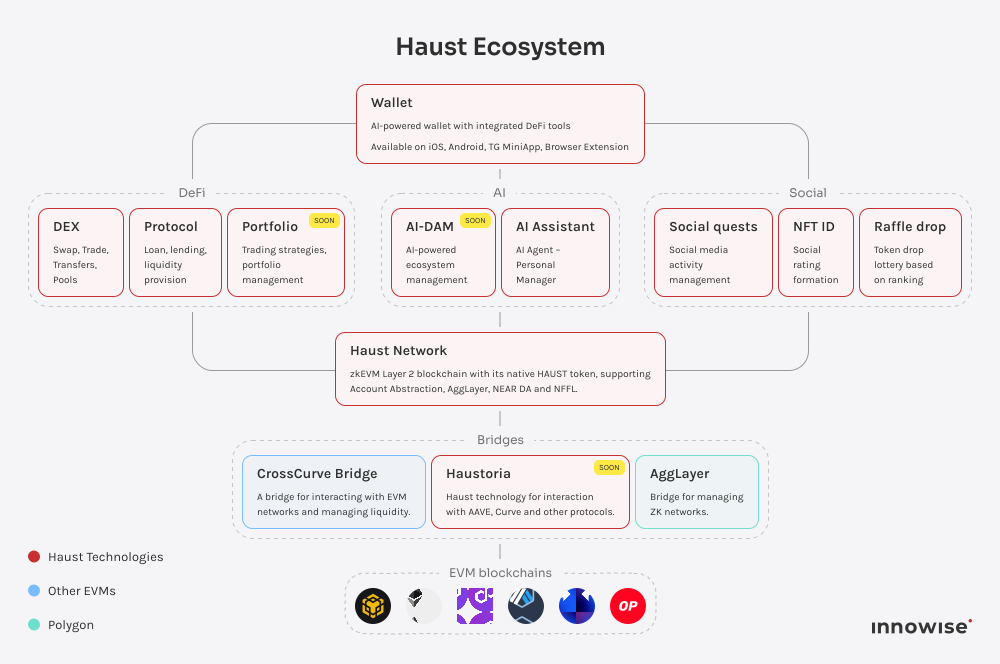
While decentralized finance offers unparalleled freedom in terms of peer-to-peer transactions, the tech brings about a whole new set of challenges that the Haust Network aims to solve.
Haust Network takes on the biggest challenges in DeFi by creating a complete ecosystem that removes barriers. Cross-chain compatibility makes moving assets between blockchains seamless, improves liquidity, and opens up DeFi to more users. Its smart liquidity solutions help optimize capital, cut slippage, and increase yields.
Here’s a closer look at what powers the network behind the scenes.
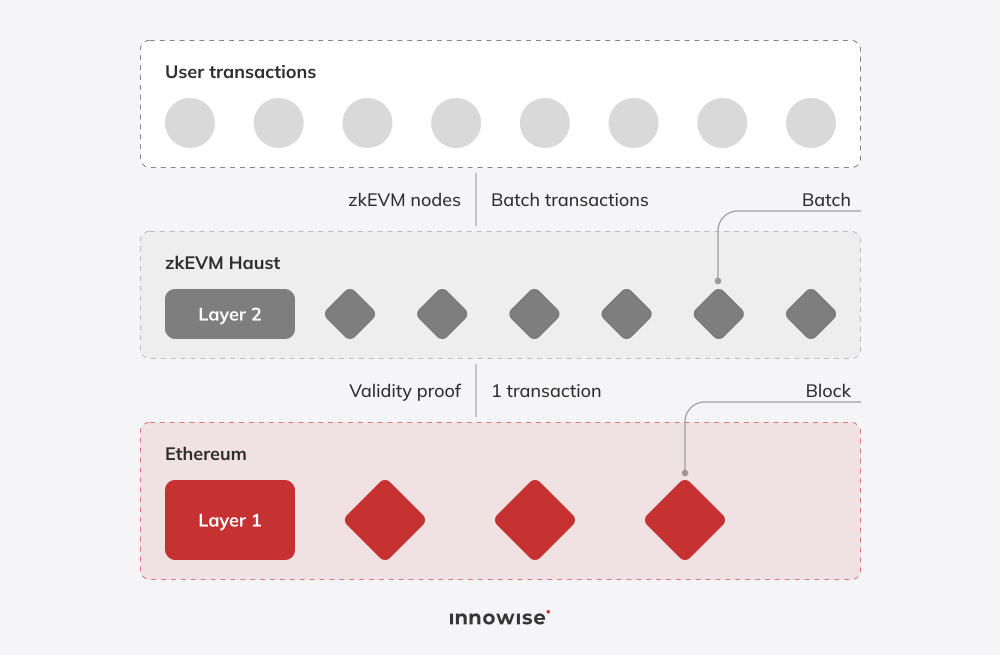
The Haust Network strategically integrates zk-rollups and Polygon zkEVM to address two major challenges in DeFi: high transaction costs and scalability issues.
As a Layer-2 scaling solution, zk-rollups bundle multiple transactions into one, processing them off-chain and submitting only a concise Zero-Knowledge Proof (ZKP) to the Layer-1 blockchain. This process verifies the validity of all transactions without revealing their details, significantly reduces on-chain data usage, speeds up transaction processing, and cuts fees.
Polygon zkEVM is an Ethereum-compatible Layer-2 solution that uses zk-rollups to deliver fast and cost-efficient transactions. Acting as a “Zero-Knowledge Ethereum Virtual Machine,” it enables developers to run Ethereum-compatible smart contracts using zero-knowledge proofs. This compatibility allows existing Ethereum applications to migrate to zkEVM with minimal adjustments to make integration with Haust Network seamless and efficient.
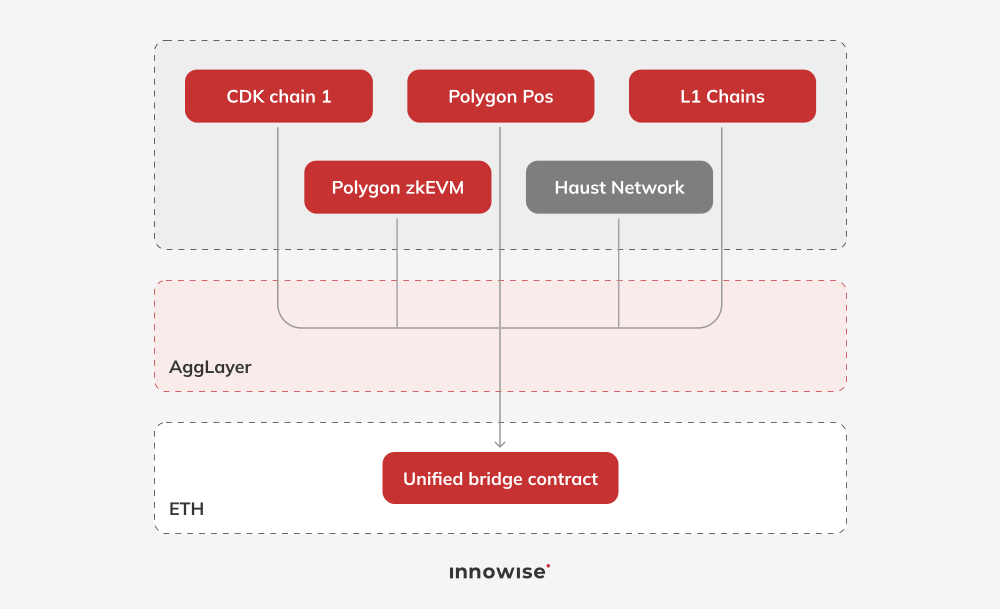
AggLayer is a powerful bridge that connects multiple blockchains, making it super easy to move assets across networks. Instead of juggling a bunch of different bridges, users get a single, straightforward way to access cross-chain liquidity.
Using ZK proofs, AggLayer keeps every transaction secure, so you don’t have to worry about safety. It solves the problem of fragmented liquidity and ensures smooth, reliable interactions between blockchains.
AggLayer also lets all connected chains share their TVL (Total Value Locked) to simplify liquidity management. Users can even pay gas fees with HAUST, the network’s native token, which adds extra convenience to the cross-chain operations.
Account abstraction lets users use smart contracts as their accounts. It is key to the Haust Network, transforming the Haust Wallet experience with features like Web2-style sign-in, keyless wallet management, social recovery, and smart gas fee handling.
As part of Haust Network’s modular architecture, the team developed a lightweight multi-signature wallet using its own abstract account system. At this stage of the project, there was no need to bring in a full external solution like Safe (formerly Gnosis Safe), which can be powerful but also heavy and complex. Instead, the team built a custom version that fits their current needs more efficiently.
The wallet handles multi-party authorization through smart contract logic, which means different roles can approve transactions in a secure and controlled way. Since it’s built directly on top of Haust’s abstract account layer, it works seamlessly with other features like gas fee abstraction, social recovery, and smart automation.
The result is a secure, efficient multi-sig solution that gives users shared control without the overhead of a third-party system. It’s a tailored approach that keeps everything aligned with Haust’s technical direction and ecosystem goals.
Haust Network includes two core protocols: Haust DEX, a decentralized exchange forked from Uniswap v3, and Haust Lend, a lending platform built as a fork of Aave v3. Both protocols were carefully adapted to integrate with Haust’s custom abstract account architecture, enabling advanced account logic and seamless user interactions.
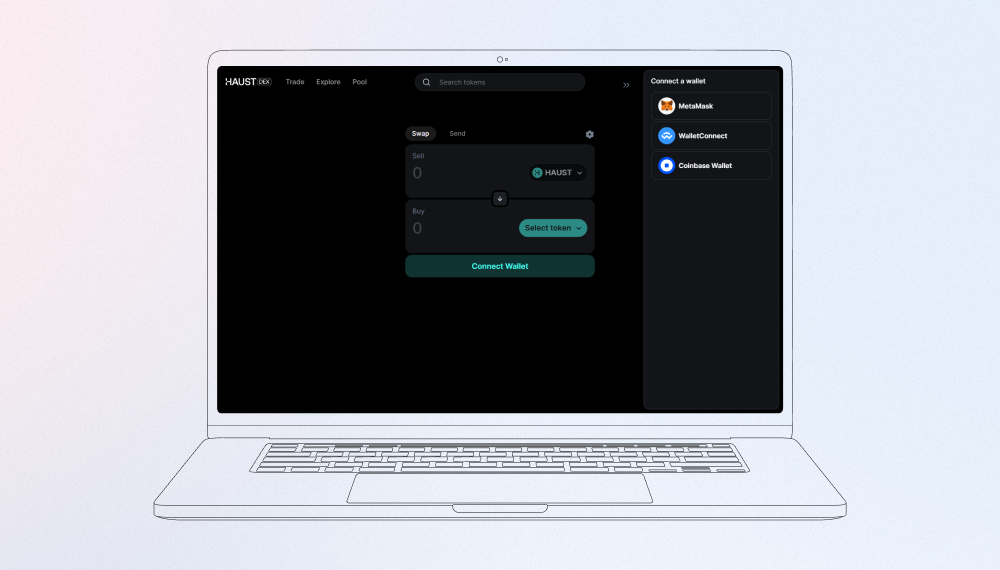
Haust DEX is a user-focused decentralized exchange that supports efficient token swaps and liquidity provision in a fully non-custodial environment. It inherits advanced features like concentrated liquidity and flexible fee tiers, while extending the protocol to function with Haust’s smart contract–based accounts. To improve transparency, the DEX includes a built-in explorer that provides real-time insights into Total Value Locked (TVL), token capitalization, and pool-level activity to help users evaluate liquidity conditions and make informed trading decisions.
To encourage participation, the team developed a custom liquidity incentives module, which rewards LPs with additional benefits beyond trading fees. This module is designed to increase pool depth and stimulate the attraction of liquidity to this blockchain.
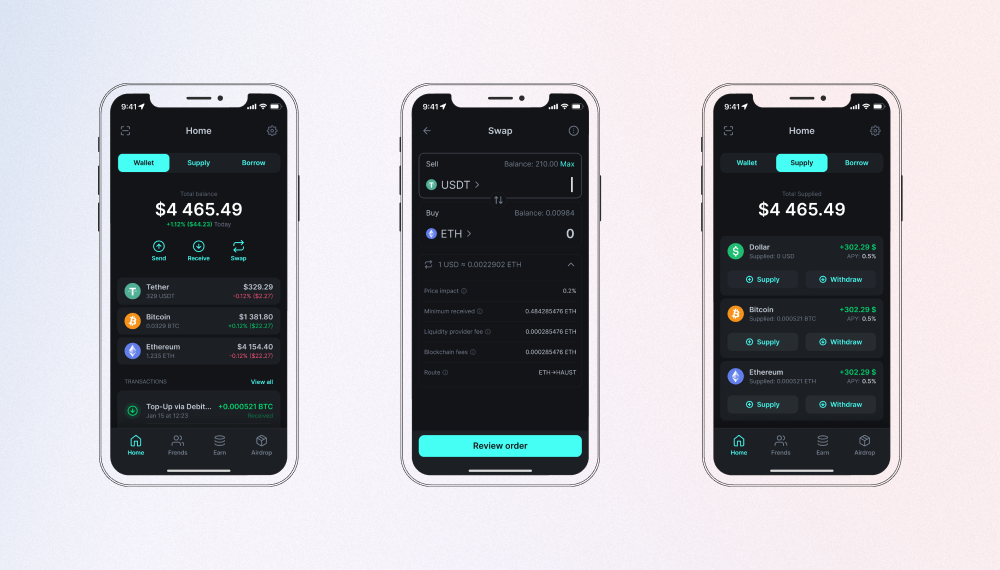
Haust Lend brings capital efficiency to the Haust ecosystem, allowing users to supply assets and earn interest, or to borrow against deposited collateral. As a fork of Aave v3, it retains the flexibility of overcollateralized borrowing while integrating with Haust’s abstract account system for better automation, access control, and gas abstraction.
Users can monitor lending pool health and liquidity in real time, with protocol-level metrics available directly through the UI. As with Haust DEX, all user interactions are non-custodial and fully compatible with Haust’s smart wallets and account abstraction features.
To provide long-term sustainability and decentralized decision-making, Haust Labs is building a DAO that combines proven tokenomics with secure, modular infrastructure. The governance model draws inspiration from Curve Finance, using vote-escrowed tokens (veHAUST) and quadratic voting to balance influence across the community. HAUST holders can lock their tokens for a defined period to receive veHAUST, with voting power increasing based on both the amount locked and the lock duration. This governance logic is implemented on Aragon DAO smart contracts, which provide a robust and upgradeable on-chain framework for proposal management, permissions, and treasury control.
veHAUST holders govern multiple aspects of the protocol’s development, including:
All governance decisions are enforced through smart contracts to ensure trustless execution and full transparency.
To support protocol expansion and community contributions, the DAO also oversees:
Together, these systems make sure that governance is not only decentralized but also productive, with real economic incentives tied to active participation and contribution.
The Haust Wallet is a secure, EVM-compatible wallet designed for effortless asset management across multiple chains. It offers innovative features like social recovery, keyless wallet access, multi-chain gas payments, and even a Telegram mini app for added convenience.
By integrating a decentralized exchange (DEX) based on Uniswap v3, the wallet contains advanced trading tools and improved liquidity management directly within the platform.
The wallet provides a consolidated, real-time view of the user’s holdings across multiple networks, thanks to seamless integration with AggLayer. This eliminates the need to switch networks manually and ensures better visibility into overall asset positions.
The wallet also supports dynamic NFTs issued by the Haust Labs team. These NFTs are natively integrated into the interface and may play roles in user identity, ecosystem access, or engagement mechanics.
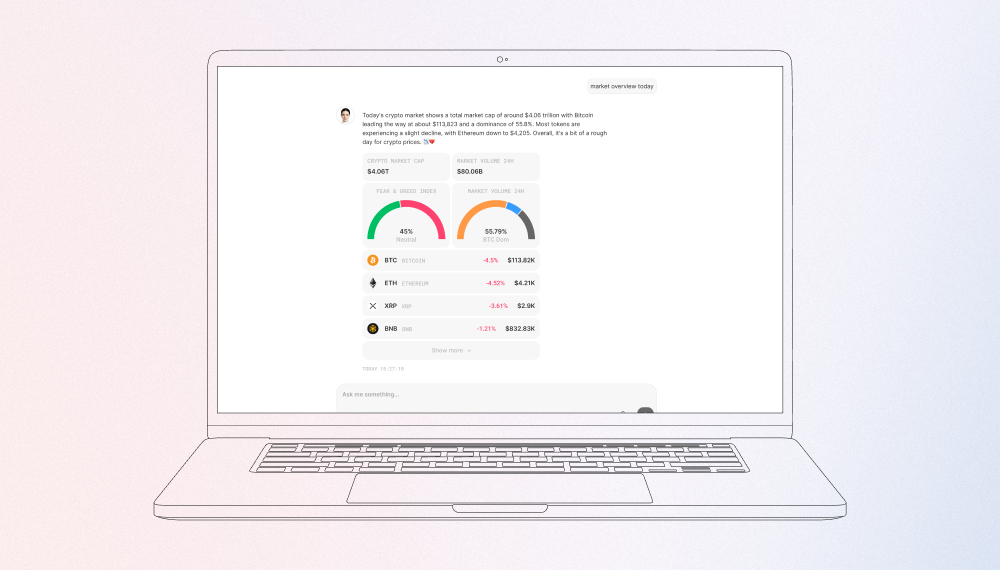
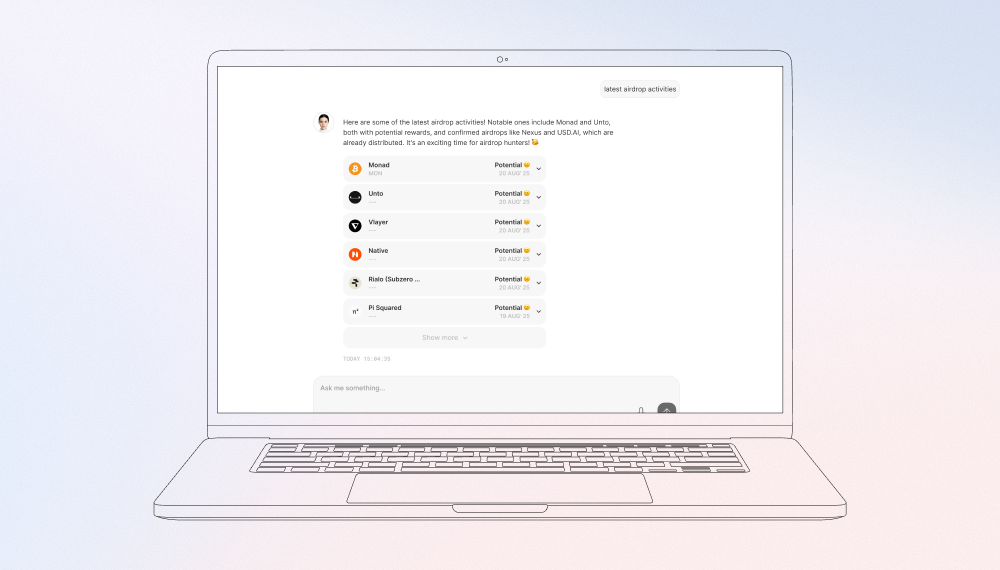
In addition, the wallet comes with native integration of HAIA, Haust’s AI-powered financial assistant. Users can interact with HAIA directly inside the wallet to receive personalized recommendations, automate DeFi strategies, or navigate the ecosystem more efficiently.
To deliver a seamless, data-rich DeFi experience, Haust Network integrated multiple third-party services into its infrastructure, most notably CryptoRank and Superform. These integrations work together to power HAIA by providing both reliable market data and actionable investment opportunities.
Prior to the integration, the Haust team faced several challenges:
The CryptoRank API resolved these issues with structured, high-quality endpoints:
To complement this data layer, Haust integrated Superform, a cross-chain yield marketplace that enables users to explore and invest in high-performing DeFi strategies across different networks. Instead of manually searching for yield opportunities, users can now:
This integration turns Haust into a decision-to-execution platform, where users don’t just view data, but can act on it instantly. Combined, CryptoRank and Superform give HAIA the intelligence and the tools to guide users through market insights and profitable DeFi strategies.
Haust Network’s integration with the CrossCurve MetaLayer marks a significant upgrade to its modular DeFi stack. By embedding CrossCurve’s multichain liquidity infrastructure directly into Haust’s smart account and AI systems, the integration enhances yield access, execution efficiency, and UX abstraction. Below are the core technical components of this collaboration:
Haust’s modular wallet architecture now includes native support for CrossCurve’s liquidity routing and aggregation layer. This enables asset swaps, rebalancing, and multichain yield strategies to be executed directly from the wallet UI without manual bridging, signature prompts, or network switching. All interactions are handled within the smart account layer via modular intent-based execution.
Through intent-driven account logic and backend liquidity orchestration, the user is abstracted from typical DeFi complexity. Network switching, wallet management, and DApp navigation are eliminated. Instead, users interact through a single interface where CrossCurve handles routing and liquidity, and Haust handles authorization and execution.
This integration moves DeFi closer to consumer-grade usability. The AI layer (HAIA), the wallet logic (MSAs), and the liquidity infrastructure (Superform) operate in tandem to convert user intent into on-chain execution. This is particularly impactful for mobile-first users, Telegram-based agents, and newcomers unfamiliar with manual DeFi workflows.

As a result of our ongoing collaboration, the team behind Haust Network introduced a robust ecosystem for next-generation DeFi. Development is ongoing, with key achievements to date including:
Integration of essential third-party infrastructure:
Your message has been sent.
We’ll process your request and contact you back as soon as possible.

By signing up you agree to our Privacy Policy, including the use of cookies and transfer of your personal information.