The pros and cons of offshore outsourcing in 2026

Hero section image

Key takeaways

  • Offshoring in 2026 is about strategic savings. No longer chasing the cheapest rates alone. Offshoring proves considerable TCO savings in infrastructure, recruiting, and long-term support.
  • Hiring speed is a real advantage. In mature offshore destinations, strong HR processes make it possible to find niche experts in AI, DevOps, or cybersecurity within just 2–4 weeks.
  • Strengths differ from region to region. Eastern Europe offers quality-to-cost balance, industry expertise, and strong compliance. India and Southeast Asia win on cost and scale, though quality can vary.
  • Cross-border IT services work in partnership, not blind delegation. Treat your vendor as an extension of your team, not a black box, and you’ll unlock the speed and scale you’re paying for.

Offshore outsourcing is hardly a new concept, but in 2026, it’s having a resurgence. With engineering talent in short supply, salaries climbing, and product launches faster than ever, companies are returning to offshore as a practical solution. However, this time it’s less about “cutting costs for the sake of it” and more about stable scaling with access to global expertise.

Because qualified IT talent is scarce — and salaries in the U.S. have climbed around 125K on average — many companies struggle to hire locally, especially in high-demand fields like AI, cloud, and cybersecurity. Going offshore allows companies to close talent gaps (even for niche positions) by pulling in teams from suitable regions.

Over the past 20 years, offshore outsourcing has transformed from a “cheap” IT workforce into mature, proficient delivery centers, embracing the follow-the-sun model, flexible launch, and sustainable TCO savings. In this piece, we’ll break down the offshore outsourcing pros and cons, how the model is set to work in 2026, what risks to keep in mind, and how to weigh offshore against nearshore.

What is offshore outsourcing?

Offshore outsourcing is the transfer of a process or call for a service to an external vendor located in a distant region — most often Eastern Europe or Asia. Traditional offshoring comes with a significant time zone gap, geographic distance, and typically lower service costs.

It differs from nearshoring, where you work with teams in closer time zones, like Latin America for the U.S. In general, companies opt for nearshoring when seeking instant sync and lower cultural barriers, while offshoring provides access to niche expertise, larger talent pools, and better quality-to-cost ratio.

Offshoring is just a type of outsourcing, and it allows for different ways to engage. Mature offshore partners can handle all engagement models equally well — from staff augmentation, where you hire missing talent to complete your in-house team, to dedicated software development teams, where you bring a managed group of experts, and full outsourcing, where the entire project is delegated to a vendor. The latter is more complex as you give up direct control, but it also has the highest potential leverage if managed well.

Advantages of offshore outsourcing

A tool against rising costs and talent shortages

In 2025, offshore outsourcing has reentered the spotlight not because it’s “cheap,” but rather everything else has become too expensive, too slow, or too scarce. Developer salaries in the U.S. hover steadily around $125K a year, while many critical roles remain unfilled for months on end. The talent gap is most acute in AI, cloud engineering, and cybersecurity, where demand far outstrips supply. For instance, with a cybersecurity shortfall of over 500,000 specialists in North America, you’ll be forced into fierce competition for local specialists, with no guarantee of coming out on top.

Offshoring comes as a scalable pressure valve, with a vast talent pool and strong global expertise. It helps close critical skill gaps quickly, balance overloaded teams, and maintain momentum in build-measure-learn loop.

Significant TCO savings

With rates at $20–40 in Asia and $30–65 in Eastern Europe, companies save far more than just on salaries. They also cut costs tied to infrastructure, recruiting, and back-office overhead. But there’s something even more important.

When you look beyond the “hourly rate” and consider the total cost of ownership, offshoring can slash expenses two to threefold. By outsourcing to Poland or other high-quality destinations, you gain stable and maintainable code in the output, which lowers long-term support costs. The difference becomes especially visible in large-scale projects with dense teams, where every efficiency compounds over time.

Scalability of IT teams

India alone offers access to over 6 million IT professionals. Central and Eastern Europe adds another 2 million, and Southeast Asia roughly a million more. That kind of reach means you can assemble a team with the exact tech stack you need, without months of back-and-forth with HR, endless rejections, or settling for second-best in a market where everyone’s already been snatched up.

Offshoring processes are purpose-built for speed. Established vendors already have ready-made operational frameworks, flexible contracts, and well-honed onboarding workflows that eliminate setup delays. With access to pre-vetted talent pipelines, they can assemble and launch a team within 2–4 weeks — and then scale it in line with business demands. Moreover, cross–time-zone collaboration contributes to continuous project progress around the clock.

24/7 mode and the follow-the-sun effect

Viewed strategically, time differences can be seen as an advantage rather than a barrier. While the U.S. is asleep, engineers in India and Southeast Asia are deep into their workday, and European teams bridge the overlap, creating a true follow-the-sun workflow. With a strong and proven coordination framework in place, this model cuts downtime between iterations, helps resolve critical issues asap, and pushes products 25—30% faster.

Access to niche expertise

Offshoring’s biggest differentiator is its regional expertise tied to the various regions. For instance, AI, blockchain, fintech, and healthtech are Poland’s strong suits. With over 40 technology parks and accelerators, the country enables building sophisticated financial platforms, AI-driven analytics, and blockchain-based solutions at scale. Embedded and automotive engineering thrive in the Czech Republic. India remains competitive in full-stack software development, and Southeast Asia has carved out a niche in manufacturing IT and ERP systems.

Many offshore outsourcing providers now run dedicated R&D centers focused on verticals. Instead of simply hiring extra developers, you’re engaging a team that’s already solved similar problems before. Such teams tackle your challenges faster, use proven architectures and pre-tested modules, and offer reliability that local ad hoc hiring often can’t provide.

The flexibility to scale up and down

In-house HR processes invariably can’t match offshore outsourcing advantages in terms of speed and freedom. Need a fast kickoff, an extra QA, a DevOps engineer, or short-term software support? Offshoring lets you add or remove roles without long-term commitments or internal strife. For major outsourcing providers (with 2,000+ onboard experts), it’s precisely this kind of agility that helps startups get off the ground quickly, helps manage sudden product pivots, lends support to teams in the post-MVP stage, and absorbs unexpected spikes in demand.

Need niche talent?

Get a curated batch of CVs in 3 days — the right experts, no endless briefs with Innowise.

Risks of offshore outsourcing and how to mitigate them

Communication barriers

Working with teams across time zones, cultural contexts, and varying levels of English can understandably lead to misunderstandings, which in turn bring about delays and mistakes in execution. In some cultures, for fear of upsetting colleagues or rocking the boat, people will do everything in their power to avoid saying “no”. While polite, it only hurts you in the long run. This becomes especially critical in projects where requirements shift frequently or the product itself is still unstable, making fast issue resolution challenging.

How to mitigate: First, choose offshoring destinations with a similar business and development culture — in Europe, this is far more familiar than in Asia. For instance, Poland’s IT sector has matured under Google, Intel, Microsoft, and other tech giants that established their R&D centers there. Then, ensure at least 3 working hours overlap for daily stand-up, handoff, and urgent issue triage. Check the English proficiency index and screen for language skills during selection. Finally, agree on regular, transparent reporting.

Legal and regulatory risks

Handing over development and data to another jurisdiction always carries risk, from HIPAA and ITAR compliance to state-level patchwork laws, breaches, or weak IP protection. Vendors may not be deeply familiar with them or may need significant time to go deeper. Risks escalate for healthcare, fintech, e-commerce, and other regulations-heavy industries, where every contract is scrutinized under a microscope — another area where the advantages and disadvantages of offshore outsourcing become clear.

How to mitigate: Partner only with vendors that hold ISO 27001, SOC 2, and have a proven track record in your domain. If outsourcing to the EU, you’ll benefit from strong data protection since GDPR is mandatory there. Make sure your NDA and core terms are enforceable. The more mature the vendor, the lower your chances of getting caught in a legal trap.

Hidden costs

A low upfront rate can quickly spiral into mounting change requests, management overhead, SLA penalties, and ballooning budgets at the first sign of instability. More often than not, the root cause is a vague scope or underestimated task complexity, prevalent among immature vendors.

How to mitigate: First, know what you want from the very beginning. Define a clear product vision, set rock-solid priorities, spell out your SLAs, and outline deliverables to limit the room for maneuver. Develop an onboarding framework and better start with a small pilot team to validate skills and processes before scaling. Also, there’s no such thing as a true “fixed price” if you’re running Agile. Better to work on a time & materials model with transparent controls than pay twice for the illusion of predictability.

Loss of control

When a development process is handed over to an offshore vendor, some managers are tempted to delegate blindly and risk losing their grip on speed, priorities, and quality as a result. A company can become vendor-dependent, forced to rely on delayed decisions or risk IP and knowledge lock-in when most of the product knowledge resides offshore. Anxiety creeps in, micromanagement explodes (*sigh*), and conflicts of interest may surface as the project moves forward.

How to mitigate: Put strong operational governance in place with detailed SLAs, regular reporting, and shared repositories. Establish clear documentation practices so that every process and decision is traceable and easy to hand over. Assign an internal tech lead to oversee delivery quality and a dedicated PM on both sides to keep priorities in focus and avoid distractions. Weekly syncs, KPI tracking, and a transparent task board help you gain a snapshot anytime you need it.

Good offshoring means sharing control, not giving it up. If you’re ready for managed partnerships, you’ll get way more than just delegating routine tasks. Our processes at Innowise are built for strategic collaboration, supported by a 70K+ talent pipeline that provides superior scalability — all to help implement your vision in the best way possible for the long term.

Global Development Director

Offshore vs. nearshore outsourcing: what to choose

On the surface, they look alike: you’re tapping external expertise instead of hiring in-house. With offshore outsourcing, you hand over responsibility to a vendor often halfway across the world, while nearshoring involves working with a vendor closer in time zone. The trade-offs in cost, control, and talent access are also not the same. Here’s a snapshot.

NearshoringOffshoring
Key regionsLatAm — Mexico, Argentina, Columbia, Brazil, Costa Rica, etc.Eastern Europe — Poland, Baltics, Romania, Ukraine etc.; Asia — India, Philippines, Vietnam, etc.
Cost~$30–$55/hourRegion-based: ~$20 to $65/hour
Time zone overlapUp to 3 hours difference7 to 16 hours difference
Talent pool~1M~9M for key offshoring regions in total
ExpertiseCloud, mobile, full-stack, and fintech expertise prevailsFull spectrum: AI, ML, cybersecurity, game dev, blockchain, healthtech, fintech, and more
Best forAgile projects, frequent iterations, close collaboration, product pivotsRare expertise, cost-sensitive projects, large-scale builds, long-term outsourcing partnerships, 24/7 support models

If synchronous communication and fast response to change matter more, nearshoring gives you tighter control. Offshoring demands stronger vendor management, but it also lets you pick from the very best talent available.

Best offshore outsourcing locations in 2026

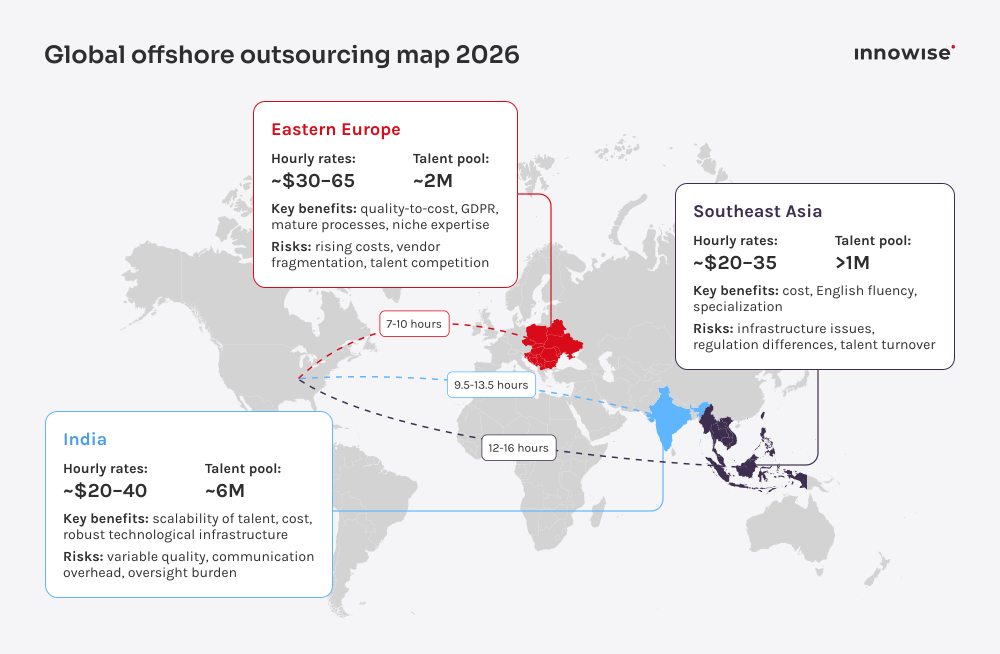
By 2026, the global map of offshore development will still revolve around three core regions — Eastern Europe, India, and Southeast Asia, each offering distinct advantages and characteristics. 

  • Eastern Europe comprises Poland, Romania, Ukraine, and the Baltics. Rates in this region are higher, but so is service quality. European IT vendors have cooperated with world-renowned clients for decades, which is reflected in mature processes and business culture. European engineers are well-educated in computer science, and many specialize in specific industries. This region is often chosen for long-term and highly innovative projects, as you can rely on well-vetted professionals eager to embrace unique challenges.
  • India still leads in scale, though quality is often said to vary. The region is usually opted for large projects with extensive routine tasks, ongoing support, and DevOps work. While you can capitalize on its scale and price, the trade-off comes with time-zone gaps and the need for closer management oversight.
  • Southeast Asia includes Vietnam, the Philippines, Malaysia, and Indonesia. The region offers competitive rates and a fast-growing IT talent base. Vietnam leads in core software engineering and AI, the Philippines in support and e-commerce, and Malaysia and Indonesia in manufacturing IT and ERP. However, expertise is uneven across the region, so stricter quality control may be required.
top locations for offshore outsourcing

Need an expert project team, fast?

Innowise assembles it in 1–2 weeks — matched to your stack, roles, and development pace.

How to choose the right offshore outsourcing partner

How to pick a partner who truly delivers results in your market? Here are some tips on how to avoid roll of the dice deals that can cost months, budget, and your team’s focus.

First, start with the basics. Your vendor should hold ISO 27001 or SOC 2 certifications, which are the bare minimum for managing sensitive data and processes. If your project touches GDPR or HIPAA, demand proven compliance and prior experience in those domains.

Second, a serious partner should be able to assemble a high-quality, fully relevant team of the right size in 2–4 weeks. In addition to headcount, look at the depth of their talent pool in your stack, especially if you’re working in AI, cloud, or niche technologies.

Third, security needs to be examined. If the company incorporates role-based access and centralized identity management, maintains activity logs, and has a clear offboarding checklist to manage NDAs, you can move on.

Fourth, request real case studies. Any company can create glossy landing pages, but you need concrete examples with teams, timelines, metrics, and outcomes. Proven vendors don’t hide the details, but share them and clarify anything allowed under the NDA.

Additionally, pay attention to interaction. A strong offshoring partner provides a dedicated PM, consistent meeting schedule, KPIs that reflect project velocity and quality, and a transparent path for resolving issues. If you’re only assigned an account manager for communication “just in case,” you’re dealing with a reseller not responsible for results.

To avoid mistakes, validate with this checklist:

  • ISO 27001/SOC 2 certifications and GDPR/HIPAA compliance.
  • Scalability for your stack within 2–4 weeks.
  • Documented processes for security and data access.
  • Engagement model with dedicated PM, regular syncs, clear KPIs.
  • Case studies with timelines, metrics, and results.

If a vendor fails on these five points, it doesn’t matter how cheap their pitch is. They are more likely to burn your money along the way rather than save it.

Conclusions: The true value of going global in 2026

  • By 2026, offshore outsourcing will no longer be just a cost-cutting tactic. Increasingly, companies turn to it strategically to keep work moving and results evolving when local resources hit a wall. 
  • Global resources can help fill gaps in niche roles and accelerate product launches, but you need to know where to find them. Central and Eastern European IT vendors offer the optimal quality-to-cost balance.
  • Offshoring is no longer about “throwing work over the wall.” It works best as a mature and well-structured partnership, where ownership is shared, and processes are designed to stay steady across time zones.
  • If you value governance over micromanagement, offshore outsourcing can be one of the most effective tools to keep your delivery engine running smoothly.

FAQs

Offshore enables faster development of innovative products at scale, which is often impossible to achieve at home. It helps fill talent gaps in AI, cloud, cybersecurity, and other challenging positions, increase development density, and get products out the door 25–30% faster.

Yes, but not just on hourly rates. The savings show up in the total cost of ownership, since offshoring helps reduce hiring time along with overhead for offices and benefits. Offshoring to high-quality destinations drives your products’ maintainability, which reflects in lower support costs. For long-term projects, that means 2–3x lower development spend without sacrificing quality.

If cost and scale are the priority, offshore will satisfy you. If you need real-time sync and cultural proximity, nearshore wins. Many U.S. firms treat LatAm as nearshore and Eastern Europe as offshore, and often mix both to strike a balance of price, expertise, and collaboration.

Everywhere, there’s a time-zone gap and potential miscommunication. In lower-cost regions like India, you may also face scope creep, weaker IP enforcement, and management overhead. These risks can be minimized with a proven partner that has mature processes and well-defined SLAs.

Eastern Europe offers the strongest quality-to-cost ratio, with deep engineering expertise and GDPR compliance. India and Southeast Asia are best when cost is the main driver. Ultimately, the choice depends on your priorities.

Dmitry leads the tech strategy behind custom solutions that actually work for clients — now and as they grow. He bridges big-picture vision with hands-on execution, making sure every build is smart, scalable, and aligned with the business.

Table of contents

    Contact us

    Book a call or fill out the form below and we’ll get back to you once we’ve processed your request.

    Send us a voice message
    Attach documents
    Upload file

    You can attach 1 file up to 2MB. Valid file formats: pdf, jpg, jpeg, png.

    By clicking Send, you consent to Innowise processing your personal data per our Privacy Policy to provide you with relevant information. By submitting your phone number, you agree that we may contact you via voice calls, SMS, and messaging apps. Calling, message, and data rates may apply.

    You can also send us your request
    to contact@innowise.com
    What happens next?
    1

    Once we’ve received and processed your request, we’ll get back to you to detail your project needs and sign an NDA to ensure confidentiality.

    2

    After examining your wants, needs, and expectations, our team will devise a project proposal with the scope of work, team size, time, and cost estimates.

    3

    We’ll arrange a meeting with you to discuss the offer and nail down the details.

    4

    Finally, we’ll sign a contract and start working on your project right away.

    arrow