Stock trading app development: a complete guide to secure, scalable, and compliant platforms

Updated: Feb 27, 2026 10 min read
Small cover Smart home app development teaser

So you want to build a trading app. Not a demo. Not a “we can place a fake order in a sandbox” prototype. A real platform that people trust with real money, that can survive market spikes, regulator questions, and the kind of user growth that breaks weaker systems.

If you’re nodding, you’re in the right place.

This guide walks through what stock trading app development really involves. Compliance basics, must-have features, tech stack options, and a practical way to pick a development partner without gambling on vibes.

Key takeaways

  • Stock trading app development starts with choosing your operating model: licensed brokerage, brokerage API partner, or bank channel extension.
  • Compliance affects architecture early: audit logs, retention, best execution duties, and operational resilience planning.
  • Users expect clean onboarding, funding, real-time data, orders, portfolios, and alerts. The “quiet features” keep you out of trouble.
  • Cost depends on scope and obligations. Published estimates exist, but your stack, vendors, and compliance footprint decide your real number.

First, a reality check. What kind of trading app are you building?

Let’s not pretend “a stock trading app” is a singular product. Before you choose a stack or sketch screens, answer this: Are you building a brokerage, or are you building an investing front end that sits on top of someone else’s brokerage rails?

That single decision changes everything: licensing, compliance scope, architecture, timelines, and cost.

Here are the common routes.

You are a licensed broker-dealer (or you plan to become one)

You control order routing, clearing relationships, customer agreements, and books and records. You also inherit a host of regulatory duties, including record retention rules. For example, FINRA points firms to SEC Exchange Act Rule 17a-4 requirements for electronic recordkeeping formats.

You are a fintech building on a brokerage API

You focus on onboarding, UX, education, funding, portfolios, and a clean trading flow. The brokerage partner handles parts of execution and custody, but you still have obligations around privacy, security, disclosures, and operational resilience. If you’re in the UK, the FCA has explicit expectations around outsourcing and operational resilience.

You are a bank adding trading to an existing digital channel

This is where a lot of “all-in-one” apps land. For example,  in the latest project I participated in, the goal was an all-in-one mobile app for novice investors, including account opening, funding, trading, FX, analytics, and document flows like W-8 and FATCA/CRS inside the app.

If you’re not sure which bucket you’re in, here’s a quick heuristic:

  • If you want control of execution policies, venues, and reporting. You’re in bucket 1.
  • If you want speed to market and can accept partner constraints. You’re in bucket 2.
  • If you already have KYC, accounts, and digital identity flows. You’re often in bucket 3.

Now let’s talk compliance, because it drives product design far earlier than most teams expect.

Compliance basics: what you must plan for up front

Nobody likes to hear this, but it’s true: compliance is not a checklist you paste in during QA. It shapes your data model, audit logs, user flows, and vendor choices. Below are the common areas that hit stock trading apps.

Books, records, and audit trails

If you’re in the US broker-dealer world, recordkeeping expectations are not “nice to have.” FINRA Rule 4511 requires firms to make and preserve books and records, and it points to SEC requirements like Rule 17a-4 for format and retention details.

What this means in product terms:

  • Every order lifecycle step needs an immutable event trail.
  • You need retention rules. Often longer than you’d choose on your own.
  • You need to be able to reproduce “what happened” fast, with timestamps, user identifiers, and system identifiers.

Best execution and order execution policies

If you’re operating under MiFID II in the EU, best execution is a core obligation. ESMA’s materials reference Article 27 requirements around describing processes and implementing order execution policies.

In product and platform terms, that pushes you toward:

  • Clear order routing logic and transparency in disclosures.
  • Monitoring and reporting hooks that don’t become a separate data mess later.

Operational resilience (especially in Europe and the UK)

If you operate in the EU, the Digital Operational Resilience Act (DORA) applies from 17 January 2025 and is aimed at strengthening ICT risk management for financial entities, including incident reporting expectations.

In the UK, FCA guidance on outsourcing and operational resilience is explicit about what it expects from firms using third parties.

Translation into engineering work:

  • You need incident response playbooks and monitoring baked in.
  • You need vendor management discipline, not just vendor contracts.
  • You need tested recovery scenarios, not “we’ll add backups.”

Data privacy and security controls

If you touch personal data for EU users, GDPR Article 32 is the part that gets referenced constantly. It requires “appropriate technical and organisational measures” based on risk, including things like encryption where appropriate.

And if you accept card payments for funding, PCI DSS becomes part of your world, because it defines security requirements for environments handling payment account data.

Mobile security expectations

Trading apps are a juicy target. So you need a benchmark that security teams can actually test against. OWASP MASVS is widely used as a mobile app security verification standard.

If you want a practical way to use MASVS, treat it as a set of acceptance criteria for mobile hardening, storage, auth, and network security testing.

Major regulations and security standards that shape stock trading apps

Regulation/ standard What it means for a trading app Where it applies
FINRA Rule 4511 (Books and Records) Requires FINRA members to make and preserve required records. It also sets baseline retention (at least 6 years when no other period is specified). This drives audit logs, retention policies, and evidence-ready reporting. United States (FINRA member broker-dealers)
SEC Exchange Act Rule 17a-4 (Recordkeeping format and retention) Sets requirements for how broker-dealers preserve certain electronic records, including rules around non-rewriteable/non-erasable storage or an audit-trail alternative. This affects storage design, immutability, and “recreate the original record” capabilities. United States (SEC-regulated broker-dealers)
MiFID II Article 27 (Best execution and order execution policy) Requires investment firms to take sufficient steps for the best possible execution and to maintain an order execution policy (including venues used and how they’re chosen). This impacts order routing logic, disclosures, and monitoring/reporting hooks. EU/EEA (investment firms and relevant entities under MiFID II)
DORA. Digital Operational Resilience Act EU-wide rules for ICT risk management and operational resilience for financial entities, including resilience testing and incident handling expectations. This pushes you toward strong monitoring, incident response processes, and vendor oversight. Applies from 17 Jan 2025. European Union (financial entities in scope. Plus oversight of certain critical ICT third-party providers)
FCA guidance on outsourcing and operational resilience Sets UK expectations for how firms manage third-party providers and operational resilience. For a trading app, this affects vendor due diligence, exit plans, monitoring, and continuity planning. United Kingdom (FCA-regulated firms)
GDPR Article 32 (Security of processing) Requires appropriate technical and organisational security measures based on risk, including measures like encryption where appropriate. This shapes security controls, access management, and incident readiness for personal data. EU/EEA (and applies to non-EU companies processing EU/EEA personal data in many cases)
PCI DSS (Payment card data security standard) Baseline technical and operational requirements to protect payment account data. If your app handles card payments for deposits, this affects architecture boundaries, tokenization, and vendor choices. Global (industry standard used by merchants, processors, service providers handling card data)
OWASP MASVS (Mobile Application Security Verification Standard) A security verification baseline for mobile apps. Useful as acceptance criteria for mobile hardening, secure storage, auth, and network security testing. Global (industry security standard, not a law)

Plan your build the right way before you commit budget

Features users expect, and the ones regulators will care about

Let’s do this in two layers: user-facing features, then “quiet features” that keep your compliance and ops teams sane.

User-facing: the minimum viable trading experience

Most serious apps land on a core set:

  • Onboarding and verification:  Fast, but not sloppy. The best onboarding flows keep registration and verification simple, and let users complete forms like W-8 and FATCA/CRS in-app, including electronic signing.
  • Brokerage account opening: Multiple account types if your business model needs it. This was a primary feature in that implementation.
  • Funding and withdrawals: Cards, wire transfers, e-wallets, and instant transfers are common patterns. Again, this was part of the bank app scope.
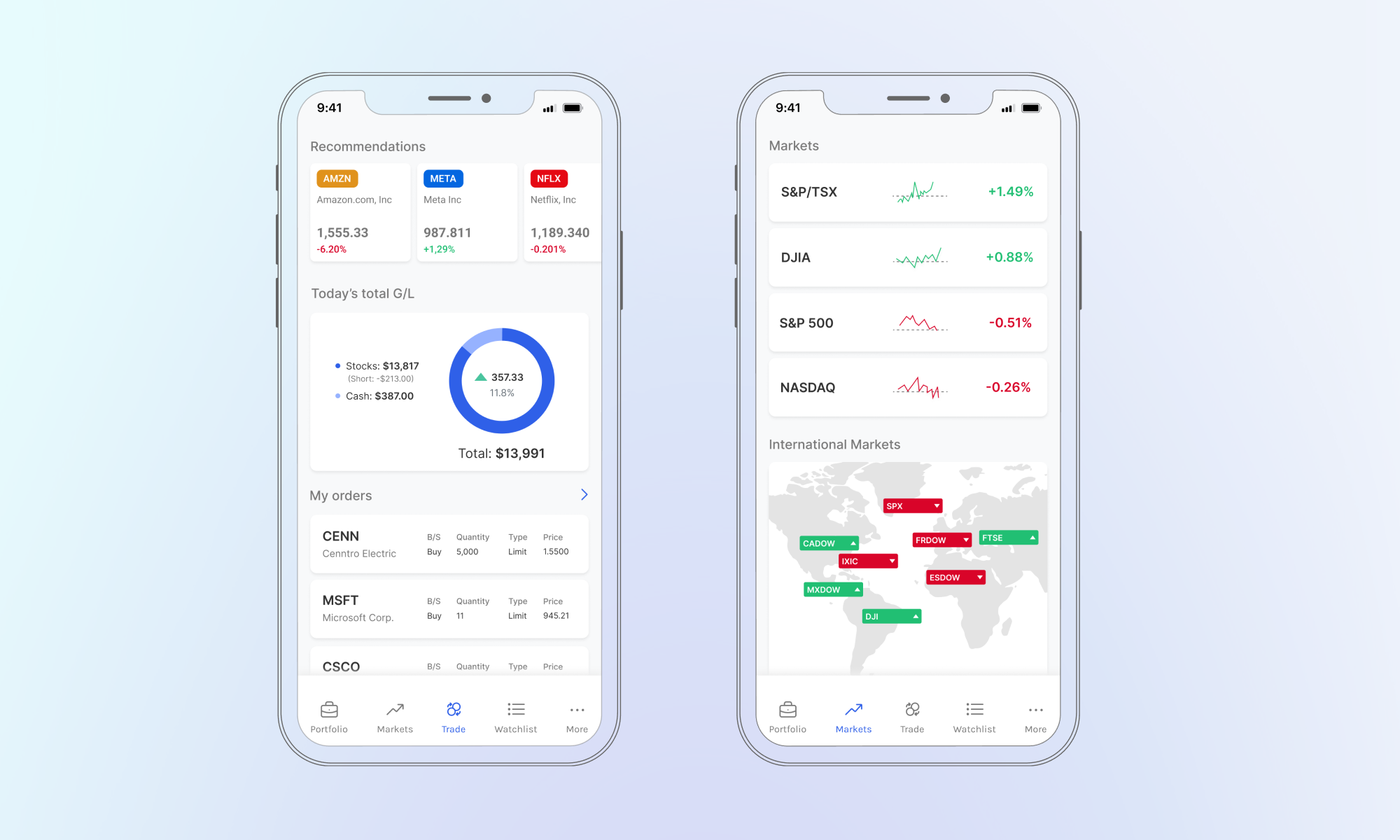
  • Quotes, charts, and market data: Users expect bid/ask, last price, OHLC, volume, and charts that update without manual refresh.
  • Order placement: Market, limit, stop, and a few more, depending on your target users. Also consider time-in-force rules.
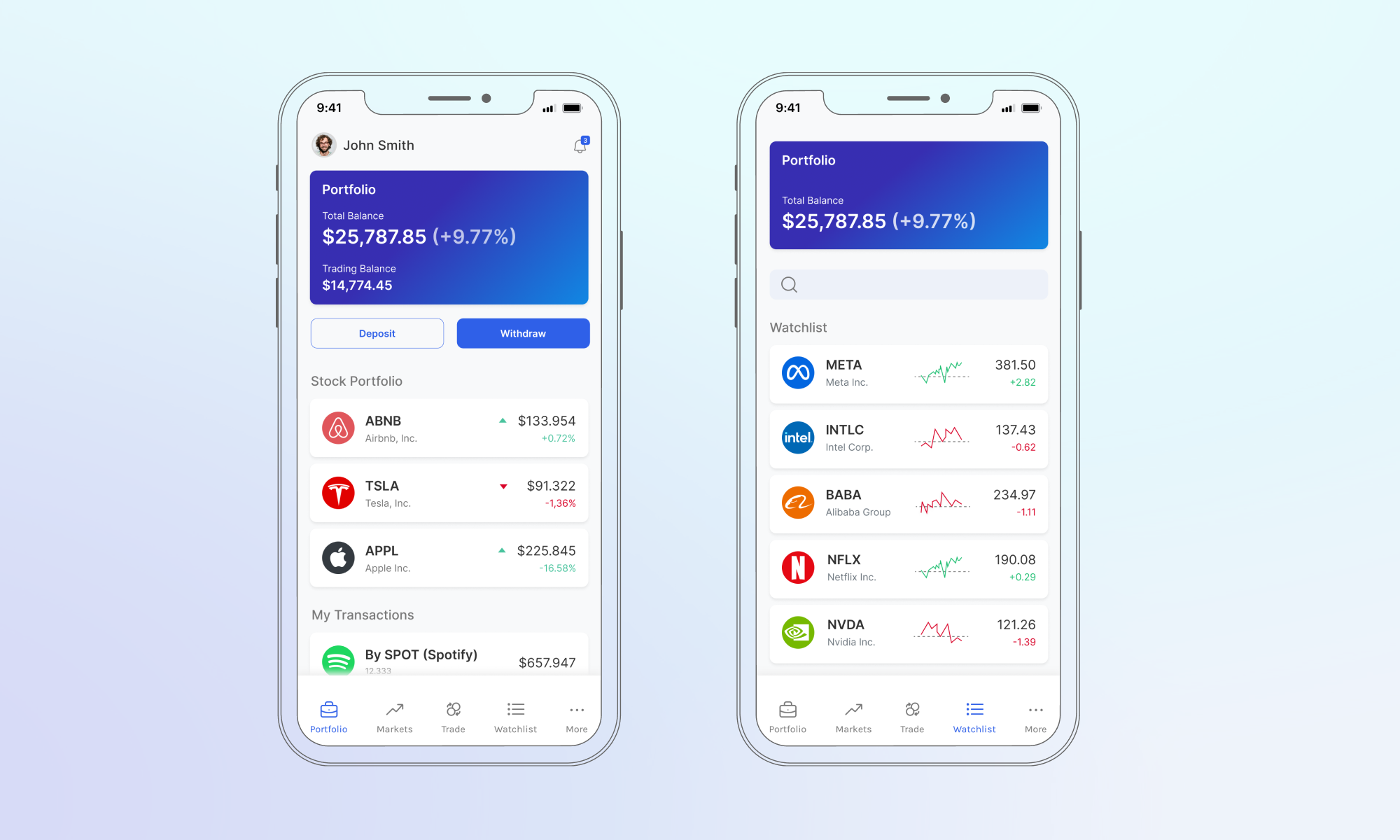
  • Portfolio view: Holdings, P&L, allocation, currency views, and asset categorization. The bank app supported revaluation across currencies and categorization by asset class.
  • Alerts and notifications: Price alerts, order status, account activity, news triggers. Customizable alerts were included in the app scope.
  • Activity and history:  Order history, transactions, statements, export options. Users want this for trust. Support wants it for troubleshooting.
Mobile stock trading app screens showing account balance, stock holdings, and real-time watchlist charts.

“Quiet features”: the stuff that makes audits and incidents survivable

These are rarely flashy, but they’re the difference between “we launched” and “we can operate.”

  • Immutable audit logs for trading actions, funding events, KYC steps, document signatures, and consent flows.
  • Role-based access controls for staff tools. Plus full traceability.
  • Monitoring and alerting for latency, failed orders, vendor timeouts, and suspicious activity.
  • Incident workflows and post-incident reporting support, especially relevant under frameworks like DORA’s ICT incident reporting expectations.
  • Record retention policies that align with your regulatory scope.

Want a quick gut-check question? Ask your team this: If a regulator asks, “Show me exactly what happened to this user’s order at 10:03:11,” can you answer within minutes?

If not, you have design work to do.

Stock trading app development works best when you design for audits, failure, and peak traffic from day one. Build clear event logs, strict access controls, and tested recovery paths before adding extra features. That is how you protect users, reduce support load, and keep regulators calm.

Siarhei Sukhadolski

Chief Delivery Officer & Head of Competence Center

Architecture choices: what changes when money is moving in real time?

Now we’re getting into the part that decides whether you sleep at night. A trading app isn’t just “mobile + API + database.” It’s a distributed system tied to third parties, market volatility, and strict correctness requirements.

Here are the architecture topics that show up in almost every serious build.

Event-driven backbone for orders and funding

Orders and transfers are naturally event-based. Each step produces an event you must log, replay, and reconcile. This is why many teams move toward message queues and event logs early, especially when integrating multiple brokers or market data sources.

Separation of concerns: trading vs analytics vs onboarding

Mixing everything into one service makes deployments risky.

Common split:

  • Identity and onboarding services
  • Trading and orders services
  • Portfolio and positions services
  • Market data ingestion and caching services
  • Notifications services
  • Reporting and statements services

Peak-load planning

You do not get to choose your traffic patterns. The market chooses them for you, so stress testing isn’t optional. Tools like Apache JMeter are often used to simulate peak loads and see where the system bends, or breaks, before real users find out.

Mobile-specific hardening

Mobile is its own threat model: rooted devices, interception, reverse engineering, and session hijacking. This is where OWASP MASVS helps, because it gives you concrete categories to test against.

Get a quick architecture sanity check before you build your trading app

Integration points: where trading apps usually break first

Integrations are where timelines slip and incident tickets multiply. Plan them early.

Brokerage APIs

If you connect to one broker, your integration surface is smaller. If you connect to multiple, you’ll usually need an abstraction layer so the rest of your system isn’t tied to one vendor’s quirks. That also makes it easier to support more instrument types without rewriting your trading core every time you add a new brokerage API.

Market data vendors

Market data comes with:

  • licensing rules,
  • latency expectations,
  • and lots of edge cases (halts, auctions, corporate actions).

Plan for caching and throttling. Also, plan for what happens when data goes stale.

Charts and technical analysis tools

Some teams integrate tools like MetaStock or TradingView for charting and technical analysis, instead of building the entire charting layer from scratch.

News feeds

News inside a trading app can drive engagement, but it can also drive support load if it’s noisy or irrelevant. That’s why many platforms integrate third-party financial news feeds for in-app updates, then filter and personalize what users see so it stays useful instead of overwhelming.

Robo-advisory (optional)

If you offer guided portfolios, risk profiling, and auto-rebalancing, you’re stepping into suitability and advice territory in many jurisdictions. That changes your compliance posture fast. Many trading platforms handle this by integrating robo-advisory capabilities that build portfolios based on a user’s profile and goals, then keep them on track with periodic rebalancing rules.

Stock trading app screens with portfolio allocation, buy orders, and global market performance data.

A step-by-step build plan you can actually run

Let’s map the work in a way a product lead and a CTO can use.

01
Step 1: Lock your regulatory perimeter
Define your regions and licenses, decide what stays in-house vs outsourced, and document retention and audit requirements early.
02
Step 2: Define the product scope by user type
Novice investors and active traders behave differently. If you’re building for beginners, you’ll usually lean toward a simpler interface and more guidance, because confidence and clarity matter more than advanced tools on day one.
03
Step 3: Choose your brokerage and market data approach
Decide on single vs multi-broker, real-time vs delayed quotes, and vendor licensing limits. Deliver an integration map, data flows, plus a “what breaks and how we recover” plan.
04
Step 4: Design the data model around auditability
Don’t bolt logging on at the end. Define an event schema early for orders, funding, authentication, documents, and consent so you can trace every action cleanly.
05
Step 5: Build the core flows first
Build the core flows first: account opening, verification, funding, quotes, order placement, portfolio, and history. That’s your “people can trade” milestone.
06
Step 6: Add the trust layer
Add the trust layer next: 2FA and biometric login, alerts and notifications, statements and exports, plus clear customer support hooks.
07
Step 7: Add growth features only after reliability is proven
IPO access, bond offers, custom strategies, and robo-advice. Those were introduced as offerings in the bank app scope, with some available at an early stage.
08
Step 8: Test like you mean it
Use real devices, real load profiles, and real integration failures. A practical testing mix is Espresso and XCTest for mobile tests, Appium for end-to-end UI automation, and JMeter for load and stress scenarios.
09
Step 9: Prepare for audits and incidents before launch
Put monitoring and alerting in place, write incident runbooks, define vendor escalation paths, run security reviews, and set up evidence collection for audits.
01 CLock your regulatory perimeter
Define your regions and licenses, decide what stays in-house vs outsourced, and document retention and audit requirements early.
02 Define the product scope by user type
Novice investors and active traders behave differently. If you’re building for beginners, you’ll usually lean toward a simpler interface and more guidance, because confidence and clarity matter more than advanced tools on day one.
03 Choose your brokerage and market data approach
Decide on single vs multi-broker, real-time vs delayed quotes, and vendor licensing limits. Deliver an integration map, data flows, plus a “what breaks and how we recover” plan.
04 Design the data model around auditability
Don’t bolt logging on at the end. Define an event schema early for orders, funding, authentication, documents, and consent so you can trace every action cleanly.
05 Build the core flows first
Build the core flows first: account opening, verification, funding, quotes, order placement, portfolio, and history. That’s your “people can trade” milestone.
06 Add the trust layer
Add the trust layer next: 2FA and biometric login, alerts and notifications, statements and exports, plus clear customer support hooks.
07 Add growth features only after reliability is proven
PO access, bond offers, custom strategies, and robo-advice. Those were introduced as offerings in the bank app scope, with some available at an early stage.
08 Test like you mean it
Use real devices, real load profiles, and real integration failures. A practical testing mix is Espresso and XCTest for mobile tests, Appium for end-to-end UI automation, and JMeter for load and stress scenarios.
09 Prepare for audits and incidents before launch
Put monitoring and alerting in place, write incident runbooks, define vendor escalation paths, run security reviews, and set up evidence collection for audits.

How to choose a stock trading app development company without regret

Let’s be direct:  you’re not just buying code, you’re buying execution under pressure.

Here’s the partner checklist that actually matters.

Can they show trading-domain delivery, not just fintech buzz?

Look for proof of:

  • order flows,
  • market data integration,
  • KYC and document handling,
  • audit trails,
  • load testing.

Do they ask the right compliance questions early?

If a vendor jumps straight to UI without asking about:

  • jurisdictions,
  • licensing,
  • record retention,
  • execution policy duties,
  • operational resilience expectations,

That’s a red flag.

Can they build the “quiet features”?

Ask how they handle:

  • immutable audit logs,
  • incident response readiness,
  • access controls for back office,
  • evidence collection for audits.

Do they have a real QA and performance testing plan?

If they don’t talk about load testing tools and scenarios, push back.

Are they honest about cost drivers?

A good team will break costs down by:

  • integrations,
  • compliance scope,
  • feature complexity,
  • testing depth,

not by hand-wavy “packages.”

If you’re looking specifically for stock trading app development services, this is the kind of conversation you want in the first week, not after the contract is signed.

A quick wrap-up. What to do next

If you’re comparing vendors right now and need a sanity check, here’s a simple next step:

Write down your jurisdiction scope, your brokerage approach, and your must-have integrations. Then use that as the baseline to evaluate a stock trading app development company.

Once those three are clear, everything else gets easier. And if you want a partner that has already built a trading mobile app with real-time analytics, portfolio management, broker integrations, and heavy testing under load, Innowise is a strong place to start.

Siarhei Sukhadolski

Chief Delivery Officer & Head of Competence Center

Siarhei works at the intersection of tech and business, helping companies build systems that work smarter and solve real operational and strategic challenges. With deep expertise in FinTech and enterprise systems, he’s led projects that connect strategy with execution — from automation and AI deployment to core banking platforms implementation. The goal is always the same: make things work better for the business and the people behind it.

Table of contents

    Contact us

    Book a call or fill out the form below and we’ll get back to you once we’ve processed your request.

    Send us a voice message
    Attach documents
    Upload file

    You can attach 1 file up to 2MB. Valid file formats: pdf, jpg, jpeg, png.

    By clicking Send, you consent to Innowise processing your personal data per our Privacy Policy to provide you with relevant information. By submitting your phone number, you agree that we may contact you via voice calls, SMS, and messaging apps. Calling, message, and data rates may apply.

    You can also send us your request
    to contact@innowise.com
    What happens next?
    1

    Once we’ve received and processed your request, we’ll get back to you to detail your project needs and sign an NDA to ensure confidentiality.

    2

    After examining your wants, needs, and expectations, our team will devise a project proposal with the scope of work, team size, time, and cost estimates.

    3

    We’ll arrange a meeting with you to discuss the offer and nail down the details.

    4

    Finally, we’ll sign a contract and start working on your project right away.

    More services we cover

    arrow