Will AI replace programmers? 2026 reality check for leaders and coders

Will AI replace programmers

Key takeaways

  • Will software engineers be replaced by AI? Mostly, no. Tools like Copilot and GPT-5 handle repetition and syntax, freeing engineers to focus on system design, validation, and business alignment.
  • Automation shifts value from typing to thinking. The future of software engineering jobs with AI depends on reasoning, not raw speed. The real differentiator is architectural clarity and judgment.
  • Poor use of AI just scales chaos faster. Without governance, code review, and accountability, companies risk security vulnerabilities, compliance issues, and mounting AI-induced technical debt.
  • Leaders must design automation. The best CTOs treat AI as a managed process (automate, validate, integrate, govern) to boost productivity without losing control.
  • Human context stays irreplaceable. AI will take over coding tasks, but not responsibility. Software engineers who evolve into system thinkers and automation orchestrators will thrive long after the hype fades.

So, will AI replace programmers? The short answer is no. The long answer is that it’s already replacing the lazy parts of programming: the filler, the fragments, the copy-paste inheritance that’s been slowing teams down for years. And honestly, it’s about time.

I’ve spent enough late nights reviewing codebases to know most software is built by inertia. Teams moving quickly, cloning snippets, trusting frameworks to think for them. AI-powered code generation didn’t create that culture; it just put a mirror to it. Now, when tools like Copilot or GPT-5 generate nearly half the code that used to be written manually, you start to see which parts of your workflow are craftsmanship… and which are just coasting.

Inside our delivery teams, that line is clear. AI tools for developers handle the scaffolding (setting up endpoints, writing boilerplate, filling in repetitive logic) while engineers focus on reviewing, refactoring, and aligning the system’s direction with business goals. Productivity is up, yes, but not because AI is replacing software engineers. It’s because the best developers are spending less time proving they can type fast, and more time proving they can think fast.

That’s what this piece is about. A practical look at AI’s role in software development, what’s really changing, and what leaders should do next.

Don’t gamble with code quality

Partner with a delivery team that builds reliable, maintainable software.

Why everyone’s asking this question

The conversation around AI and software engineering started with curiosity and turned into pressure almost overnight. Every boardroom deck now has a slide about ‘AI productivity.’ Every CTO I know gets asked the same thing: “Can we build the same product with half the team?” That’s where the anxiety starts. In expectations.

Headlines didn’t help. When major tech figures started claiming AI will “take over programming,” investors heard ‘cost savings.’ The nuance vanished. Inside delivery teams, that translated into unease. Junior developers started wondering if they’d still have jobs. Mid-level engineers began questioning their value. Even delivery managers worried: “If AI can take over coding jobs, what’s left to manage?”

And to be fair, the fear has logic behind it. Automation has already reshaped accounting, marketing, even design. Many now wonder:Is AI going to replace programmers the way industrial robots once replaced assembly-line workers?” The anxiety isn’t unfounded. When AI-powered code generation completes a Jira ticket faster than a human, it’s natural to ask so.

But here’s what those sweeping predictions miss. The further you move from repetitive tasks toward full product delivery (architecture, integration, security, trade-offs), the less automation helps and the more human judgment in coding matters. So, as I see it, the question isn’t whether AI will replace coders, but whether teams can evolve fast enough to use it responsibly.

Every organization experimenting with AI right now is learning the same lesson: automation doesn’t remove complexity, it redistributes it. Someone still needs to understand where the code fits, how it scales, and why it exists at all. That’s why even as AI takes over parts of software engineering, the best developers are becoming more valuable, not less.

What AI can actually do in 2026

AI is finally good enough to surprise even seasoned engineers. It can generate functional, syntactically correct code across most modern stacks. It writes documentation, unit tests, and even comments with an almost human touch. And yet, the moment context or ambiguity enters the equation, the magic starts to fade.

Let’s look at what’s actually true today: where AI delivers real value, and where it still needs a human at the wheel.

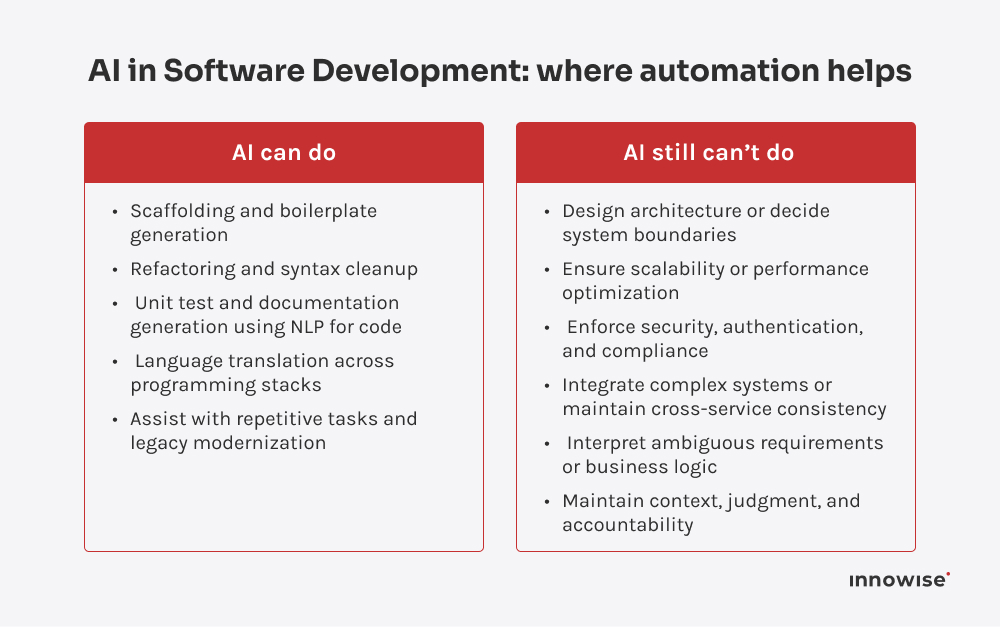
Infographic showing AI capabilities and limitations in software engineering. Left side lists areas like code generation, refactoring, and documentation; right side lists gaps such as architecture design, scalability, and security.

Where AI shines

AI thrives on repetition. Give it a clear, well-defined pattern, and it performs with astonishing consistency. In production environments, that means:
  • Scaffolding and boilerplate generation: setting up endpoints, DTOs, data models, and repetitive logic in seconds.
  • Refactoring and syntax cleanup: identifying redundant structures, unused variables, and formatting inconsistencies.
  • Unit testing and documentation: generating test coverage and API docs with Natural Language Processing (NLP) for code.
  • Language translation: converting legacy stacks through programming languages for AI integration that keeps teams from getting stuck in the past.
Each use case amplifies human productivity without removing human relevance. The most successful engineers understand that AI as a tool for software engineers multiplies capability only when paired with judgment and clear intent — just as it does in other industries adopting AI for real, measurable impact.

Where AI falls short

Every advantage AI brings evaporates once reasoning, abstraction, or context enters the frame. Its blind spots are consistent across all major LLM-based tools:
  • Architecture and scalability: AI doesn’t understand system boundaries or deployment environments. It can’t judge when to decouple services or when to optimize for performance.
  • Security and compliance: most generated code ignores authentication flows, encryption, and regulatory requirements.
  • Integration logic: combining multiple subsystems still demands human orchestration and testing.
  • Ambiguous requirements: AI models hallucinate when business logic isn’t crystal clear, producing elegant but incorrect solutions.
The short version: AI can write correct code that solves the wrong problem, unless someone experienced guides it.

Lately, some teams have tried building entire applications through conversational interfaces like ChatGPT-5 or Replit Ghostwriter — a trend now called vibe coding. The approach feels fast and effortless: describe what you want, get running code instantly. But in practice, these systems collapse under real-world pressure. We’ve already been contacted by companies asking us to rebuild systems written entirely through this approach. The pattern repeats: everything compiles, but nothing scales. The architecture is shallow, integrations fail, and security vulnerabilities in AI-generated code become impossible to track. It’s a reminder that while AI can generate prototypes, it still can’t design resilient systems.

Dmitry Nazarevich

CTO

So, the real takeaway is that AI doesn’t replace engineers. Actually, without them, it breaks fast. Teams with solid architecture, review discipline, and strong ownership use it as leverage. Teams without those habits just accumulate AI-induced technical debt at record speed. As I see it, the smartest leaders don’t ask, “will AI take over software development?” They ask how to build organizations that stay relevant when it does.

How AI changes what engineers do

AI has automated the mechanical layer of development: scaffolding, syntax, and boilerplate generation. Now, the work that matters most is what happens above the IDE: designing scalable systems, aligning technology with business logic, and making trade-offs that machines still can’t reason through.

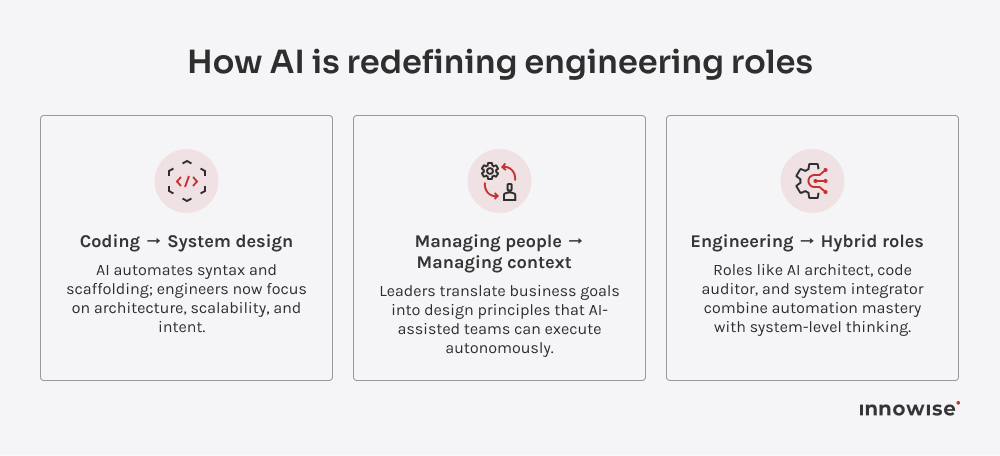
Three evolving engineering focuses in AI-driven software development — from manual coding to system design, leadership, and hybrid roles.

Coding is giving way to system design

A few years ago, development was a craft built on repetition. Teams wrote similar patterns again and again. Controllers, DTOs, database handlers. AI now handles that layer with ease. Who writes the code doesn’t matter anymore. What matters is who makes it make sense in the bigger picture.

Inside modern delivery teams, the best engineers spend most of their time working at the system level. They design flows, evaluate trade-offs, and decide where automation fits without breaking structure or security. The emphasis has moved toward architecture, maintainability, and clarity of intent.

That shift feels subtle until you see it at scale. Suddenly, small teams can deliver what used to take entire departments. Time once spent on syntax now goes into alignment, testing, and long-term stability. Engineering starts to look less like manual production and more like system design.

New responsibilities for technical leaders appear

As AI’s role in software development expands, the expectations for technical leadership shift. Velocity doesn’t matter if the system can’t endure. Resilience is the new performance metric. As well as architectural health and predictability.

Leads now spend more time curating context than assigning tasks. It translates business direction into design principles that AI-assisted teams can execute without constant supervision. The more structured the intent, the stronger the output.

This requires a new mindset: leaders must think less about managing capacity and more about managing quality of reasoning. Teams that think clearly build scalable systems. AI simply amplifies the thinking that’s already there.

Hybrid engineering is becoming the norm

With AI integration spreading across delivery pipelines, new hybrid roles are emerging. Roles that combine automation expertise with system-level thinking:
  • AI architect: governs how and where automation is applied, ensuring it reinforces rather than fragments system design.
  • Code auditor: validates machine-generated code for performance, security, and compliance before it enters production.
  • System integrator: connects human and AI workflows, bridging tooling gaps and aligning automation with architecture.
These roles emerge to protect coherence — the one thing AI still can’t guarantee.What does it mean for delivery organizations? The real differentiator is trustworthiness: how consistently teams deliver software that scales, integrates, and survives version two.Organizations that treat AI as a strategic collaborator, not a replacement, will see compounding returns: faster delivery, lower verification overhead, and teams that can focus on solving business problems instead of managing syntax.The ones that treat it as a shortcut will gain temporary velocity and long-term fragility.

Build with professionals who understand architecture, governance, and sustainable innovation

Who gets replaced and who thrives

Every technological leap redraws the skill map. AI is doing it faster and more visibly than anything before. Inside delivery teams, the gap between people who use AI and people who understand it is widening by the month.

The new landscape of developer roles looks like this:

Developer type Risk of replacement Reason Path to stay relevant
Junior developers relying on external snippets High Tasks like syntax, CRUD logic, and documentation are now automated. Focus on problem-solving, debugging, and understanding business context early.
Mid-level engineers without systems thinking Medium AI covers 60–70% of feature work, reducing the value of execution-only roles. Learn architecture, scaling principles, and system integration.
Senior engineers / architects Low Their value lies in cross-functional judgment, design, and long-term maintainability. Expand into AI oversight, validation frameworks, and technical leadership.
Hybrid engineers (AI + domain experts) Lowest They combine deep context with the ability to guide automation effectively. Master AI workflows, prompt engineering, and cross-domain collaboration.

The pattern is clear: the more a role depends on understanding why code exists, not just how it’s written, the safer and more valuable it becomes.

Who’s actually thriving

The people leading this transition aren’t necessarily the most technical. They’re usually the most adaptable.

They treat AI as a tool for software engineers, not a threat. They test, validate, and integrate its output with intent. Their work feels less like code production and more like orchestration.

In teams we’ve seen perform best, these engineers are driving architectural clarity, automation governance, and internal training. Their productivity isn’t measured in commits but in reduced review cycles, smoother handovers, and better long-term stability.

How leaders can narrow the gap

According to Gartner (2024), by 2027, nearly 80% of the global engineering workforce will need to upskill to work effectively alongside AI systems. Rather than replacing software engineers, AI is giving rise to new hybrid roles such as AI engineers who blend software, data science, and ML expertise.

McKinsey’s 2025 “Superagency” research echoes this shift. It found that while 92% of companies are investing in AI, only 1% consider themselves mature in adoption — not because employees resist change, but because leaders aren’t steering fast enough. In other words, engineers are ready for AI; leadership readiness is now the real barrier to transformation.

Action points for CTOs and delivery heads:

  • Integrate AI into daily tools: make Copilot, CodeWhisperer, or GPT-based IDEs standard within workflows.
  • Pair automation with oversight: add automated code review and audit checkpoints before merges.
  • Re-skill mid-level engineers: move them from feature delivery to architecture validation.
  • Create AI governance playbooks: define ownership, validation, and IP accountability early.

Automation will change entry-level hiring, but not eliminate it. As AI takes over programming jobs, leaders will need experienced engineers who can manage complexity, validate code integrity, and keep systems aligned with evolving business logic. The next question for every leader is whether their teams are learning fast enough to stay above the line where automation stops and engineering begins.

Avoid technical debt before it starts — partner with professionals who design clean architecture

What the future actually looks like

Every delivery organization is now somewhere along the same curve. Some are still experimenting with AI on side projects. Others have fully integrated generative tools into production pipelines. A few are already asking the harder question: what comes after this phase of acceleration?

Three plausible futures are emerging, each defining a different relationship between humans, AI, and software creation.

Phase 1: the automation plateau (2025–2027)

Right now, every engineering organization is racing to embed AI tools for developers into daily workflows. Over the next few years, AI will settle into every layer of the development process: IDEs, CI/CD, documentation, and testing. Every engineer will have an assistant; every pipeline will include automated reviews. Productivity gains will be real but incremental, leveling off as teams hit the limits of what can safely be automated.Key characteristics:
  • AI everywhere, but still under human supervision.
  • Fastest gains in repetitive coding and QA.
  • Verification and governance remain manual.
  • Main leadership focus: standardization and policy.
This phase rewards disciplined integration over experimentation. The advantage goes to companies that create stable, repeatable workflows around automation without compromising control.

Phase 2: hybrid engineering (2027–2035)

Once tools mature and trust grows, humans and AI will share ownership of the codebase. Machines will handle 70% of development tasks, while humans guide architecture, validation, and long-term strategy.Key characteristics:
  • Teams evolve into orchestration units: less about writing, more about steering.
  • Code review becomes semi-autonomous, with AI flagging architectural or security risks.
  • Delivery velocity stabilizes, but time-to-trust (how long it takes to validate new code) becomes the main KPI.
  • Main leadership focus: architecture coherence and risk management.
This is where the balance of power shifts. Companies that train engineers to interpret, audit, and direct AI output will outperform those still treating it as a shortcut.

Phase 3: machine-centric development (2040 and beyond)

By 2040, AI’s role in software development will extend far beyond code generation. Interconnected systems will plan, test, deploy, and refactor themselves — what we now call “machine-centric” or “agentic” development. Humans won’t vanish; they’ll simply move higher up the abstraction chain.Key characteristics:
  • Continuous, self-refactoring systems.
  • Humans oversee purpose, compliance, and accountability.
  • Value migrates from production to direction.
  • Main leadership focus: governance and interpretability.
Even in this phase, software engineers will not be replaced by AI completely. The system can build itself, but it still needs someone to decide why it should.What does this mean for today’s leaders? For CTOs, delivery heads, and founders, the message is pragmatic. The tools will evolve faster than the organizations using them. Preparing now means:
  • Investing in AI-assisted literacy across all technical roles.
  • Building governance frameworks before velocity becomes chaos.
  • Redefining KPIs around coherence, resilience, and trust—not raw output.
The goal isn’t to predict which future arrives first. It’s to design a culture that can adapt to all of them.

What to do now: a decision framework for leaders and teams

Every CTO I know is asking the same question right now: how far do we lean into AI without breaking what already works? The answer depends less on technology and more on governance. The companies navigating this shift successfully share one pattern — they treat automation as a managed process, not an experiment.

The framework is simple but powerful: automate → validate → integrate → govern.

Step 1: identify repeatable, low-risk tasks

Start small and strategic. Introduce automation where the quality of AI-generated code can be easily verified: documentation, testing, or migration tasks. Focus on areas that create immediate time savings without touching business logic or customer-facing systems.

Once your team sees value, scale gradually. Make automation visible and measurable, so you can prove the gain rather than just feel it.

Step 2: build guardrails around AI output

AI doesn’t know when it’s wrong. That’s your responsibility. Establish a dual-review process: machine generation followed by human validation. Use automated testing pipelines, code linters, and compliance checkers, but make sure every change still passes through experienced eyes.

Encourage engineers to treat AI output as a draft, not a deliverable. Review for logic, scalability, and alignment with architectural principles before merging.

Step 3: make AI part of the delivery fabric

Once trust is built, embed AI directly into your delivery pipelines. Merge it with CI/CD systems, deployment automation, and AI-assisted debugging processes.

This is where most teams hit an unexpected wall — the integration complexity of AI tools. Each tool must align with your architecture, data governance, and release process. The integration effort often defines whether automation scales or stalls.

Keep this phase structured. Make AI support your existing processes, not the other way around.

Step 4: maintain accountability and traceability

The biggest long-term risk isn’t bad code, it’s untraceablecode. Every organization needs policies defining ownership, data handling, and auditability for AI-generated content. Decide now who signs off on code that machines produce, where logs are stored, and how compliance is verified.Strong governance doesn’t slow teams down; it protects them from hidden liabilities later: licensing issues, IP disputes, and ethical breaches.
  • What this means for engineers: For technical professionals, the next few years are about adaptability. Learn how to guide automation instead of fighting it. Focus on architecture, communication, and domain logic — the parts machines can’t replicate. Build personal fluency with AI tools, but stay grounded in fundamentals like data modeling, API design, and testing discipline.The engineers who thrive will be those who treat AI as a teammate that needs management, not worship.
  • What this means for leaders: For CTOs, Heads of Delivery, and business founders, the challenge is orchestration. Your job is to create the environment where humans and automation enhance each other without eroding accountability. That means designing processes that balance speed with oversight, and curiosity with discipline.The smartest organizations aren’t chasing “AI-first.” They’re becoming AI-fluent. They know exactly where automation adds value and where it adds risk.

Need AI-assisted, human-led delivery?

We use AI as leverage, not a shortcut and ensure every line of code is reviewed and reliable

Conclusion

So my answer to Will AI replace programmers?” is “Only if you keep writing code like it’s 2015.”

AI is the stress test. It exposes every weak link in how teams build, review, and align software with business goals. The old model (feature tickets, endless sprints, manual reviews) wasn’t built for a world where code can be generated in seconds. What separates companies now isn’t access to AI tools; it’s the maturity to use them with discipline.

The best teams are already moving differently. They spend less time pushing commits and more time defining systems. They design before they automate, validate before they scale, and treat code as a living ecosystem, not a production line.

The future of software belongs to those who adapt fast, think structurally, and lead with clarity. AI may write the functions, but humans still write the story, deciding what gets built, why it matters, and how it endures.

In the end, AI won’t replace great engineers. It will replace complacent ones. The rest will evolve and build what comes next.

FAQ

Not entirely. While AI can generate large portions of functional code, it still lacks contextual understanding, domain reasoning, and accountability. The idea that AI will replace programmers misunderstands what engineers actually do: design systems, validate logic, and align technology with business needs. AI speeds up typing, not thinking. Skilled developers who guide automation and ensure architectural clarity will remain indispensable.

Tasks built on repetition, such as scaffolding, boilerplate generation, testing, and bug detection, are already being automated. This is where AI-driven software delivery and automated bug detection bring measurable gains. However, higher-level work like architecture design, security validation, and system integration still requires human oversight. In other words, AI replaces tasks, not entire software engineering roles.

AI’s impact on software engineering careers will reshape, not eliminate, the profession. Engineers who rely purely on execution risk being replaced, while those who specialize in design thinking, validation, and AI integration will thrive. The demand will shift from code producers to AI-literate system thinkers who can guide automation responsibly. This is where adaptability becomes the ultimate skill.

Over-reliance on AI in software development often leads to AI-induced technical debt, security vulnerabilities, and poor architectural decisions. Without proper validation, AI can generate code that’s correct in syntax but wrong in logic. The more teams automate without governance, the faster they scale chaos. Responsible adoption means pairing automation with continuous human review and context-driven accountability.

Yes. And they’re becoming increasingly serious. AI tools can unintentionally reuse licensed snippets, raising Intellectual Property (IP) concerns with AI code. Moreover, data privacy and compliance risks with AI must be managed carefully when integrating such systems into production pipelines. Organizations also need to consider ethical considerations in AI-driven development, ensuring transparency, accountability, and explainability of AI decisions in coding.

Modern software engineering education must evolve beyond syntax and frameworks. Engineers need to learn prompt design, automation oversight, validation frameworks, and ethical governance. AI fluency will become as essential as version control. Educational programs should emphasize problem-solving, data awareness, and the importance of human judgment in coding, ensuring future developers can guide, not just consume, automation.

Leaders should treat automation as a managed process. Build governance frameworks, define ownership of AI-generated content, and invest in AI upskilling. Prioritize AI-driven software delivery and validation pipelines, not uncontrolled experimentation. Teams that align automation with architectural discipline will outperform those chasing short-term velocity. The future belongs to organizations that are AI-fluent, not AI-dependent.

Head of Big Data and AI

Philip brings sharp focus to all things data and AI. He’s the one who asks the right questions early, sets a strong technical vision, and makes sure we’re not just building smart systems – we’re building the right ones, for real business value.

Table of contents

    Contact us

    Book a call or fill out the form below and we’ll get back to you once we’ve processed your request.

    Send us a voice message
    Attach documents
    Upload file

    You can attach 1 file up to 2MB. Valid file formats: pdf, jpg, jpeg, png.

    By clicking Send, you consent to Innowise processing your personal data per our Privacy Policy to provide you with relevant information. By submitting your phone number, you agree that we may contact you via voice calls, SMS, and messaging apps. Calling, message, and data rates may apply.

    You can also send us your request
    to contact@innowise.com
    What happens next?
    1

    Once we’ve received and processed your request, we’ll get back to you to detail your project needs and sign an NDA to ensure confidentiality.

    2

    After examining your wants, needs, and expectations, our team will devise a project proposal with the scope of work, team size, time, and cost estimates.

    3

    We’ll arrange a meeting with you to discuss the offer and nail down the details.

    4

    Finally, we’ll sign a contract and start working on your project right away.

    arrow