Your message has been sent.
We’ll process your request and contact you back as soon as possible.
The form has been successfully submitted.
Please find further information in your mailbox.

In-house or outsourcing? The widely disputed dilemma. You may have charted your development course years ago, but here you are again — checking how things are progressing in 2026.
In the mature 2026 outsourcing market, the perks of going external extend far beyond competitive rates. Companies no longer simply seek more hands; they increasingly prefer partnership models with SLAs tied to business outcomes.
Control vs flexibility, core knowledge retention vs speed to market, strategic alignment vs tactical execution — these are the factors actually being weighed when comparing in-house development vs outsourcing. How can you tackle this without sacrificing any of these? Is it possible to create a win-win?
I’ve been in the industry for 15+ years, helping clients and partners make the most out of software development. In this guide, I’ll break down the models, highlight impactful factors, and bring a fresh piece of data to finally solve your software in-house vs outsourcing puzzle.
of leaders plan to maintain or increase outsourcing
Source: Deloitte
is the average salary of a software engineer in the U.S.
Source: Indeed
of the IT outsourcing market is dedicated to infrastructure outsourcing
Source: Mordor Intelligence
CAGR of the nearshore IT outsourcing market (2024–2030)
Source: Mordor Intelligence
The term in-house means you develop and manage software within your company walls using your team and your resources. In this model, you oversee each process directly and take responsibility for quality, skills, security, and whatever else within your product.
Over time, in-house teams accumulate unique knowledge that is hard to replicate by competitors. They deeply understand the company’s processes, corporate culture, and priorities, which drives a smoother adoption of changes. Internal experts are usually culturally embedded, since they are chosen initially for fit, and over time, they start thinking in line with its values and processes.
However, companies risk being locked into key employees who hold critical knowledge. By working exclusively on one or a few products, teams operate around the same techs, and maintaining advanced skills becomes both time-consuming and costly.
On the other hand, there is outsourcing, built for delegating business functions to external vendors. You can outsource a wide range of operational processes: from design to infrastructure and CTO, as well as turnkey product development.
Outsourcing to a specialized partner means you get an expert team straight away, without having to train your staff on new technologies. This model enables ramping up and down overnight, as long as the vendor’s talent pool allows for it. A secondary benefit is risk mitigation, as the external vendor takes these on, too.
Outsourcing is a broad term, so it’s good to get some context. First, choose a location that aligns with your goals. Options to consider include:
Once the location is set, the next step is choosing how you want to collaborate. Outsourcing engagement models include:
A full-cycle project delivery, meaning outsourcing product or component development to an external partner. It features a fixed scope and timeline, a single objective, and clear milestones.
Embedding external experts into your team to operate under your workflows. It features temporary expertise, direct integration, and flexibility — you can add or remove resources smoothly.
A hybrid, long-term model where the vendor runs delivery but integrates tightly with client governance. Recruitment, logistics, and other day-to-day operations remain with the vendor.
Traditionally, outsourcing is the go-to choice for those prioritizing cost and time-to-market. That’s still true, but by 2026, it is valued most for niche expertise. Think of the outsourcing locations as strategic engineering hubs where you can make up for missed expertise and leverage best practices for innovation. For example, Poland has become a well-known fintech and AI hub, while the Czech Republic remains highly competitive in embedded engineering outsourcing.
The outsourcing case is bolstered further with AI-backed development. As the market demands speed, vendors are increasingly testing and establishing proven frameworks for using AI automation for code checks, RAG knowledge bases, and so on. Meanwhile, in-house teams tend to get stuck in legacy processes.
In-house development offers superior control and cultural alignment but typically comes with significant overhead. Building a team takes months, and scaling up or down is slow and disruptive. Outsourcing provides predictable project-based costs, teams can start delivering within weeks, and capacity scales without the organizational trauma of layoffs or lengthy hiring cycles.
In-house teams excel for long-term, regulated core systems where institutional knowledge and culture are embedded in the product. Outsourcing is a common choice for MVP development, seasonal capacity needs, niche expertise (ML, blockchain, IoT), and budget-sensitive projects. Security concerns exist in both models — internal teams face attrition risk, while vendors require strong NDAs and certifications like ISO 27001. It becomes increasingly common for businesses not to choose one exclusively, but maintain core in-house capabilities while strategically outsourcing specific initiatives where speed, specialization, or cost efficiency matter most.
Reveal pros and cons of in-house software development and IT outsourcing:
| Factor | In-house development | Outsourcing development |
| Total cost | Salary × ~2.7 (benefits, taxes, space, idle time). $250k–$300k per US engineer/year. | Hourly $30–$150 depending on region. Predictable, project-based cost. |
| Time to start | 40-60+ days to hire + notice period. | 1-4 weeks to vet vendor and start a sprint. |
| Control & oversight | Full control, cultural alignment, embedded governance. | Requires vendor governance, SLAs, and checkpoints. |
| Talent pool | Limited to local market. Hard to fill niche roles (e.g. ML, blockchain, IoT). | Global pool; on-demand access to specialized skills. |
| Scalability | Months to expand or contract. Layoffs burn morale. | Elastic capacity; scale pods up and down within weeks. |
| IP & security | Easier to enforce internally, but attrition risk. | Needs NDAs, DPAs, ISO 27001, SOC 2. Good vendors provide compliance reports. |
| Best For | Long-term, regulated core systems, and culture-critical platforms. | MVPs, scaling spikes, niche expertise, cost-sensitive projects. |
When evaluating in-house teams, the headline salary is only the tip of the iceberg. In reality, you must include benefits, employer taxes, licenses, recruitment, training, attrition backfill, and management overhead — all of which expand costs by 100-170%.
The fair formula looks like this:

Companies nearly always overlook the attrition churn, which can reach 15-20% per year, as well as the managerial drag that necessitates a parallel layer of engineering managers, architects, and HR professionals when expanding headcount. Given this, it’s wise to plan at least a three-year horizon to avoid underestimating inflation, retention bonuses, accumulated re-hiring, and other long-term costs.
With outsourcing, costs are variable and time-bound, but the total cost is better modeled beyond the hourly rates. One of the most apparent costs is vendor onboarding, which usually comes with 1–2 sandbox sprints before achieving planned speed. Internal PM/PO is still recommended and sometimes required, which typically accounts for ~15–20% of total dev spend for internal oversight. At project close or vendor exit, allow time and cost for structured handover.
You may face change requests during the project and end up with scope creep. If your vendor is cheap-first, you risk burning the budget on fixes, which can negate any savings you counted on.

With a risk adjustment, a $30/hour vendor with 25% rework turns out to be more expensive than a $60/hour Tier 1 partner with disciplined delivery. By partnering with a proven vendor, you’ll likely experience a reduction in both cost and budget volatility.
Unlike in-house, where you fully manage business and technical risks, outsourcing assumes a shared responsibility with the vendor. Social proof, such as high rates and multiple positive testimonials, can help you catch a proven vendor with well-established risk mitigation practices. What you can do to protect your budget, resources, and reputation from your side:
| Risk | Impact | How to mitigate |
| IP leakage | High |
|
| Code quality failure | High |
|
| Knowledge transfer loss | Medium |
|
| Vendor lock-in | High |
|
| Attrition | Low |
|
If your code itself is a fundamental pillar of competitive advantage, keep development largely in-house to ensure your sensitive innovations are shielded. For instance, if you’re developing a custom trading algorithm based on proprietary data models, which could be patented. Similarly, in industries like aerospace, where designing critical technologies like flight control systems, leakages can undermine trust and compromise market position.
Next point of attention — industries such as finance, healthcare, defense, or government, where regulatory frameworks and security protocols are legal imperatives. In these sectors, maintaining an internal team allows for tighter control over compliance and timely responses to changes in laws or regulations. Such experts are deeply familiar with both the company’s operations and the regulations. For example, developing banking systems that handle PCI-DSS compliance requires constant oversight of payment processing flows and immediate responses to regulatory updates.
The benefits of in-house vs outsourcing are especially visible if you have a concrete multi-year development plan and confidence in predictable iterations, and it can make more sense for you to stay in-house. As features evolve gradually based on user feedback and strategic objectives align with business goals, stability thrives. This way, internal teams understand the product more deeply, taking ownership over its long-term scalability. For example, a business intelligence platform can steadily evolve over several years to meet changing data analysis needs.
If your development process relies heavily on feedback and collaboration with retail, supply chain, or other divisions, it’s much more convenient to handle it internally. This drives agile solutions, based on a profound understanding of real-time operational challenges and customer needs. Let’s take an IoT-based factory automation system as an example. You need to ensure that the software integrates seamlessly with existing machinery, enhances efficiency, and adapts to changing production demands, which requires rapid and iterative feedback between your on-site engineers, floor managers, and the development team. Outsourcing slows this down through time-zone and cultural gaps, as well as procedural handoffs.
By developing internally, you can foster a strong corporate and engineering culture, which is a key to retaining top talent. This is particularly vital for tech startups and fintech companies, where innovation is a key to growth.
Retaining highly skilled data scientists and software engineers within an in-house team allows for the cultivation of expertise in your unique product while maintaining a sense of ownership. By creating a thriving internal ecosystem, businesses can attract top talent, reduce turnover, and build a sustainable competitive advantage rooted in the collective expertise of their workforce.
When competition is intense, pragmatic strategies like outsourcing become a necessity. You cut lengthy delays within hiring and onboarding, and eliminate the learning curve on new tech stacks within your internal teams. This often becomes crucial when building a PoC or rolling out an MVP to validate an idea or respond to market demands quickly. Fewer delays enable faster product release and flexibility to test various hypotheses with minimal time investment. For tech startups or consumer app companies operating in fast-paced markets, this can be a make-or-break factor.
If you handle pioneering projects that require cutting-edge skills, outsourcing can turn out not only more reliable but also a cost-efficient way to reach the right talent. Blockchain development, AI/ML development, data engineering, and other high-end skill sets are in demand for outsourcing. Well-vetted vendors with a large talent pool typically have effective sourcing and retention strategies to bring you the best talent and keep it aligned with your project needs. At Innowise, we’ve proven this on 1,600+ projects.
For meeting fluctuating demand, in-house development is simply too time-consuming. External development covers periods of high activity, such as product launches or seasonal peaks, eliminating the need to hire permanent staff who would face downtime during quieter periods. In this way, companies adjust team size quickly, adding or removing developers as necessary, and avoiding the complexities and costs of long-term employment contracts. This flexibility is ideal for project-based work, seasonal projects, or scaling teams for specific product features.
The financial case for outsourcing is straightforward: you pay for expertise when you need it without year-round overhead. You can reduce hourly rates by two or three times by outsourcing to lower-cost regions, such as India. Alternatively, add expenses like training, benefits, infrastructure, and long-term commitment to the actual salary cost. For example, if an emerging tech startup outsources development to a vendor in a region with lower labor costs, it can allocate more resources to business-critical needs, such as marketing or customer acquisition.
Last but not least — testing new ideas. External teams help you experiment with new product features or technologies, quickly bringing in the necessary expertise to prototype without overloading internal teams. This model is well-suited for companies exploring new markets, testing unproven concepts, or working in highly dynamic sectors where risk tolerance and flexibility are key. Outsourcing offers a way to test the waters before committing to large-scale development efforts.
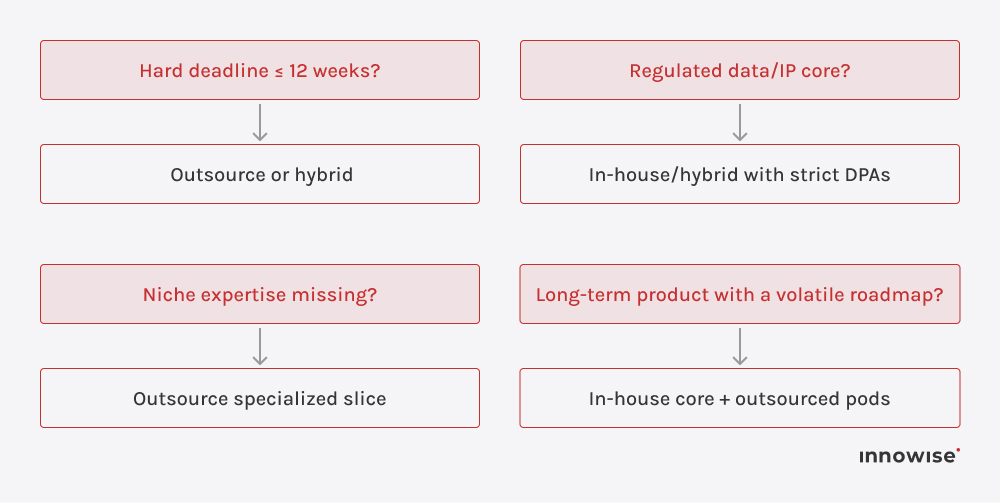
Choosing the right development model boils down to four key pillars: timeline, expertise, security, and long-term goals. If there are no specific requirements, the following options work in 99% of cases:

To combine in-house and outsource effectively, leverage the strengths of both models. These best practices will help you make the most out of both worlds:
By 2026, outsourcing has become a strategic choice for groundbreaking projects, where niche expertise is a must. It’s still chosen for speed and flexibility, which are now even more tangible with AI tools.
The optimal approach is rarely static. Many companies evolve from fully internal teams to hybrid models, blending internal knowledge with specialized external expertise. Others start with outsourcing and gradually internalize core capabilities to strengthen compliance or long-term product ownership.
If you’re looking for a partner who can join your team without slowing things down, Innowise brings experienced engineers, flexible ways to collaborate, and a proven record of delivering real products so you start getting value from day one.
Dmitry leads the tech strategy behind custom solutions that actually work for clients — now and as they grow. He bridges big-picture vision with hands-on execution, making sure every build is smart, scalable, and aligned with the business.


Your message has been sent.
We’ll process your request and contact you back as soon as possible.
By signing up you agree to our Privacy Policy, including the use of cookies and transfer of your personal information.