- Customer service automation
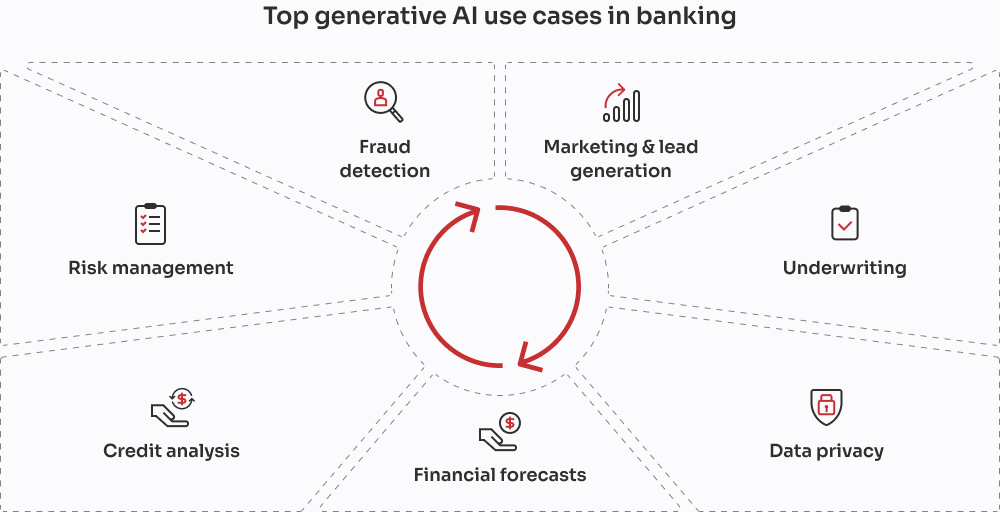
- Fraud detection and risk assessment
- Financial forecasting
- Document processing
- Financial crime investigation
- Product development and market analysis
- Credit scoring
- Trading and wealth advisory
Customer service automation
Generative AI in banking is changing the game for customer service. Think AI chatbots that chat like humans, offer 24/7 support, and give personalized recommendations and real-time help — exactly what today’s customers expect.
And big banks are already on board. Wells Fargo’s virtual assistant, Fargo, uses Google’s PaLM 2 to handle everyday banking questions. Airwallex is speeding up KYC and onboarding with its GenAI copilot. And Morgan Stanley’s GPT-4 assistant helps financial advisors quickly find answers and deliver personalized insights in no time.
Fraud detection and risk assessment
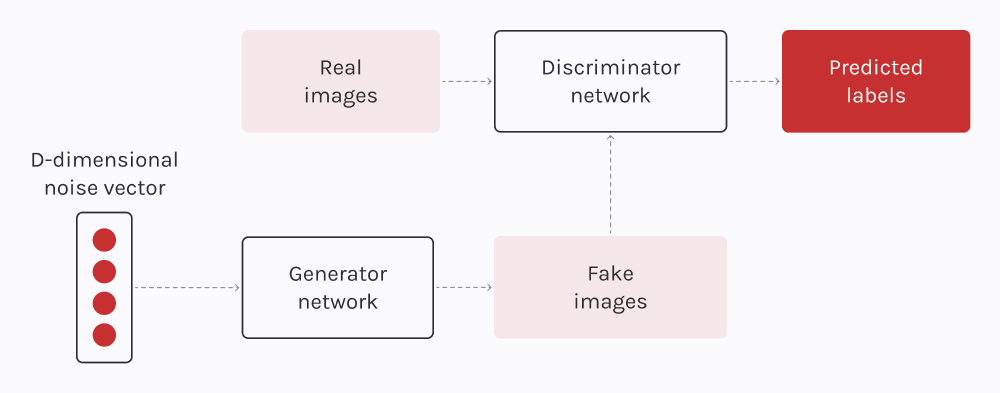
GenAI models like GANs simulate fraudulent transactions to help banks boost their fraud detection and risk management.
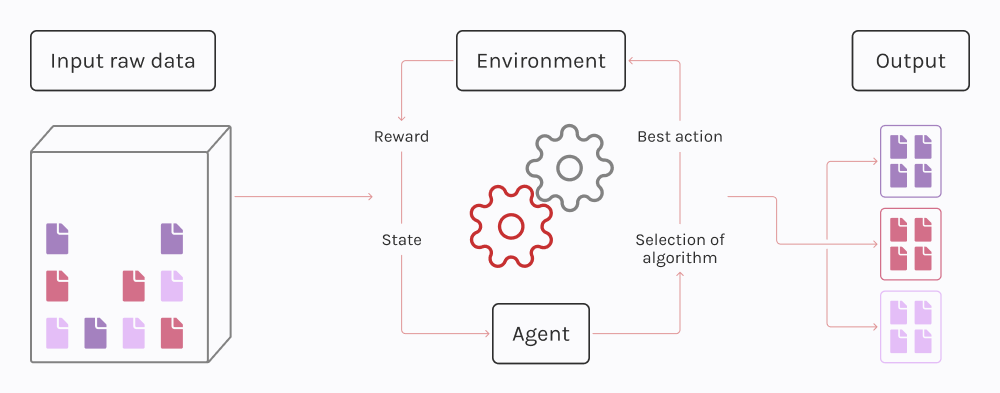
For example, Citi’s Payment Outlier Detection uses advanced statistical ML to proactively identify outlier payments. Deutsche Bank, in partnership with NVIDIA, is testing LLMs called Finformers to provide early risk warnings and speed up data retrieval. And HSBC teamed up with Google Cloud to develop AML AI — an autonomous solution trained on customer data to prevent money laundering.
Financial forecasting
GenAI’s ability to process huge amounts of data makes it a great tool for financial forecasting. Banks love this because accurate predictions in fast-changing markets are key for making smart decisions.
Take JPMorgan Chase, for example — they’re tapping into deep learning and reinforcement learning to spot market trends and fine-tune their trading strategies. Goldman Sachs leans on Kensho, an AI platform that digs into financial documents with neural networks and NLP, helping them predict asset prices with more confidence.
Document processing
GenAI tools make document processing in banking way faster: they can easily spot patterns, extract the required data much quicker, and they’re way less prone to mistakes. Plus they get smarter over time.
A great example of this is JPMorgan Chase's COiN (Contract Intelligence) — an AI platform that can handle thousands of documents in seconds. It uses NLP to make sense of legal jargon, flagging risks like non-compliance or sketchy terms hiding in contracts. This cuts down on errors and reduces the need for manual work, freeing up resources and helping avoid costly legal disputes.
Financial crime investigation
One of the best things about GenAI is how it can handle things on its own, making it a super useful tool for investigations. It can sift through data, find patterns, and even suggest or take action, which is a great thing for tricky cases like financial crimes.
Take Barclays’ use of Darktrace, for example — this AI retraces how fraudsters pulled off their schemes and shows the security team exactly what went wrong, which systems were targeted, and how to beef up defenses. Plus, if fraud is happening in real time, it can step in to block shady transactions or freeze accounts, all without messing up regular business operations.
Product development and market analysis
GenAI helps banks create personalized financial products, tweak features, and even spot risks before they hit, all while staying flexible as markets shift.
A good example is Standard Chartered, which uses platforms like Peltarion and AWS AI to dive into market data and customer behavior. This helps them predict trends and create customized products, like ESG-focused investments and personalized banking solutions, while also simulating product performance.
Credit scoring
In contrast to traditional credit scoring methods, GenAI takes a more comprehensive approach by considering factors beyond just credit history. It looks at spending habits, life events, and market changes to offer a more accurate and fair assessment of a customer's creditworthiness.
For example, JPMorgan Chase and Wells Fargo use the FICO Falcon Platform, which leverages GenAI. It simulates different scenarios, like how a customer might handle a job loss or economic downturn, helping banks understand the customer’s ability to repay loans and create a more personalized credit score.
Trading and wealth advisory
GenAI helps banks uncover hidden investment opportunities and streamline tough decisions, making it easier to stay ahead with smart, timely strategies even in volatile markets.
JPMorgan’s LOXM platform uses GenAI models to crunch market data, come up with personalized trade recommendations, and simulate various trading scenarios. Over at Morgan Stanley, their Next Best Action platform uses GenAI to give advisors investment advice based on each client’s financial goals and risk tolerance.

 About us